
Last updated March 2026
A fatal distracted driving crash can lead to very different legal outcomes depending on one critical issue: was the conduct merely negligent — or was it reckless?
In Florida, distracted driving that results in death can be prosecuted as vehicular homicide, a serious felony punishable by up to 15 years in prison. But not every tragic accident rises to that level. To understand how prosecutors define “reckless” driving in fatal crash cases, see our complete guide to Vehicular Homicide in Florida.
Understanding the difference between a criminal charge and a civil accident case often comes down to how prosecutors interpret the driver’s behavior in the moments before impact.
What Is Vehicular Homicide in Florida?
Under Florida law, vehicular homicide involves:
The killing of a human being caused by the operation of a motor vehicle in a reckless manner likely to cause death or great bodily harm.
The key word is reckless.
Recklessness means more than simple carelessness. It requires a conscious disregard for human life or safety — conduct that goes beyond ordinary negligence.
If distracted driving crosses that line, prosecutors may file a second-degree felony charge.
When Does Distracted Driving Become “Reckless”?
Not all distraction is treated equally.
The State will examine:
Whether the driver was texting or using social media
How long the driver’s eyes were off the road
Vehicle speed at impact
Sudden lane departures or aggressive maneuvers
Prior warnings or traffic violations
Event Data Recorder (black box) evidence
Speed is often a key factor prosecutors rely on when arguing that distracted driving rises to the level of criminal recklessness. We examine how courts analyze this issue in Whether Speed Alone Can Support a Vehicular Homicide Charge in Florida.
Momentary distraction may be argued as negligence. But prolonged texting at highway speeds, ignoring traffic signals, or driving aggressively while distracted may be characterized as reckless disregard.
The distinction is fact-specific — and heavily dependent on crash reconstruction and digital evidence. Reconstruction conclusions are not always definitive, however, and flawed analysis can significantly affect charging decisions. We explore these issues in Accident Reconstruction Errors in Vehicular Homicide Cases.
Accident vs. Criminal Charge: What’s the Legal Difference?
If prosecutors cannot prove recklessness beyond a reasonable doubt, the case may remain a civil wrongful death matter rather than a criminal prosecution.
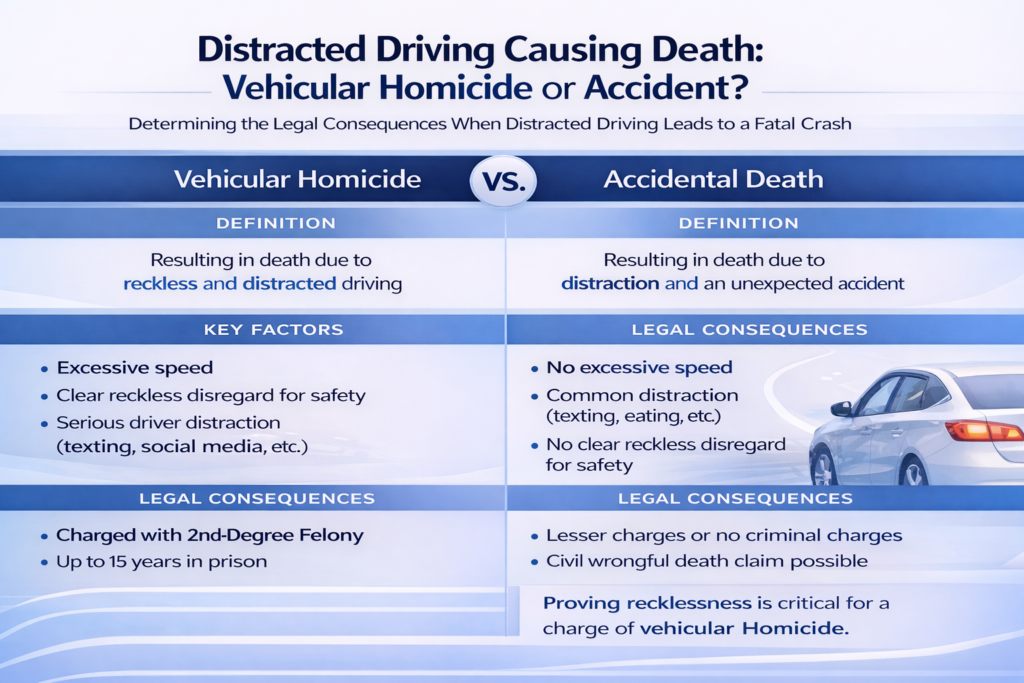
Here’s how the difference typically plays out:
Accident (Negligence)
Brief distraction
No excessive speed
No aggressive driving behavior
No evidence of conscious disregard
Civil lawsuit possible, but no felony charge
Vehicular Homicide
Prolonged texting or device use
Excessive speed combined with distraction
Dangerous lane changes or racing behavior
Clear disregard for traffic safety
Second-degree felony prosecution
The legal threshold is not “mistake.” It is reckless disregard for life.
The Role of Cell Phone and Black Box Evidence
In fatal distracted driving cases, digital evidence often becomes central.
Prosecutors may obtain:
Cell phone extraction data
Text message timestamps
App usage logs
GPS records
Event Data Recorder (EDR) speed and braking data
However, as discussed in our post on Black Box (Event Data Recorder) Evidence, that data is not always perfect. It may be incomplete, misinterpreted, or limited to only a few seconds before impact.
A defense attorney must examine:
Whether the phone was actively in use
Whether the data timing aligns with impact
Whether external factors (weather, road design, another vehicle) contributed
Whether investigators made assumptions beyond the data
Technology does not automatically prove recklessness. In many fatal crash cases, prosecutors rely heavily on vehicle data. Learn more about how that technology works — and how it can be challenged — in our guide to Black Box (Event Data Recorder) Evidence in Florida Crash Cases.
Penalties for Vehicular Homicide in Florida
Vehicular homicide is generally charged as a second-degree felony, punishable by:
Up to 15 years in prison
15 years of probation
Significant fines
Permanent felony record
If the driver leaves the scene of a fatal crash, penalties increase significantly and prosecutors may file additional felony charges. We explain how these cases are prosecuted in Leaving the Scene of an Accident Involving Death in Florida.
Because this is a life-altering charge, early intervention matters.
What Prosecutors Must Prove
To convict someone of vehicular homicide, the State must establish:
The defendant operated a motor vehicle.
The operation was reckless.
The reckless operation caused the death.
The burden is high. Recklessness cannot be presumed simply because a death occurred.
The defense may challenge:
Causation
Speed calculations
Reconstruction methodology
Phone data reliability
Alternative explanations for the crash
Determining whether the alleged distraction actually caused the fatal crash is often one of the most contested issues in these prosecutions. We discuss this issue in greater detail in Challenging Causation in Vehicular Homicide Cases.
Fatal accidents are tragic — but tragedy alone does not equal felony guilt.
Distracted Driving vs. DUI Manslaughter
If alcohol or drugs are involved, prosecutors may pursue DUI manslaughter instead.
The key difference is this:
DUI manslaughter focuses on impairment.
Vehicular homicide focuses on reckless operation.
If there is no allegation of impairment, distracted driving cases are evaluated under vehicular homicide standards.
Why These Cases Require Immediate Legal Strategy
Fatal crash investigations move quickly.
Law enforcement may:
Seize phones
Download vehicle data
Conduct forensic mapping
Interview witnesses immediately
Statements made in the early stages can shape the entire case.
If you are under investigation for a fatal distracted driving crash in Fort Lauderdale or anywhere in Broward County, you should speak with a criminal defense attorney before speaking further with investigators.
Frequently Asked Questions
Can texting while driving automatically lead to vehicular homicide?
No. Texting alone is not automatically reckless. Prosecutors must prove that the distraction rose to the level of reckless disregard for human life.
Is distracted driving always a felony if someone dies?
No. Many fatal crashes remain civil negligence cases. Criminal charges depend on the level of recklessness.
What if I only looked at my phone for a few seconds?
The duration, speed, road conditions, and driving behavior all matter. A brief glance may not rise to recklessness — but context is critical.
Can black box data prove I was reckless?
Black box data may show speed or braking patterns, but it does not automatically establish recklessness. The data must be interpreted properly and can be challenged.