
Last updated March 2026
Speeding is one of the most common traffic violations in Florida.
But when a fatal crash occurs, prosecutors often argue that excessive speed transforms a traffic offense into a felony vehicular homicide case.
The critical legal question is:
Is speeding alone enough to prove vehicular homicide under Florida law?
The answer is more nuanced than many people think.
For a full overview of vehicular homicide charges, penalties, and defenses, see our guide to Vehicular Homicide in Florida.
⚖️ The Legal Standard for Vehicular Homicide
Under Florida Statute § 782.071, vehicular homicide requires proof that:
1️⃣ A person caused the death of another
2️⃣ Through operation of a motor vehicle
3️⃣ In a reckless manner likely to cause death or great bodily harm
The key word is reckless.
Vehicular homicide is not based on ordinary negligence.
It requires proof of conduct that goes beyond simple carelessness.
🎯 Speeding vs. Reckless Driving: The Critical Distinction
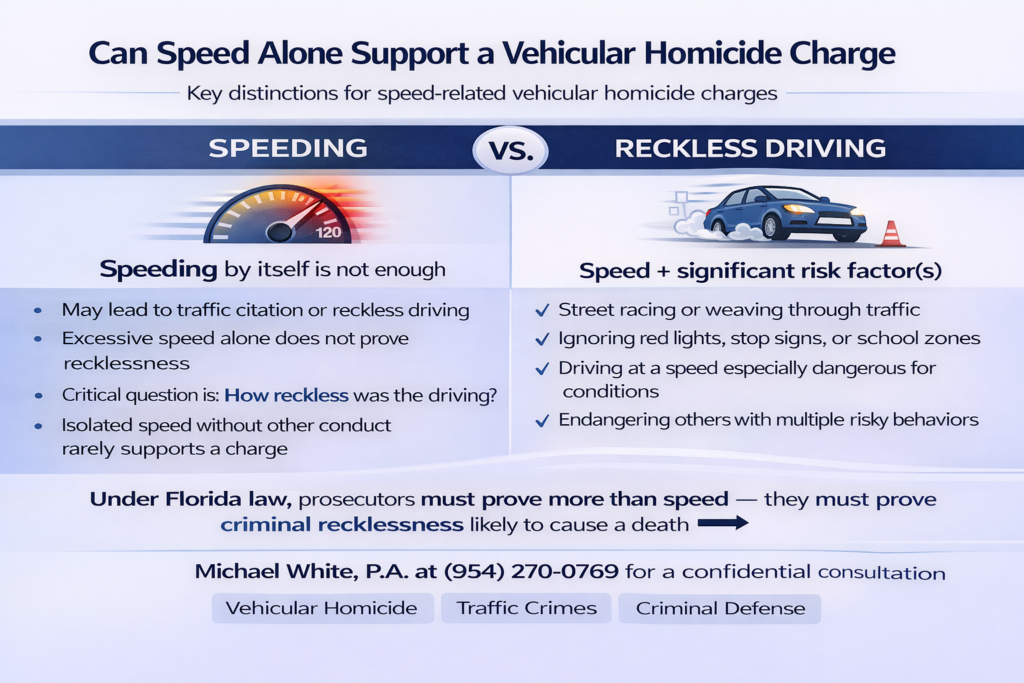
Speeding alone does not automatically equal recklessness.
Florida courts distinguish between:
🚦 Ordinary traffic speeding
⚠️ Criminally reckless conduct
Speeding becomes legally significant when:
The speed is extreme relative to conditions
The driver ignored traffic controls
The conduct endangered others beyond ordinary speeding
The driver was racing or driving aggressively
Weather or roadway conditions made the speed especially dangerous
The issue is not simply how fast someone was driving —
It is whether the speed, under the circumstances, constituted reckless disregard for human life.
Florida courts frequently analyze this issue through the lens of reckless driving law. We examine how reckless driving allegations can escalate into felony charges in our guide to Reckless Driving and Vehicular Homicide in Florida.
🔍 When Speed May Support a Vehicular Homicide Charge
Prosecutors often rely on speed evidence when:
• The vehicle was traveling far above the posted limit
• The crash occurred in a residential or school zone
• The driver was weaving through traffic
• The driver ignored red lights or stop signs
• The vehicle’s black box shows sustained extreme speed
• The speed combined with other dangerous behaviors
Event Data Recorder data is frequently used to estimate vehicle speed before a crash, but the data is not always interpreted correctly. Learn more in our guide on Whether Black Box (Event Data Recorder) Evidence Can Be Wrong.
In those cases, speed is rarely the only factor — it is usually combined with additional conduct.
🚫 When Speed Alone Is Not Enough
Florida courts have repeatedly held that:
Excessive speed alone does not automatically establish recklessness.
Speed without more may support:
Traffic citations
Civil liability
Possibly reckless driving
But for vehicular homicide, the State must show something more than:
Poor judgment
Inattention
Miscalculation
The prosecution must prove a willful or wanton disregard for safety.
That is a much higher threshold.
📊 The Role of Crash Reconstruction
In fatal crash investigations, law enforcement often relies on:
• Event Data Recorder (“black box”) downloads
• Skid mark analysis
• Scene measurements
• Surveillance footage
• Dashcam footage
• Witness speed estimates
Speed calculations are not always precise. These estimates often depend on reconstruction models that rely on assumptions about roadway conditions, drag factors, and braking distances. We discuss common flaws in these analyses in Accident Reconstruction Errors in Vehicular Homicide Cases.
Defense challenges often focus on:
Margin of error
Assumptions built into reconstruction models
Incomplete scene analysis
Missing roadway data
Alternative causation theories
For more on how prosecutors structure these cases, see what prosecutors must prove in a Florida vehicular homicide case.
⚖️ Speed Combined With Other Conduct
Speed may become legally sufficient when combined with:
Street racing
Aggressive lane changes
Passing in no-passing zones
Driving into oncoming traffic
Ignoring pedestrian crossings
In those scenarios, the State argues that speed reflects conscious disregard for human life.
The defense often focuses on separating:
Speed
fromTrue criminal recklessness
🧠 Causation Still Matters
Determining whether speed actually caused the fatal crash is often one of the most contested issues in these prosecutions. We examine this issue in detail in Challenging Causation in Vehicular Homicide Cases. Even if speed was excessive, the State must also prove:
✔ That the speed caused the crash
✔ That the death would not have occurred absent that conduct
If:
Another driver caused the collision
A pedestrian entered unexpectedly
A mechanical failure occurred
Road design contributed to the crash
Causation becomes a major defense issue.
📍 Broward County Reality
In Broward County vehicular homicide investigations, speed is frequently emphasized in charging decisions.
However:
Initial speed estimates are sometimes revised
Reconstruction assumptions are challenged
Overcharging can occur before full forensic review
Early independent investigation is critical.
🛡️ Defense Strategy in Speed-Based Vehicular Homicide Cases
Effective defense may include:
✔ Independent crash reconstruction
✔ Event data recorder review
✔ Challenging margin-of-error calculations
✔ Alternative causation analysis
✔ Mechanical inspection
✔ Medical causation review
✔ Suppression issues if evidence was unlawfully obtained
Vehicular homicide cases are highly technical.
Speed alone rarely tells the full story.
⚖️ Can Speed-Only Cases Be Reduced?
Yes.
If the defense shows:
No legally sufficient recklessness
No proof of conscious disregard
No clear causation
Reconstruction weaknesses
Charges may be reduced to:
Reckless driving
Traffic offenses
Or dismissed depending on evidence
The distinction between speeding and recklessness often determines felony exposure.
📞 Facing Vehicular Homicide Charges in Florida?
If your case centers on alleged excessive speed, the legal standard is higher than many people realize.
Not every fatal crash involving speeding meets Florida’s recklessness requirement.
Early legal intervention can significantly affect how evidence is preserved, analyzed, and presented.
Call Michael White, P.A. at (954) 270-0769 for a confidential consultation.