
Last updated March 2026
In Florida, the term reckless driving means very different things depending on the charge. While reckless driving can be a traffic offense on its own, it takes on a much higher legal meaning when prosecutors allege vehicular homicide.
In vehicular homicide cases, the State must prove far more than carelessness or a momentary lapse in judgment. Ordinary negligence — even when a death occurs — is not enough.
Understanding this distinction is critical, because many vehicular homicide cases hinge on whether prosecutors can legitimately elevate driving behavior from negligence to criminal recklessness.
For a full explanation of how vehicular homicide cases are charged, defended, and proven in Florida, see Vehicular Homicide in Florida.
⚖️ Reckless Driving Has a Higher Meaning in Vehicular Homicide Cases
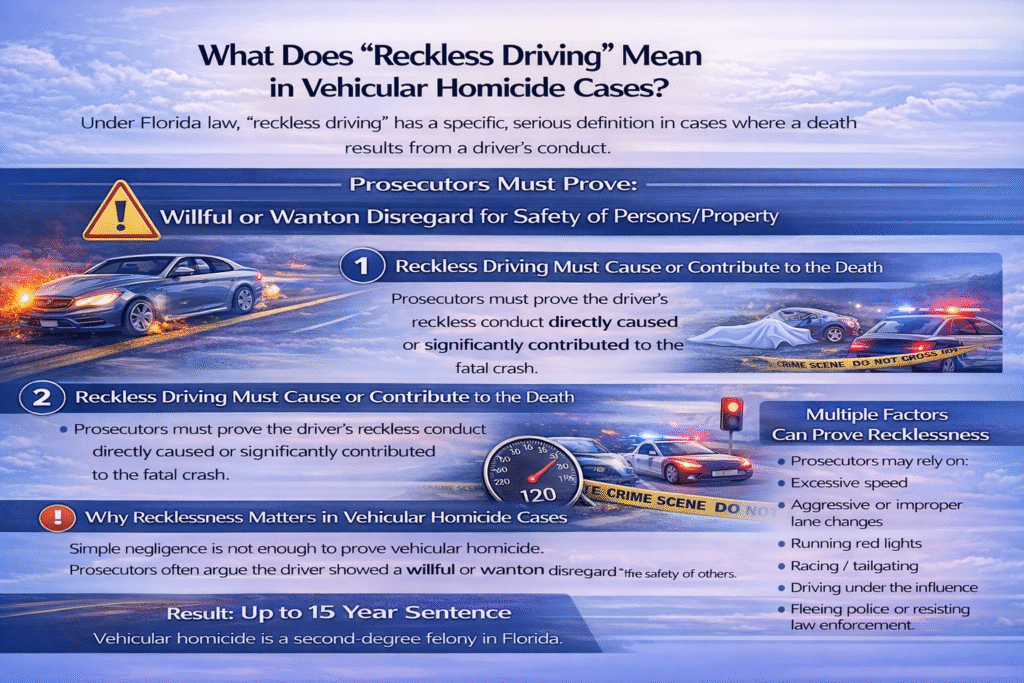
Vehicular homicide requires proof that a driver operated a motor vehicle with a willful or wanton disregard for the safety of persons or property, and that this conduct caused a death.
This is a higher standard than:
Simple negligence
Careless driving
Ordinary traffic violations
The presence of a fatality alone does not automatically transform bad driving into vehicular homicide.
🚫 Ordinary Negligence + Death Is Not Enough
One of the most common misconceptions in vehicular homicide cases is that any fatal crash involving a traffic violation qualifies as reckless driving.
It does not.
Speeding, distraction, or poor judgment may support civil liability or traffic charges, but vehicular homicide requires proof of criminal recklessness, not just error.
Examples of conduct that is often insufficient by itself:
Slightly exceeding the speed limit
Momentary distraction
Failure to see another vehicle
Misjudging distance or timing
Prosecutors must prove more than a mistake — they must prove conscious disregard of a known risk.
🧠 What Prosecutors Must Prove Instead
To establish reckless driving in a vehicular homicide case, prosecutors must show that the driver:
Knew or should have known their conduct created a serious risk of death or great bodily harm, and
Chose to engage in that conduct anyway
This is why vehicular homicide cases are often built around context, not just the moment of impact.
For a deeper explanation of the legal elements prosecutors must establish, see What Prosecutors Must Prove in a Florida Vehicular Homicide Case.
🔍 Reckless Driving Must Cause or Contribute to the Death
Even if reckless conduct is proven, the State must still prove causation.
The prosecution must show that the alleged reckless driving:
Directly caused the fatal crash, or
Significantly contributed to the death
If the death would have occurred regardless of the defendant’s conduct, vehicular homicide may not be legally sustainable.
This is where accident reconstruction evidence becomes central.
Errors in reconstruction analysis can dramatically affect how investigators interpret the crash. We examine these issues in Accident Reconstruction Errors in Vehicular Homicide Cases.
📊 Factors Prosecutors Commonly Use to Argue Recklessness
Rather than relying on a single act, prosecutors often point to multiple factors to argue willful or wanton disregard, such as:
Excessive speed far beyond traffic flow
Aggressive or improper lane changes
Racing or tailgating
Running red lights or stop signs
Fleeing from law enforcement
Driving behavior showing sustained danger over time
Similar arguments arise in cases involving cell phone use or other driver distraction. We discuss how prosecutors analyze those situations in Distracted Driving Causing Death: Vehicular Homicide or Accident?
Importantly, prosecutors often attempt to combine marginal facts to manufacture recklessness. Defense analysis focuses on separating speculation from proof.
Speed is often one of the primary factors prosecutors rely on when arguing that driving behavior crossed the line into criminal recklessness. We examine how courts analyze this issue in Can Speed Alone Support a Vehicular Homicide Charge in Florida?
⚠️ Why Recklessness Is the Central Battleground
In vehicular homicide cases:
Death is often undisputed
Identity is often undisputed
That leaves recklessness and causation as the primary issues for trial.
If the State cannot elevate the conduct beyond negligence, the charge may be subject to:
Reduction
Dismissal
Acquittal
This is why early investigation and expert review are critical.
Disputes over whether driving behavior was truly reckless often overlap with questions about whether the conduct actually caused the fatal crash. We examine this issue in Challenging Causation in Vehicular Homicide Cases.
🔗 How This Differs From Reckless Driving as a Traffic Offense
Reckless driving as a standalone offense falls under Florida’s traffic crimes framework and carries far lesser penalties.
Vehicular homicide, by contrast, treats reckless driving as the mechanism of a homicide, not a traffic violation.
This post addresses how reckless driving is evaluated when a death occurs, not the general definition used in traffic cases.
🚨 Why Early Legal Involvement Matters
Once prosecutors label driving behavior as “reckless,” that narrative can harden quickly. Accident reports, reconstruction assumptions, and charging affidavits often adopt the State’s theory early — even when it is debatable.
Early legal involvement allows:
Independent accident reconstruction
Preservation of vehicle data
Challenge to exaggerated speed or behavior claims
Control of the recklessness narrative
✅ Final Takeaway
In vehicular homicide cases, reckless driving means far more than careless driving. Prosecutors must prove willful or wanton disregard for safety and must connect that conduct directly to the death.
Not every fatal crash — even a tragic one — meets that standard.
Under Investigation After a Fatal Crash?
Vehicular homicide charges often turn on how driving behavior is characterized. Early legal involvement can affect how evidence is preserved, analyzed, and ultimately charged.
Request a confidential consultation to discuss your situation.