
Last updated March 2026
Vehicular homicide is not a traffic offense. It is a violent felony homicide charge that requires prosecutors to prove specific legal elements beyond a reasonable doubt.
Many vehicular homicide cases begin as “accidents,” but the State cannot obtain a conviction simply by showing that a crash occurred or that someone died. Florida law requires proof of recklessness, causation, and operation of a motor vehicle, not just bad driving or a tragic outcome.
Vehicular homicide is prosecuted as a violent felony and falls within Florida’s homicide laws. For a full explanation of how these cases are charged, defended, and proven, see Vehicular Homicide in Florida.
Understanding what prosecutors must prove — and where these cases often fall apart — is critical in any vehicular homicide defense.
Vehicular Homicide Is an Elements-Based Crime
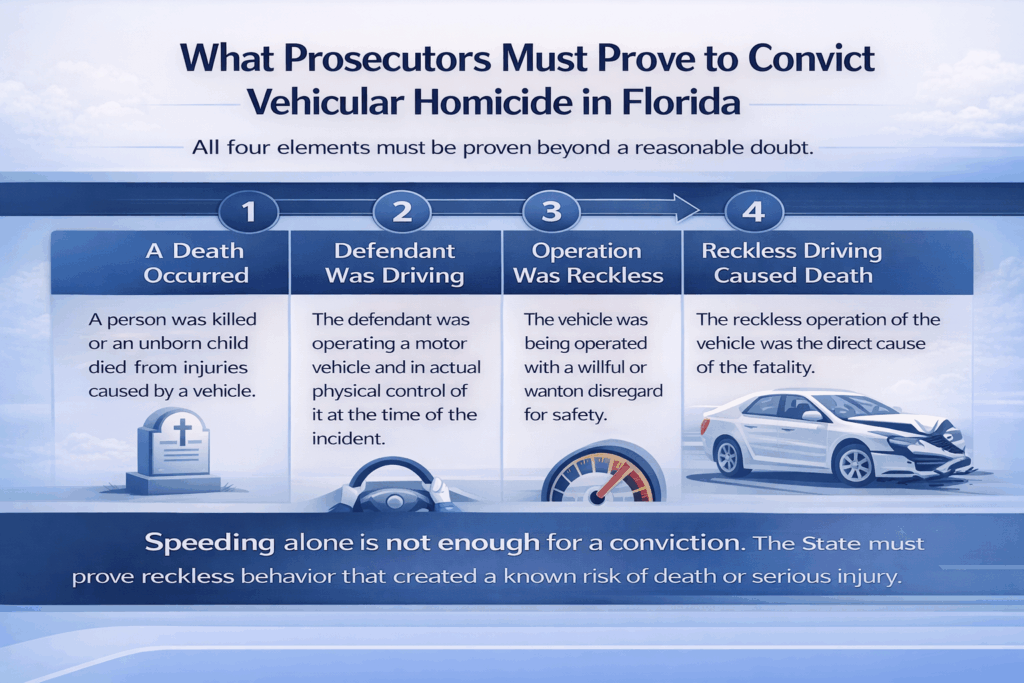
To convict someone of vehicular homicide in Florida, the State must prove all four elements beyond a reasonable doubt.
If any one element is not proven, the charge fails.
Those elements are:
A death occurred
The defendant was operating a motor vehicle
The vehicle was operated in a reckless manner
The reckless operation caused the death
Each element is independently contestable.
1. A Death Occurred
The State must first prove that a human being died as a result of injuries caused by a motor vehicle.
This element is usually established through:
Medical examiner testimony
Autopsy and cause-of-death reports
Hospital and emergency medical records
However, this element is not always automatic. Defense issues can arise when:
Death occurs days or weeks after the crash
Intervening medical complications are involved
The cause of death is disputed or multifactorial
The prosecution must still link the death to the crash itself — not merely assume causation.
2. The Defendant Was Operating the Vehicle
Prosecutors must prove that the defendant was driving or in actual physical control of the vehicle at the time of the incident.
This can become a contested issue when:
There are multiple occupants
The driver fled the scene
The vehicle was found after the crash
Witness accounts conflict
Evidence often used includes:
Eyewitness testimony
Surveillance or traffic camera footage
DNA or fingerprint evidence
Statements made after the crash
If the State cannot reliably establish who was driving, the case may collapse.
3. The Vehicle Was Operated Recklessly
This is the core element in most vehicular homicide cases — and one of the most frequently overstated.
Florida law requires proof of reckless driving, not ordinary negligence or a simple traffic violation. Recklessness means driving with a willful or wanton disregard for the safety of persons or property, creating a known and substantial risk of death or great bodily harm.
The legal definition of reckless driving becomes critical in these prosecutions. We explain how courts analyze that issue in What Does “Reckless Driving” Mean in Vehicular Homicide Cases?
Prosecutors often attempt to prove recklessness by pointing to allegations such as:
Excessive speed
Racing or aggressive driving
Ignoring traffic signals or signage
Dangerous lane changes or maneuvers
Distracted driving claims (phone use, infotainment systems), which prosecutors sometimes argue show reckless disregard. We examine how those cases are evaluated in Distracted Driving Causing Death: Vehicular Homicide or Accident?
Prosecutors often rely heavily on speed estimates when attempting to prove reckless conduct. However, courts have repeatedly recognized that speed alone does not automatically establish criminal recklessness. We examine this issue in Can Speed Alone Support a Vehicular Homicide Charge in Florida?
But speed alone is usually not enough. Nor is momentary inattention, a single driving error, or conduct that amounts to ordinary negligence.
Defense challenges frequently focus on:
Whether speed estimates are reliable or exaggerated
Whether driving behavior was actually dangerous under the conditions
Road design, lighting, weather, and traffic flow
Actions of other drivers that contributed to the incident
Sudden emergencies that forced evasive action
Many vehicular homicide cases rise or fall on whether the evidence truly shows recklessness, or whether the State is attempting to elevate a tragic accident into a felony homicide based on hindsight.
If the State cannot prove reckless operation beyond a reasonable doubt, the vehicular homicide charge cannot stand — even if a death occurred.
4. Reckless Driving Caused the Death
Even if the State proves reckless driving, it must also prove causation.
The prosecution must show that the reckless operation of the vehicle was the direct cause of the fatality — not merely a contributing factor.
Causation defenses commonly arise when:
Another driver caused or contributed to the crash
Roadway defects played a role
A pedestrian or cyclist acted unpredictably
Emergency response delays affected the outcome
Accident reconstruction evidence is often decisive at this stage, including:
Speed calculations
Point-of-impact analysis
Event data recorder (“black box”) evidence
These conclusions depend heavily on reconstruction methodology, and flawed assumptions can dramatically affect the results. We discuss common issues in Accident Reconstruction Errors in Vehicular Homicide Cases.
If the death would have occurred regardless of the defendant’s conduct, vehicular homicide may not be legally sustainable.
Determining whether the alleged conduct actually caused the fatal crash is often one of the most contested issues in these cases. We examine that issue in Challenging Causation in Vehicular Homicide Cases.
What Prosecutors Do Not Have to Prove
Vehicular homicide does not require proof of:
Alcohol or drug impairment
A specific intent to kill
Malice or premeditation
When impairment is alleged, prosecutors typically pursue DUI manslaughter instead, which follows a different legal framework.
Why These Cases Escalate Quickly
Vehicular homicide investigations often intensify early due to:
Fatality review protocols
Specialized traffic homicide units
Political and public pressure
Once a case is labeled a “vehicular homicide investigation,” evidence interpretation often shifts toward proving recklessness rather than determining what actually happened.
Early legal involvement can be critical to:
Preserving favorable evidence
Preventing overstatement of speed or behavior
Challenging flawed reconstruction assumptions
Final Takeaway
To convict someone of vehicular homicide, prosecutors must prove:
A death
Operation of a vehicle
Reckless driving
Causation
These cases are not automatic, and they are not simple “accident” prosecutions. Each element presents opportunities for meaningful legal challenges when examined carefully.
Under Investigation After a Fatal Crash?
Vehicular homicide charges are often shaped before an arrest is ever made. Early legal involvement can influence how evidence is preserved, how driving behavior is characterized, and whether a case escalates into a homicide prosecution.
Request a confidential consultation to discuss your situation.
FAQs
1) What are the elements of vehicular homicide in Florida?
Prosecutors must prove: (1) a death occurred, (2) the defendant was driving or in actual physical control, (3) the vehicle was operated recklessly, and (4) the reckless driving caused the death.
2) Is speeding alone enough to convict someone of vehicular homicide?
Usually no. The State must prove recklessness—a willful or wanton disregard for safety—rather than ordinary negligence or a simple traffic infraction.
3) What does “reckless driving” mean in a vehicular homicide case?
Recklessness generally means driving in a way that shows a willful or wanton disregard for safety, creating a known risk of death or serious injury. The exact facts matter.
4) What does the State have to prove about causation?
The prosecution must prove the reckless driving was a direct cause of the fatality. If another driver, road conditions, mechanical failure, or other factors caused the death, causation can be disputed.
5) Does vehicular homicide require proof of DUI?
No. Vehicular homicide does not require proof of alcohol or drug impairment. When impairment is alleged, prosecutors often pursue DUI manslaughter instead.