
Last updated March 2026
Many people believe they cannot be arrested for DUI on private property. In Florida, that belief is only partially true.
DUI charges sometimes arise inside gated communities, on private roads, or in HOA-restricted areas, often after welfare checks or complaints. Whether those charges hold up depends heavily on access, control, and danger to the public.
In these cases, prosecutors often rely on actual physical control rather than proof of driving. To understand how Florida law defines control in these situations, see our guide to Actual Physical Control in Florida DUI Cases.
🎥 Video: This video explains how DUI charges can arise on private property in Florida, including gated communities and HOA areas.
⚖️ Can You Get a DUI on Private Property in Florida?
Yes — but not every private-property DUI arrest is valid.
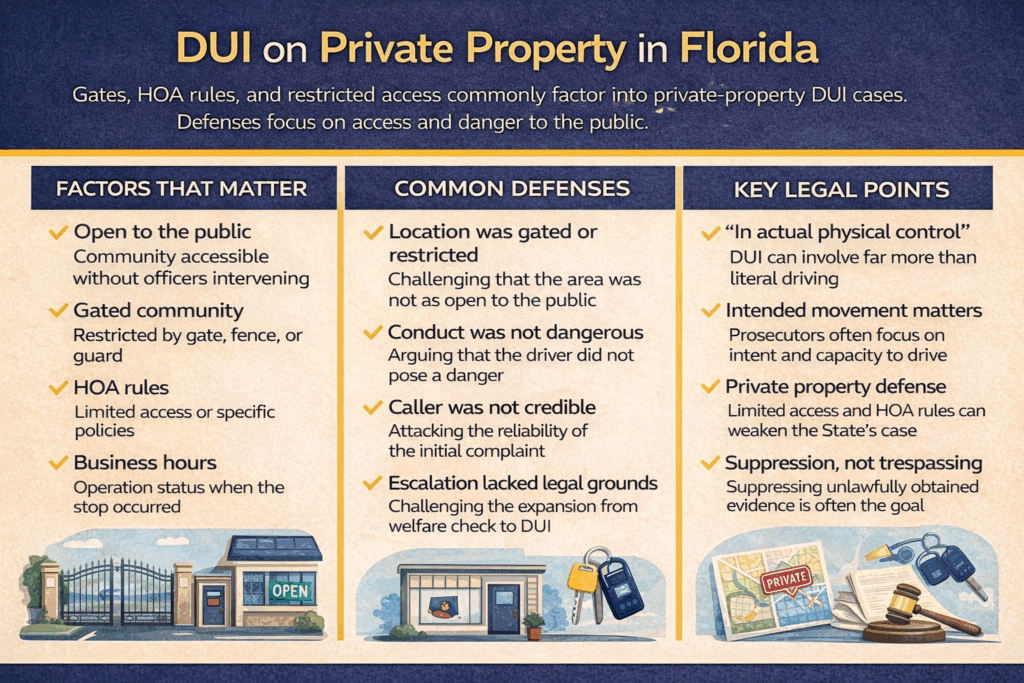
Florida courts focus on whether:
the area was open to the public,
the driver posed a danger beyond private property,
and whether police lawfully escalated the encounter.
In many cases, the strongest defense strategy is challenging and suppressing the DUI evidence, not simply arguing that the property was private.
🚘 Gated Communities and Restricted Access
Gates matter.
A community restricted by gates, guards, keypads, or HOA access controls is fundamentally different from an open parking lot or public roadway — an issue we explore further in DUI Arrests in Parking Lots and Drive-Thru Settings.
Restricted access can weaken the State’s argument that the driver endangered the public — a key component of DUI enforcement.
🏘️ HOA Roads vs. Public Roads
Some HOA roads look public but are legally private.
Courts often examine:
who controls access,
whether signage limits entry,
whether the public can freely enter,
and whether police routinely patrol the area.
If the road is not genuinely open to the public, DUI charges may face serious challenges.
🗝️ Actual Physical Control Still Matters
Prosecutors often point to:
engine status — including situations involving DUI charges when the engine is off in Florida,
key location,
seat position,
and vehicle operability.
However, private-property facts often undercut the argument that control equaled danger.
🚔 How These Cases Often Begin
Private-property DUI cases frequently start as:
welfare checks, including situations involving DUI arrests in parked vehicles in Fort Lauderdale
neighbor or security calls,
HOA complaints,
or suspicious vehicle reports.
A lawful welfare check does not automatically justify sobriety testing, detention, or arrest. Whether officers had legal grounds to escalate is often central to the defense.
🛺 What Types of Vehicles Can Lead to a DUI on Private Property?
Florida DUI law is not limited to traditional passenger cars. A DUI charge can arise on private property if a person is impaired while operating—or in actual physical control of—any vehicle capable of movement, even if it is not designed for public roads.
Examples of vehicles that have supported DUI charges in Florida include:
golf carts
ATVs and dirt bikes
utility vehicles and side-by-sides
electric scooters and e-bikes
ride-on lawnmowers
motorized wheelchairs or mobility devices
other non-traditional or recreational vehicles
What matters is not the type of vehicle, but whether the State claims the person had the ability to operate it while impaired. On private or gated property, these cases often raise additional questions about access, risk to the public, and whether enforcement was appropriate under the circumstances.
🚨 Penalties for DUI on Private Property in Florida
The penalties for a DUI do not change simply because the arrest occurred on private property, inside a gated community, or within an HOA-controlled area.
If a DUI charge is sustained, potential consequences can include:
fines starting at $500 for a first offense
probation or jail time, depending on prior history and facts
driver’s license suspension (often a minimum of six months)
mandatory DUI school and treatment
community service requirements
ignition interlock device requirements in certain cases
Because the penalties mirror those imposed for DUIs on public roads, the real battleground in private-property cases is often whether the arrest and evidence were legally obtained in the first place, not the punishment range itself.
🧪 Testing and Evidence Issues
Because many of these cases involve no observed driving, testing problems are common:
delayed breath or blood tests
reliance on subjective observations
alcohol absorption after stopping
lack of corroborating driving evidence
These issues often implicate Florida DUI testing rules and support suppression motions.
✅ Key Takeaways
DUI charges can arise on private property in Florida
Gates and restricted access matter
HOA rules can weaken the State’s case
Actual physical control is often disputed
Suppression is frequently the best defense strategy
❓ FREQUENTLY ASKED QUESTIONS
Can you get a DUI inside a gated community in Florida?
Yes, but gated access can weaken the State’s case by limiting public danger and access.
Are HOA roads treated like public roads?
Not always. Courts look at who controls access and whether the public can freely enter.
Does private property automatically defeat a DUI charge?
No, but it often creates strong defenses, especially when access is restricted.
What if police entered without permission?
Unlawful entry or escalation may support suppression of evidence.
Are private-property DUI cases defensible?
Very often. These cases frequently involve weak proof, improper escalation, or testing flaws.