
Last updated March 2026
Drug arrests in Florida often begin with a small plastic pouch and a roadside test kit.
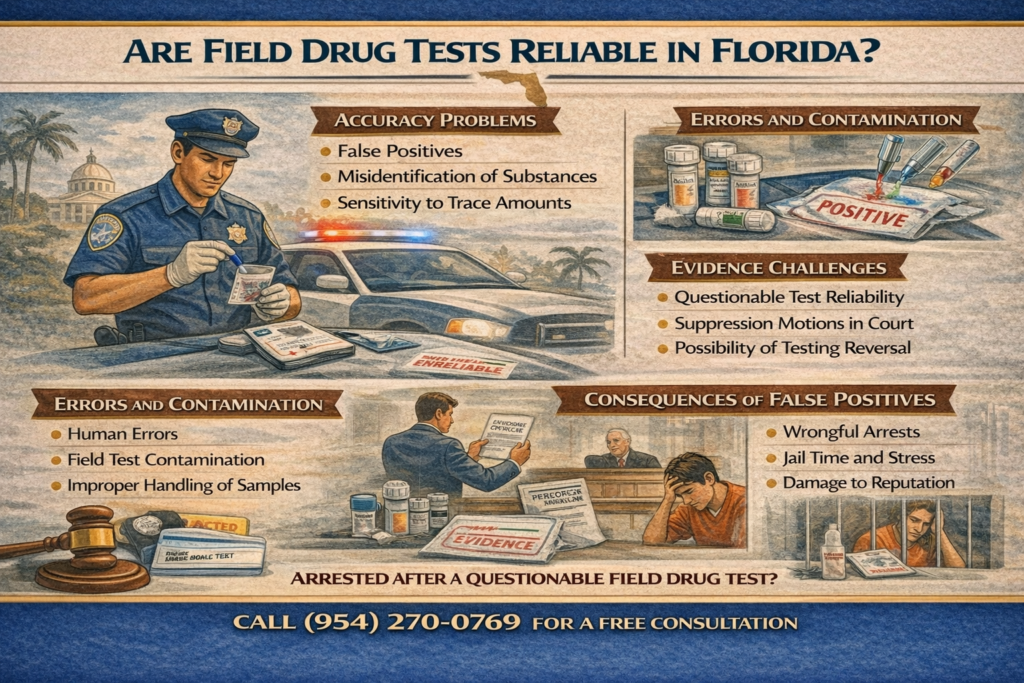
These kits — commonly called field drug tests — are used by police officers to make quick decisions during traffic stops and street investigations. The test may change color, and officers may treat that result as confirmation that a substance is illegal.
But field drug tests are not laboratory tests, and they are far from perfect.
In fact, questions about field test reliability have become an increasingly important issue in drug prosecutions. For a broader overview of legal defenses used in these cases, see our post on Drug Defense Strategies in Florida.
What Are Field Drug Tests?
Field drug tests are presumptive chemical tests used by law enforcement to identify suspected drugs in the field.
Officers typically place a small amount of the suspected substance into a test pouch containing chemicals. The pouch is then broken or shaken, allowing the chemicals to mix with the substance.
If the substance reacts in a certain way — often by changing color — the test may indicate the presence of a drug such as:
Cocaine
Methamphetamine
Heroin
MDMA
Certain prescription medications
These tests are designed to provide quick preliminary information, not definitive laboratory confirmation.
Field Drug Tests Are Only “Presumptive”
One of the most important things to understand about field drug tests is that they are presumptive tests.
This means the result only suggests that a substance may contain a controlled drug. It does not conclusively prove that the substance is illegal.
Because of this limitation, prosecutors typically rely on crime laboratory testing to confirm the identity of a substance before trial.
However, arrests and charges often occur before laboratory confirmation exists.
False Positives in Field Drug Tests
Field drug tests have been criticized because they can produce false positives.
A false positive occurs when a legal substance triggers a chemical reaction that resembles an illegal drug.
Examples reported in drug investigations and litigation include:
Powdered sugar testing positive for cocaine
Certain over-the-counter medications triggering methamphetamine results
Household products reacting with test chemicals
Prescription medications producing misleading color changes
Because the tests rely on simple chemical reactions, many unrelated substances can produce similar results.
Human Error During Testing
Field drug tests are also vulnerable to human error.
Officers typically perform these tests during roadside stops, street encounters, or other fast-moving investigations. Environmental conditions and testing procedures can affect the results.
Potential issues include:
Contamination of the testing pouch
Improper handling of the substance
Misinterpreting the color reaction
Poor lighting conditions during the test
Even small mistakes during the testing process can produce misleading results.
Why Crime Lab Testing Matters
Unlike field drug tests, crime laboratories use advanced analytical equipment to identify substances.
Laboratory testing may involve methods such as:
Gas chromatography
Mass spectrometry
Infrared spectroscopy
These techniques are designed to accurately identify chemical compounds, making them far more reliable than roadside kits.
Because of this, laboratory confirmation is often necessary before a case proceeds to trial.
However, delays in testing sometimes occur.
Field Tests and Probable Cause
Even though field drug tests are not definitive, officers often use them to support probable cause for an arrest.
Probable cause is a lower legal standard than proof beyond a reasonable doubt. It allows officers to make an arrest if they reasonably believe a crime has occurred.
However, if a case ultimately relies on a faulty field test, the reliability of the evidence may become a major issue in court.
In some cases, problems with the investigation — including questionable searches — may also affect whether evidence can be used. For more on that topic, see our post on When Drug Charges May be Dismissed Because of An Illegal Search in Florida.
Field Test Results Can Be Challenged
Defense attorneys often challenge field drug test results by examining:
How the test was performed
Whether the officer was properly trained
Whether contamination was possible
Whether a laboratory confirmation exists
These issues can weaken the prosecution’s case, particularly when the investigation contains other evidentiary problems.
For example, weaknesses in testing, possession evidence, or investigative procedures may all affect the strength of the case. See our post explaining What Makes a Drug Case Weak in Florida.
Fighting Drug Charges in South Florida
Drug charges in Florida often begin with quick decisions made during roadside investigations.
But a field test result alone does not automatically prove that a substance is illegal.
Careful review of the investigation — including the testing method, search procedures, and laboratory results — can reveal important defense issues.
Attorney Michael White, a former prosecutor, represents clients facing drug charges throughout Fort Lauderdale, Broward County, Miami-Dade, and Palm Beach County.
Early legal intervention may uncover weaknesses in the State’s case and help protect your rights.
☎ Free Consultation: (954) 270-0769
FAQs
Are field drug tests accurate?
Field drug tests are considered presumptive tests, meaning they can suggest the presence of a drug but do not definitively confirm it. Laboratory testing is usually required to accurately identify a substance.
Can you be arrested based on a field drug test?
Yes. Officers may rely on a field drug test as part of their probable cause for an arrest. However, prosecutors typically need laboratory confirmation before proving a drug charge at trial.
Can field drug tests produce false positives?
Yes. Certain legal substances, medications, and household materials can trigger reactions in field test kits, producing false positives that resemble illegal drugs.
Does the crime lab have to confirm the drug?
In most cases, prosecutors rely on laboratory testing to confirm the identity of a substance before trial. Without reliable confirmation, the strength of the prosecution’s case may be affected.