
Last updated March 2026
Not every drug arrest leads to a strong prosecution.
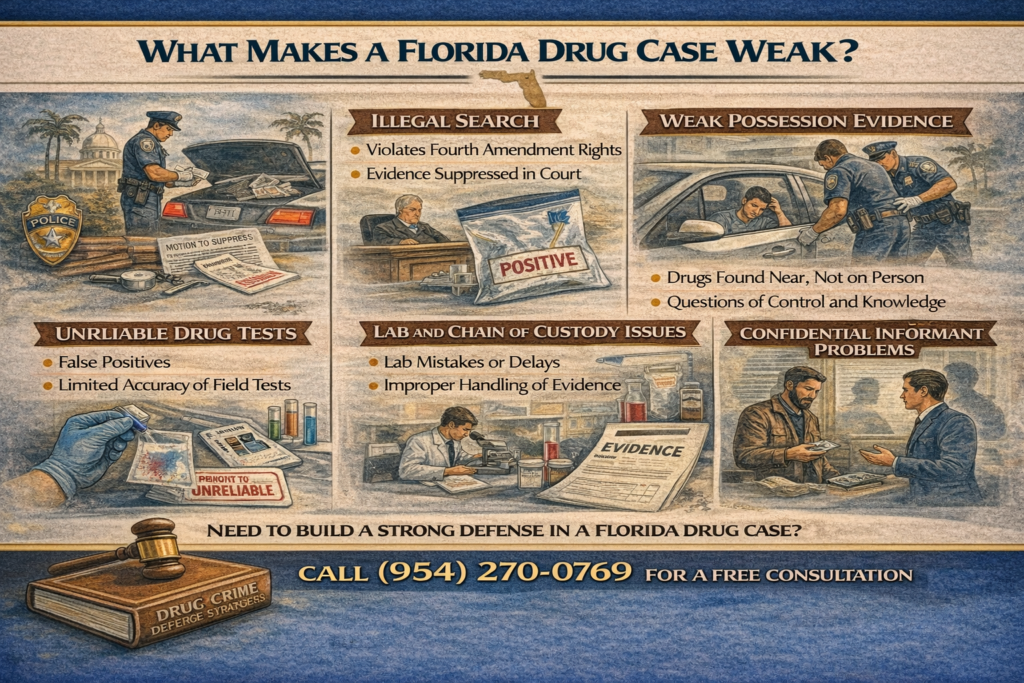
In many Florida drug cases, the evidence turns out to be incomplete, unreliable, or obtained illegally. When that happens, prosecutors may struggle to prove the case beyond a reasonable doubt.
Understanding what weakens a drug prosecution is critical for anyone facing charges. For a broader overview of legal strategies used in these cases, see our post on Drug Defense Strategies in Florida.
Weak Evidence of Possession
One of the most common weaknesses in a drug case involves proving possession.
Florida law requires prosecutors to prove that a person knew about the presence of the drugs and had control over them. This can be difficult when drugs are found in shared spaces.
Examples include:
Drugs found in a vehicle with multiple passengers
Drugs located in a shared home or apartment
Drugs discovered in an area accessible to several people
When multiple individuals could have possessed the drugs, the prosecution may struggle to prove who actually controlled them.
For example, questions about passenger responsibility frequently arise during traffic stops. See our post on Passenger Arrested After Drugs Found During a Traffic Stop in Florida?
Illegal Searches and Fourth Amendment Violations
Another major weakness in many drug cases is an unlawful search.
Police must generally obtain a warrant or rely on a valid exception to the warrant requirement before searching a person, vehicle, or home.
If officers conduct an unconstitutional search, the evidence obtained may be suppressed by the court.
Without that evidence, prosecutors may have no way to prove the charge.
For a deeper explanation of this issue, see our post on Can Drug Charges Be Dismissed Because of an Illegal Search in Florida?
Unreliable Field Drug Testing
Drug cases sometimes begin with field drug tests performed at the scene.
These roadside tests are designed to provide a quick indication of whether a substance may contain an illegal drug. However, they are presumptive tests, not definitive laboratory confirmations.
Field tests can sometimes produce false positives, especially when certain legal substances trigger similar chemical reactions.
For a detailed discussion of this issue, see our post on Are Field Drug Tests Reliable in Florida?
Problems With Searches of Personal Belongings
Drug investigations often involve searches of bags, backpacks, purses, or containers.
But these searches must still comply with the Fourth Amendment. If officers search a personal container without a warrant, consent, or probable cause, the legality of the search may be challenged.
Issues frequently arise during roadside stops or street encounters.
For example, see our post on Can Police Search a Backpack During a Drug Stop in Florida?
Crime Lab and Evidence Issues
Even when drugs are seized, prosecutors must still prove what the substance actually is.
Laboratory testing is typically required to confirm the identity of the alleged drug.
If laboratory testing is delayed, incomplete, or unavailable, the prosecution may struggle to prove the case at trial.
Weaknesses can arise when:
Crime lab results are delayed
The testing procedures are questioned
Chain of custody issues exist
The substance is never confirmed by laboratory analysis
In these situations, the reliability of the State’s evidence may become a central issue in the case.
Investigative Mistakes
Drug investigations sometimes contain procedural errors or inconsistencies.
These may include:
Inconsistent officer reports
Conflicting witness statements
Missing evidence documentation
Incomplete investigative procedures
Even small investigative mistakes can create reasonable doubt when viewed alongside other weaknesses in the prosecution’s case.
Fighting Drug Charges in South Florida
Drug prosecutions often appear straightforward at first glance, but closer examination frequently reveals weaknesses in the evidence.
Issues involving possession, search procedures, field testing, or laboratory confirmation can significantly affect the strength of the case.
Attorney Michael White, a former prosecutor, represents clients facing drug charges throughout Fort Lauderdale, Broward County, Miami-Dade, and Palm Beach County.
Careful review of the investigation may uncover defense issues that can weaken the prosecution’s case or lead to reduced or dismissed charges.
☎ Free Consultation: (954) 270-0769
FAQs
What is the most common weakness in a Florida drug case?
One of the most common weaknesses involves proving possession. Prosecutors must show that the accused knew about the drugs and had control over them, which can be difficult when drugs are found in shared spaces.
Can illegal searches weaken a drug case?
Yes. If drugs are discovered during an unconstitutional search, the evidence may be suppressed. Without that evidence, prosecutors may not be able to prove the charge.
Are field drug tests reliable evidence in court?
Field drug tests are considered presumptive tests. They can suggest the presence of a drug but do not definitively confirm it, which is why laboratory testing is typically required.
Can a drug case fail without laboratory confirmation?
Yes. If prosecutors cannot prove the identity of the substance through reliable laboratory testing, the strength of the case may be significantly weakened.