
Last updated March 2026
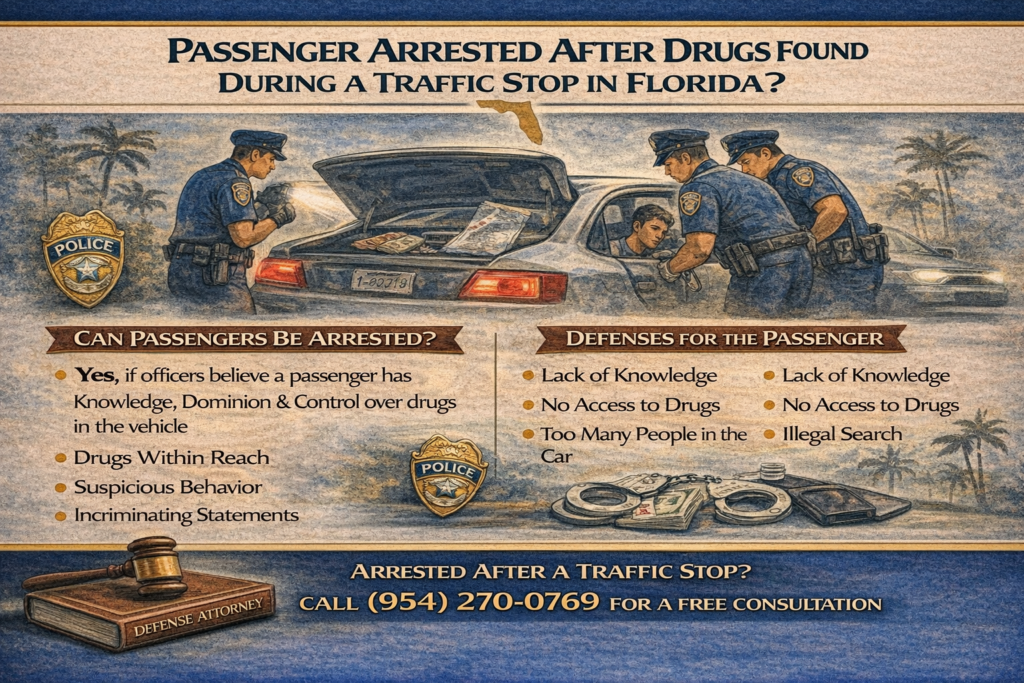
Traffic stops are one of the most common ways drug arrests occur in Florida. But when police discover drugs inside a vehicle, an important legal question arises:
Who actually possessed the drugs?
Passengers are sometimes arrested simply because they were present in the vehicle where drugs were found. However, being in the same car as illegal drugs does not automatically make someone guilty of possession.
For a broader overview of legal defenses used in drug cases, see our post on Drug Defense Strategies in Florida.
Presence in a Vehicle Is Not Enough
Under Florida law, prosecutors must prove more than just presence near drugs.
To obtain a conviction for possession, the State generally must prove that a person:
Knew the drugs were present, and
Had control over the drugs
This legal concept is known as constructive possession.
When drugs are discovered in a vehicle with multiple occupants, proving constructive possession can become significantly more difficult.
Shared Vehicles Often Create Weak Possession Cases
Many drug arrests occur in vehicles containing several people. For example:
A driver and multiple passengers
Friends sharing a ride
Rideshare or borrowed vehicles
Family members traveling together
When drugs are discovered in a shared space — such as a center console, glove box, or floorboard — prosecutors may struggle to prove which person actually possessed them.
These situations often become fact-intensive cases involving statements, physical evidence, and the circumstances of the stop.
Weak proof of possession is one of the most common problems in drug prosecutions. For more on this issue, see our post on What Makes a Florida Drug Case Weak?
Where the Drugs Were Found Matters
The location of the drugs inside the vehicle can be extremely important.
Courts often examine whether the drugs were located in a place that clearly belonged to one specific person.
Examples that may weaken a case against a passenger include:
Drugs found under a seat that multiple people could access
Drugs discovered in the driver’s area of the vehicle
Drugs located in a shared compartment
Drugs hidden in a bag that does not belong to the passenger
When the evidence does not clearly connect the drugs to a specific person, the prosecution may face difficulty proving possession beyond a reasonable doubt.
Searches During Traffic Stops
Another important issue in many drug arrests involves how police searched the vehicle.
Officers may search a car during a traffic stop under certain circumstances, such as when:
The driver gives consent
Officers have probable cause
A search occurs after an arrest
However, if officers conduct an illegal search, the evidence discovered may be suppressed.
For a deeper discussion of this issue, see our post on Can Drug Charges Be Dismissed Because of an Illegal Search in Florida?
Searches of Personal Belongings
Even if officers can lawfully search a vehicle, that does not automatically give them the right to search every passenger’s personal belongings.
Personal items such as:
Backpacks
Purses
Bags
Containers
may still receive independent Fourth Amendment protection.
Questions about container searches often arise during roadside investigations. For more on this topic, see our post on Can Police Search a Backpack During a Drug Stop in Florida?
Field Drug Testing Issues
In some traffic stop cases, officers perform field drug tests to identify suspected substances.
These tests are only presumptive tests, meaning they can suggest the presence of a drug but do not conclusively prove it.
False positives and testing errors can occur, particularly when roadside conditions affect the testing process.
For a deeper explanation of this issue, see our post on Are Field Drug Tests Reliable in Florida?
Investigating the Evidence
Drug arrests during traffic stops often appear straightforward at first. However, a closer examination of the evidence may reveal important legal issues.
A thorough investigation may include reviewing:
Body-worn camera footage
Dash camera video
Statements made during the stop
The location of the drugs in the vehicle
The legality of the search
These details can significantly affect whether the prosecution can prove the case.
Fighting Drug Charges in South Florida
Passengers are sometimes arrested during traffic stops even when the evidence connecting them to drugs is weak.
Careful review of the investigation may reveal problems involving possession, search procedures, or the reliability of the evidence.
Attorney Michael White, a former prosecutor, represents clients charged with drug offenses throughout Fort Lauderdale, Broward County, Miami-Dade, and Palm Beach County.
Early legal intervention may uncover defense issues that can weaken the prosecution’s case or lead to reduced or dismissed charges.
☎ Free Consultation: (954) 270-0769
FAQs
Can a passenger be charged with drugs found in a car in Florida?
Yes, but prosecutors must prove that the passenger knew the drugs were present and had control over them. Simply being in the vehicle is usually not enough to prove possession.
What is constructive possession in Florida?
Constructive possession is a legal concept used when drugs are not found directly on a person. Prosecutors must prove the person knew about the drugs and had the ability to control them.
Can police search passengers during a traffic stop?
Police may search passengers under certain circumstances, such as during a lawful arrest or with valid consent. However, personal belongings may still receive separate constitutional protection.
Can drugs found in a shared vehicle lead to dismissal?
In some cases, yes. When multiple people have access to the area where drugs are found, it can be difficult for prosecutors to prove which person actually possessed them.