
Last updated March 2026
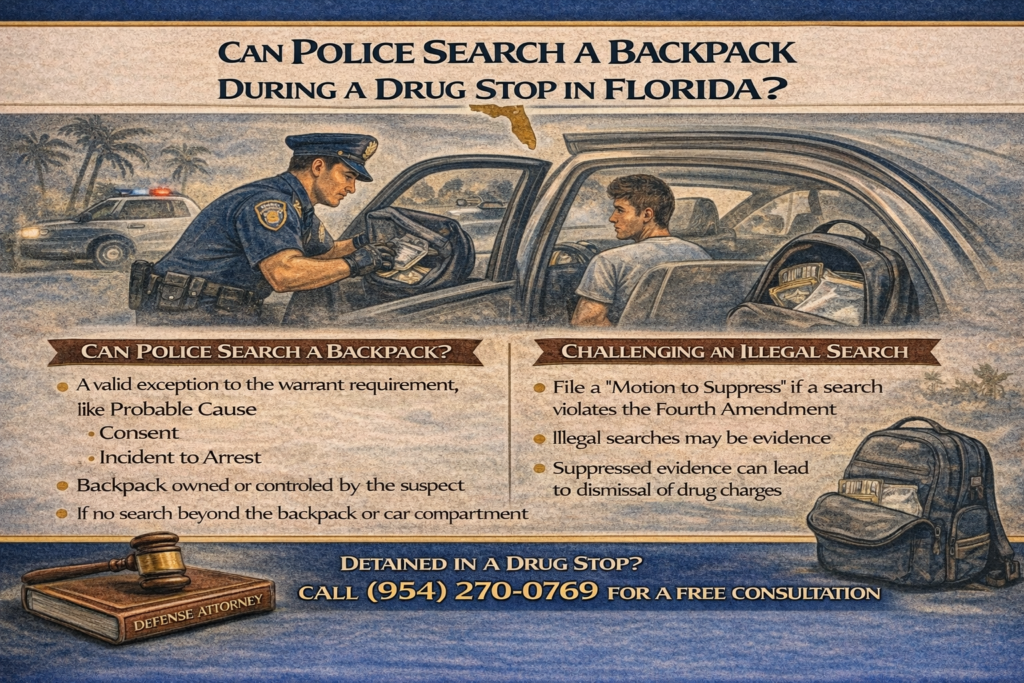
Drug arrests often occur during traffic stops, street encounters, or other roadside investigations. When officers discover a backpack or bag during these encounters, a common question arises:
Can police search a backpack during a drug stop in Florida?
The answer depends on several legal factors, including consent, probable cause, and the circumstances of the stop. Personal belongings such as backpacks may receive stronger constitutional protection than the vehicle itself.
For a broader overview of legal defenses in drug prosecutions, see our post on Drug Defense Strategies in Florida.
The Fourth Amendment and Personal Containers
The Fourth Amendment protects people from unreasonable searches and seizures.
While police may sometimes search a vehicle during a traffic stop, personal containers like backpacks, purses, and bags often receive separate legal protection.
Courts frequently examine:
Who owns the container
Whether the owner consented to the search
Whether officers had probable cause
Whether the search occurred after a lawful arrest
If officers search a backpack without legal justification, the evidence discovered inside may be challenged in court.
Consent Searches
One of the most common ways officers search backpacks is through consent.
Police may ask questions such as:
“Do you mind if I look in your bag?”
“Is it okay if I search this?”
If a person voluntarily agrees, officers may be able to search the container.
However, consent must be freely and voluntarily given. Courts may consider factors such as:
Whether the person felt free to refuse
Whether officers used intimidation or pressure
Whether multiple officers were present
Whether the individual was detained
If consent was not truly voluntary, the search may be unconstitutional.
Probable Cause Searches
Officers may also search containers if they have probable cause to believe the container holds illegal drugs or other evidence of a crime.
For example, officers may claim probable cause based on:
The odor of marijuana
Visible contraband
Statements made during the stop
Drug detection dog alerts
If probable cause exists, officers may sometimes search containers located inside a vehicle.
However, whether that probable cause actually justified the search often becomes a key issue in the case.
Backpacks Belonging to Passengers
Backpack searches frequently occur during traffic stops involving multiple occupants.
When a backpack clearly belongs to a passenger, courts may closely examine whether officers had a legal basis to search that specific container.
Simply having the authority to search the vehicle does not automatically allow police to search every passenger’s personal belongings.
Questions about passenger rights often arise during drug stops. For more on this issue, see our post on Passenger Arrested After Drugs Found During a Traffic Stop in Florida?
Searches Incident to Arrest
In some situations, police may search personal belongings after making a lawful arrest.
This type of search is known as a search incident to arrest.
Courts examine whether the container was within the arrestee’s immediate control at the time of the arrest.
If the backpack was not within reach, the legality of the search may be challenged.
Illegal Searches and Suppression of Evidence
If officers search a backpack without a valid legal basis, the search may violate the Fourth Amendment.
When that happens, defense attorneys may file a motion to suppress asking the court to exclude the evidence obtained during the search.
If the judge grants the motion, prosecutors may lose critical evidence in the case.
For more on this issue, see our post on Can Drug Charges Be Dismissed Because of an Illegal Search in Florida?
Evidence Reliability Issues
Even when drugs are discovered during a search, other issues may arise in the investigation.
For example, officers sometimes rely on field drug tests during roadside investigations.
These tests are only presumptive and can sometimes produce misleading results.
For more on this topic, see our post on Are Field Drug Tests Reliable in Florida?
Problems with testing, possession evidence, or investigative procedures may also weaken the prosecution’s case. For more on these issues, see our post on What Makes a Florida Drug Case Weak?
Fighting Drug Charges in South Florida
Drug arrests during traffic stops often involve complex legal issues related to search procedures and evidence collection.
Backpack searches are frequently challenged because they involve personal belongings that may receive additional constitutional protection.
Attorney Michael White, a former prosecutor, represents clients charged with drug offenses throughout Fort Lauderdale, Broward County, Miami-Dade, and Palm Beach County.
A careful review of the investigation may reveal search issues or other weaknesses that can affect the outcome of the case.
☎ Free Consultation: (954) 270-0769
FAQs
Can police search a backpack during a traffic stop in Florida?
Police may search a backpack if they obtain valid consent, have probable cause, or conduct a lawful search incident to arrest. Without a legal basis, the search may violate the Fourth Amendment.
Can police search a passenger’s backpack during a traffic stop?
Not automatically. Even if officers can search the vehicle, they may still need consent or probable cause to search a passenger’s personal belongings.
What happens if police search a backpack illegally?
If officers conduct an unlawful search, a defense attorney may file a motion to suppress. If the court suppresses the evidence, prosecutors may lose key evidence in the case.
Can drugs found in a backpack be thrown out of court?
Yes. If the backpack was searched illegally, the evidence obtained from that search may be excluded from court.