
Last updated March 2026
Many people assume “lewd and lascivious battery” and “sexual battery” mean the same thing.
They do not.
While both are serious felony sex offenses under Florida law, they arise under different statutes, require different elements of proof, and carry very different sentencing exposure.
In some cases, the difference can mean the gap between a second-degree felony and life imprisonment.
For a broader breakdown of how these offenses are structured under Florida law, see our Lewd and Lascivious Offenses in Florida guide.
If you are under investigation or facing charges in Fort Lauderdale or anywhere in South Florida, understanding which statute applies — and why — is critical.
📜 The Statutes: Two Completely Different Laws
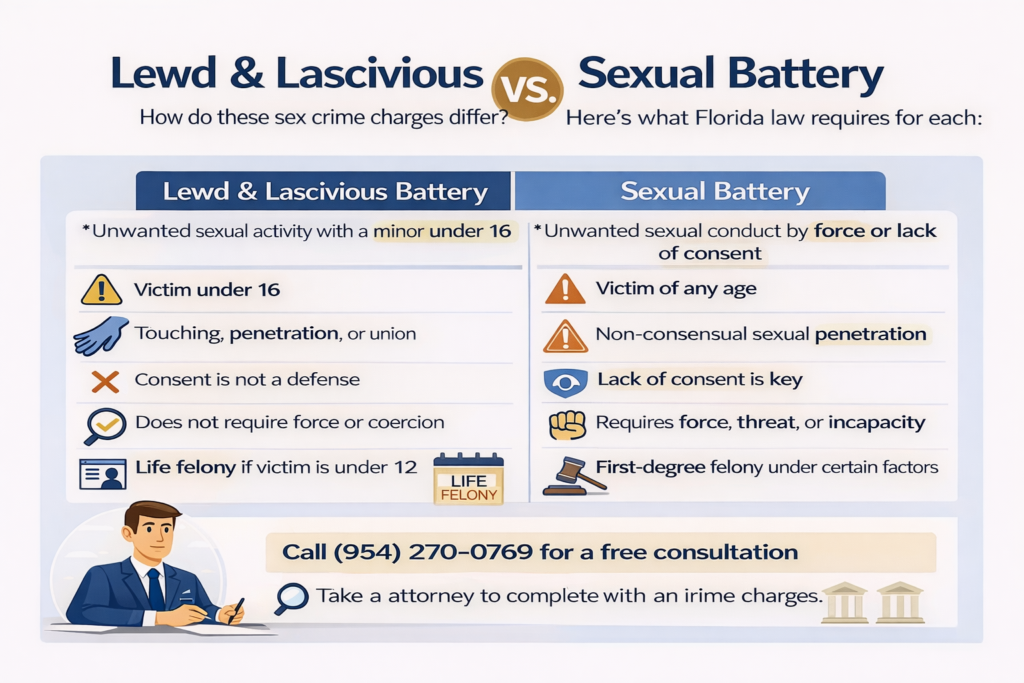
🔹 Lewd & Lascivious Battery – Florida Statute § 800.04(4)
Lewd or lascivious battery is primarily an age-based offense.
It generally involves:
Engaging in “sexual activity” with a minor between 12 and 15 years old, or
Encouraging, enticing, or forcing a minor to engage in sexual activity
Key feature:
Consent is not a legal defense when the alleged victim is under 16.
This statute focuses on protecting minors based on age — not force.
For a broader overview of all § 800.04 offenses, see our Lewd and Lascivious Offenses in Florida guide.
🔹 Sexual Battery – Florida Statute § 794.011
Sexual battery is what most people refer to as rape.
It generally involves:
Non-consensual oral, anal, or vaginal penetration
Use of force, threats, coercion, or exploitation
Victim incapacity (sleep, intoxication, mental disability)
Key feature:
The central issue is usually lack of consent and/or use of force.
Unlike lewd and lascivious battery, sexual battery applies to victims of any age.
🔎 The Most Important Legal Differences
1️⃣ Age vs. Force
Lewd & Lascivious Battery:
Triggered primarily by age (12–15)
Consent legally irrelevant
Force not required
Sexual Battery:
Triggered by non-consensual penetration
Force, coercion, or incapacity central
Age may enhance penalties but is not required
In short:
Lewd battery = age-driven.
Sexual battery = force/consent-driven.
2️⃣ Penetration vs. “Union”
Lewd & Lascivious Battery requires “sexual activity,” which under Florida law can include:
Penetration, or
Union (contact between sexual organs)
Proof of violent force is not required.
Sexual Battery requires proof of penetration.
That distinction alone often shapes charging decisions.
3️⃣ Sentencing Exposure
Lewd & Lascivious Battery:
Typically a second-degree felony
Up to 15 years in prison (more in certain age-disparity situations)
Sexual Battery:
Often a life felony
May carry mandatory minimum prison terms
Can result in life imprisonment
When prosecutors decide which charge to file, they are often deciding the sentencing ceiling at the same time.
4️⃣ Charging Strategy & Lesser Included Offenses
In some cases — especially when the alleged victim is 12–15 and penetration is alleged — prosecutors may file:
Sexual Battery
Lewd & Lascivious Battery
Additional § 800.04 counts
Why?
Because it gives the State alternative theories at trial.
If a jury does not find proof of force beyond a reasonable doubt, they may still convict on an age-based offense.
From a defense perspective, this creates both risk and negotiation leverage.
🧠 Which Charge Is “Worse”?
In most circumstances:
Sexual battery carries significantly harsher sentencing exposure.
However:
Both offenses are felony sex crimes
Both can result in prison
Both can trigger sex-offender registration, which carries long-term restrictions on housing, employment, and reporting requirements
Both carry lifelong collateral consequences
The practical difference often lies in sentencing range, plea leverage, and trial dynamics.
🛡️ Defense Strategy Differences
Because the statutes focus on different elements, defense strategy differs significantly.
In Lewd & Lascivious Battery cases:
Age verification is critical
Timeline inconsistencies matter
Digital communications often become central
The case frequently turns on credibility
In Sexual Battery cases:
Forensic evidence is scrutinized
Consent becomes central
Medical findings are heavily litigated
Statements to law enforcement are pivotal
These are not interchangeable defense strategies.
🚸 What About “Romeo & Juliet” Relief?
Florida law provides limited relief in certain close-in-age cases under the Romeo and Juliet law in Florida, which may allow certain individuals to seek removal from sex offender registration requirements.
However:
It does not eliminate criminal liability
It does not automatically prevent registration
It applies only under narrow statutory conditions
This issue typically arises in lewd and lascivious battery cases — not in adult sexual battery prosecutions.
🚨 Why Early Intervention Matters
Before charges are filed, prosecutors evaluate:
Age documentation
Digital evidence
Statements made during interviews
Whether force can be proven
Whether forensic evidence supports penetration
The classification decision — lewd battery vs. sexual battery — may happen before formal filing.
What happens during the investigation stage can determine which statute is charged.
📞 Fort Lauderdale Sex Crime Defense
At Michael White, P.A., we defend clients accused of both lewd and lascivious battery and sexual battery throughout Broward County and South Florida.
These charges may sound similar — but legally and strategically, they are very different.
If you are under investigation or facing allegations, call (954) 270-0769 for a confidential consultation.
❓ Frequently Asked Questions
Is lewd and lascivious battery the same as rape in Florida?
No. Lewd and lascivious battery is primarily an age-based offense involving minors between 12 and 15. Sexual battery (rape) focuses on non-consensual penetration and force. They arise under different statutes.
Which charge is more serious: lewd battery or sexual battery?
Sexual battery generally carries harsher sentencing exposure, including potential life imprisonment. However, both are serious felony sex offenses with severe long-term consequences.
Does lewd and lascivious battery require force?
No. Force is not required. The offense is triggered by the age of the alleged victim. Consent is not a legal defense when the victim is under 16.
Does sexual battery always require penetration?
Yes. Sexual battery requires proof of penetration. Lewd and lascivious battery may be proven through penetration or sexual union.
Can someone be charged with both offenses at the same time?
Yes. In cases involving minors and alleged penetration, prosecutors sometimes file both charges to preserve alternative theories at trial.
Does either offense require sex-offender registration?
Many convictions for both offenses require mandatory sex-offender registration under Florida law. The specific registration consequences depend on the conviction and statutory classification.
Can lewd battery be reduced from sexual battery?
In some cases, negotiations or evidentiary issues may result in reduced charges. However, outcomes depend heavily on the facts, evidence, and prosecutorial discretion.