
Last updated March 2026
Florida’s “Romeo and Juliet” law is often misunderstood.
It does not make underage sexual activity legal.
It does not automatically dismiss charges.
And it does not apply to every age difference situation.
Instead, Florida’s Romeo and Juliet provision provides a limited form of relief — primarily related to sex-offender registration in Florida — when certain age-gap conditions are met.
For a broader overview of Florida’s statutory sex offense laws involving minors, see our guide to Lewd & Lascivious Offenses in Florida.
📜 What Is Florida’s Romeo & Juliet Law?
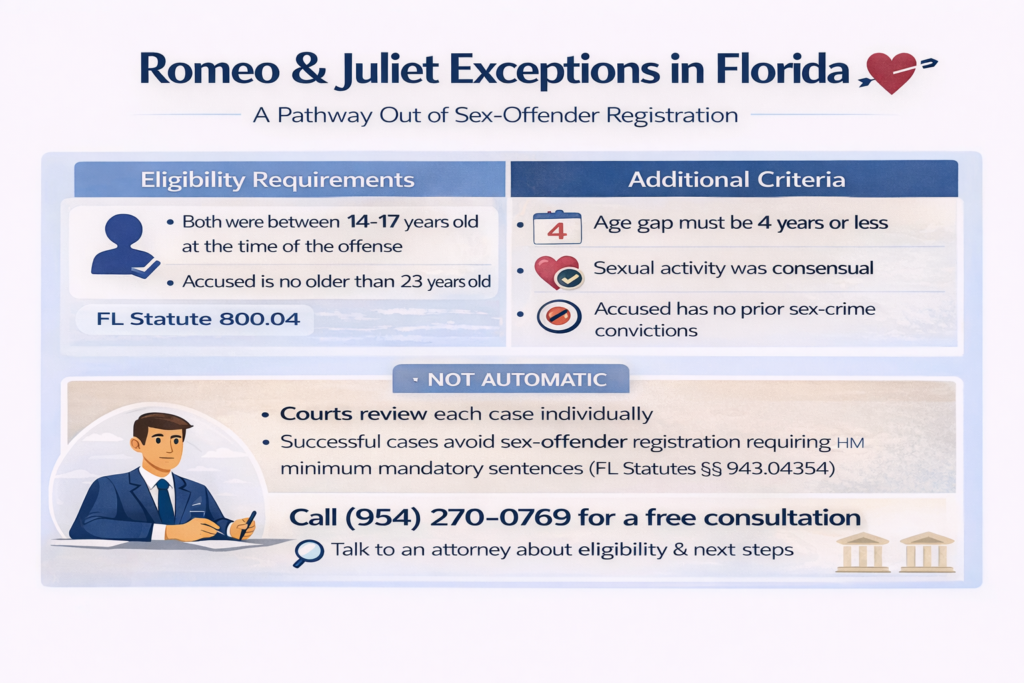
Florida’s Romeo and Juliet statute is found in Fla. Stat. § 943.04354.
It allows certain individuals convicted of specific offenses involving minors to petition the court for removal from the sex offender registry — if strict criteria are satisfied.
It is a registration relief statute, not a defense statute.
⚖️ When Does Romeo & Juliet Relief Apply?
To qualify, all of the following must generally be true:
The offender was no more than 4 years older than the victim
The victim was between 14 and 17 years old
The sexual activity was consensual
The offender has not previously been classified as a sexual predator
The offender is not otherwise disqualified
If these conditions are met, the individual may petition the court to remove the sex offender registration requirement.
🚨 What Romeo & Juliet Does NOT Do
This is where confusion often arises.
The law does not:
Prevent arrest
Prevent prosecution
Automatically reduce a felony
Erase a conviction
Guarantee registry removal
A qualifying individual must file a petition and obtain a court order.
Until that happens, registration obligations remain in place.
📊 Common Scenario
For example:
A 19-year-old and a 16-year-old engage in consensual sexual activity.
The older individual is charged with Lewd & Lascivious Battery.
A conviction occurs.
If the age difference is 4 years or less and the other statutory requirements are satisfied, the defendant may petition for relief from sex offender registration.
But the criminal conviction itself still exists.
🔍 What Offenses May Qualify?
Romeo & Juliet relief commonly applies to certain offenses under Fla. Stat. § 800.04 — including charges like lewd and lascivious molestation — involving minors between 14 and 17.
It generally does not apply to:
Sexual Battery under § 794.011 involving force
Cases involving victims under 14
Cases involving coercion or violence
Sexual predator classifications
Eligibility depends on the exact charge and factual circumstances.
🧠 Why the Age Gap Matters
Florida law draws sharp lines based on age.
If the age difference exceeds four years, Romeo & Juliet relief does not apply.
For example:
20-year-old and 16-year-old → Possibly eligible
22-year-old and 16-year-old → Likely ineligible
The calculation is strict.
Even being a few months beyond the 4-year window may disqualify eligibility.
🏛 How the Petition Process Works
To seek Romeo & Juliet relief:
A petition must be filed in the appropriate court
Notice is provided to the State Attorney
A hearing may be scheduled
The court determines eligibility
If granted:
The court may remove the registration requirement
The individual is relieved of future reporting obligations
If denied, registration continues.
📉 Strategic Considerations in Pending Cases
When charges are still pending, Romeo & Juliet eligibility can affect:
Plea negotiations
Charge selection
Sentencing exposure
Registration consequences
Because this relief is tied to conviction classification and statutory elements, early legal strategy matters.
❗ Important: This Is Not a “Close in Age” Defense
Some states have “close in age” defenses that prevent prosecution.
Florida does not.
Even when Romeo & Juliet applies, the conduct can still be criminal.
The law addresses registration consequences — not guilt.
📞 If You Are Facing Age-Based Charges
Allegations involving teenagers can carry:
Felony exposure
Mandatory minimum sentences
Sex offender registration
Immigration consequences
Permanent reputational harm
If you or your child is under investigation or has been charged in Broward County or South Florida, a careful review of age, eligibility, and statutory criteria is essential.
❓ FAQs
1️⃣ Does Romeo & Juliet apply automatically in Florida?
No. Romeo & Juliet relief is not automatic. A petition must be filed, and a judge must approve removal from the sex offender registry.
2️⃣ Can Romeo & Juliet prevent someone from being charged?
No. It does not prevent arrest or prosecution. It only provides possible relief from sex offender registration after conviction.
3️⃣ What if the age difference is slightly more than four years?
The statute is strict. If the age gap exceeds four years, even by months, eligibility may be denied.
4️⃣ Does Romeo & Juliet apply if the younger person was under 14?
No. The statute generally applies only when the minor was between 14 and 17 years old.
5️⃣ Can Romeo & Juliet remove a conviction from someone’s record?
No. It only affects sex offender registration requirements. The criminal conviction itself remains unless separately sealed or expunged (if eligible).