
Last updated March 2026
Lewd and lascivious molestation is one of the most commonly charged sex offenses involving minors in Florida — and one of the most heavily penalized.
It does not require penetration.
It does not require force.
It can be charged even when there are no witnesses and no physical evidence.
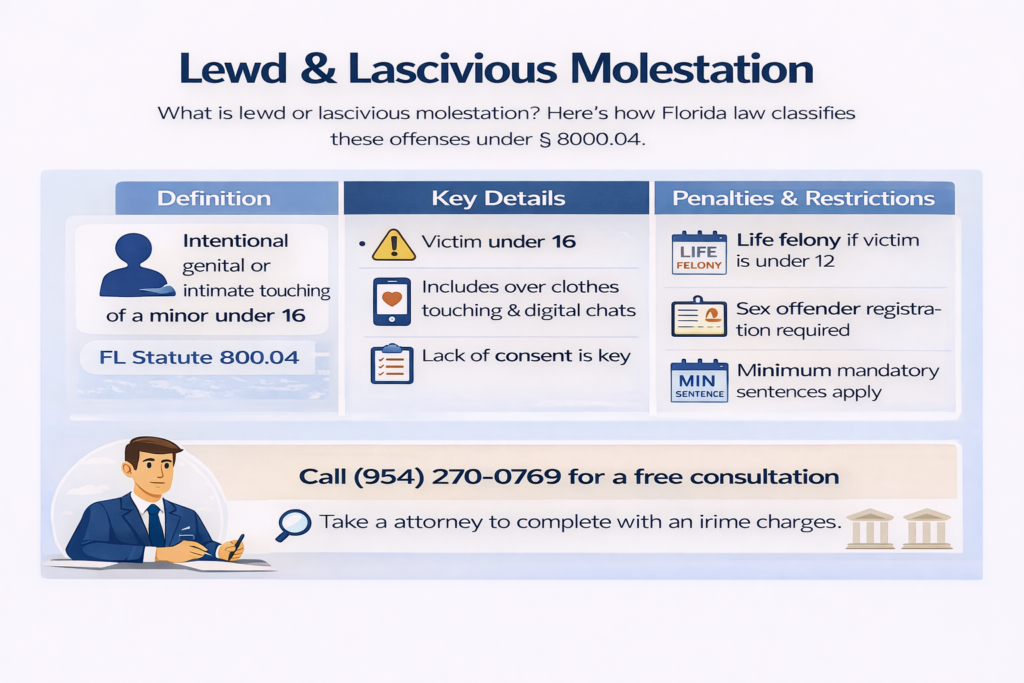
Under Florida Statute § 800.04(5), the focus is on intentional touching of specific body areas (or forcing a child to touch the accused) in a lewd or lascivious manner. Age is often the driving factor in charging and sentencing exposure.
For a broader overview of all lewd and lascivious offenses (battery, conduct, exhibition, and molestation), see our Lewd and Lascivious Offenses in Florida guide.
📜 What Is Lewd & Lascivious Molestation Under Florida Law?
Under § 800.04(5), lewd or lascivious molestation generally involves:
Intentionally touching certain parts of a person under 16 in a lewd or lascivious manner, or
Forcing or enticing a person under 16 to touch the offender in a lewd or lascivious manner.
The statute commonly focuses on touching:
Breasts
Genitals
Genital area
Buttocks
Or the clothing covering those areas
The alleged victim must be under 16.
The accused is generally 18 or older for this § 800.04 category.
Consent is not a defense.
🔎 What Makes “Molestation” Different From Other Lewd Charges?
Florida’s lewd statutes separate offenses by conduct type:
Lewd Battery (§ 800.04(4)): “sexual activity” (more than touching; can involve penetration/union)
Lewd Conduct (§ 800.04(6)): broader touching or solicitation, often context-driven
Lewd Exhibition (§ 800.04(7)): exposure/sexual acts without touching
Lewd Molestation (§ 800.04(5)): touching of specific body areas (or forcing the child to touch)
Molestation is the “body-area touching” statute — and that is why prosecutors often select it when allegations involve intimate contact but not alleged penetration.
🧠 What Does “Lewd or Lascivious” Mean in a Molestation Case?
This is where many cases are won or lost.
The State does not just have to prove touching occurred.
It must prove the touching was lewd or lascivious — meaning it was sexually motivated, indecent, or intended for sexual arousal or gratification based on the surrounding circumstances.
Key litigation questions include:
Was the contact intentional or accidental?
Was the touching sexual in nature or misinterpreted?
What was the context (location, timing, relationship, prior interactions)?
Are the allegations consistent across interviews?
Is there corroboration (messages, witnesses, medical evidence), or is it statement-only?
Because intent is often inferred, credibility and context become central.
🚸 Why Age Matters So Much
In lewd molestation cases, the age of the alleged victim and the age of the accused can dramatically change:
The degree of felony
Minimum mandatory exposure in certain scenarios
Whether the case is treated as a “mandatory prison” posture
Registration consequences
Even when the allegation sounds similar, the penalty structure can shift sharply based on age. In some close-in-age situations, individuals may seek relief under Florida’s Romeo and Juliet law.
⛓️ Penalties and Long-Term Consequences
Lewd and lascivious molestation is a felony offense in Florida. Depending on the ages involved, it can range from a second-degree felony up to a life felony.
Consequences often include:
Significant prison exposure (sometimes mandatory depending on ages/facts)
Sex offender probation with strict conditions
Court-ordered counseling or treatment
Electronic monitoring
Permanent felony record
Sex-offender registration requirements in Florida, which can impose long-term restrictions on housing, employment, and reporting obligations
Even a “non-prison” resolution can still carry life-changing restrictions.
🔍 How These Cases Are Typically Investigated
Many molestation cases begin with:
School reports or guidance counselor referrals
DCF involvement
Child advocacy center / forensic interviews
Delayed disclosure (weeks, months, or longer)
Device seizures and message reviews (depending on the relationship)
A major reality in these cases:
The first version of the story often becomes the blueprint for prosecution.
How the allegation is initially documented can shape charging and negotiation posture.
If law enforcement asks you to “come in and explain,” you are already in the charging stage — even if no arrest has happened yet.
🛡️ Defense Strategies That Matter Most in Molestation Cases
🔹 Intent and Innocent Contact
Not all contact is sexual, and accidental contact is not a felony.
A core defense theme is whether the State can prove beyond a reasonable doubt that the touching was lewd (sexually motivated) rather than misinterpreted, incidental, or falsely characterized.
🔹 Inconsistent Statements and Interview Contamination
A significant number of cases turn on:
inconsistencies across interviews
leading questions
timeline problems
external influence (coaching, family conflict dynamics)
🔹 Lack of Corroboration
Many molestation cases have no:
physical evidence
medical findings
contemporaneous reports
witnesses
When the case is statement-only, defense strategy often centers on credibility, context, and the reliability of the investigative process.
🔹 Digital Context (When Applicable)
Where there are messages or device evidence, the defense often needs:
full threads (not screenshots)
timestamps and metadata
proof of authorship/access
deleted-message recovery context
🚨 What to Do If You’re Under Investigation
If you are being investigated for lewd and lascivious molestation:
Do not give a statement to law enforcement without counsel
Do not contact the alleged child or family (even to “clear it up”)
Preserve any potentially exculpatory messages or timeline evidence
Avoid deleting content (it can be used against you)
Early intervention can sometimes influence:
whether charges are filed
what statute is charged
what “degree” posture the State takes
📞 Fort Lauderdale Lewd Molestation Defense
At Michael White, P.A., we defend clients accused of serious sex offenses throughout Fort Lauderdale and South Florida.
Molestation cases are often decided by:
intent analysis
credibility and consistency
investigative reliability
early strategy decisions
For a confidential consultation, call (954) 270-0769.
❓ Frequently Asked Questions
What is lewd and lascivious molestation in Florida?
Lewd and lascivious molestation under § 800.04(5) generally involves intentionally touching specific intimate body areas (or clothing covering them) of a person under 16 in a lewd manner, or forcing the minor to touch the offender.
Does molestation require penetration?
No. Penetration is not required. The offense focuses on lewd touching of specific body areas or compelled touching.
Does the State have to prove the touching was sexual?
Yes. The State must prove the touching was “lewd or lascivious,” which typically means sexually motivated under the surrounding circumstances.
Can molestation be charged without physical evidence?
Yes. Many cases are filed based primarily on statements, forensic interviews, and credibility assessments, even without witnesses or medical evidence.
What’s the difference between lewd conduct and lewd molestation?
Molestation focuses on touching specific body parts (or clothing covering them). Lewd conduct is broader and may involve touching or solicitation without the same body-part requirement.
Is lewd and lascivious molestation a felony?
Yes. It is a felony offense and can range in severity based on ages and facts, including extremely serious felony classifications.
Does a conviction require sex-offender registration?
Many outcomes can trigger sex-offender registration requirements. Whether registration is mandatory depends on the conviction and statutory classification.