
Last updated March 2026
A lewd and lascivious conviction in Florida can carry consequences long after the courtroom case ends.
These consequences most often arise from charges prosecuted under Florida’s lewd and lascivious statute. For a full breakdown of those offenses, see our guide to Lewd and Lascivious Offenses in Florida.
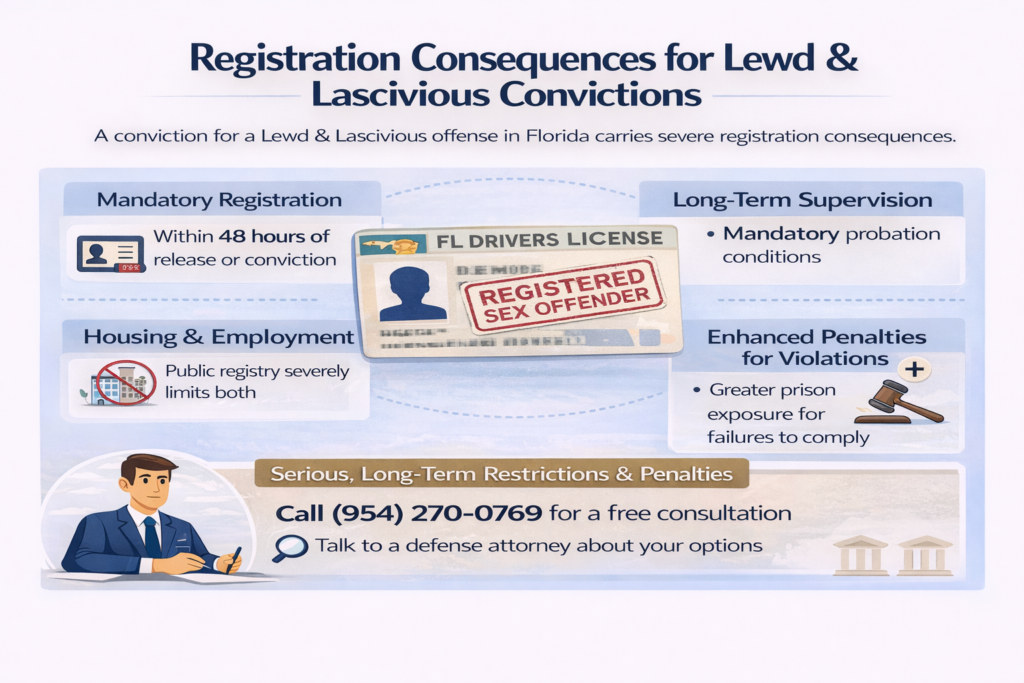
Even when a sentence involves probation, a negotiated plea, or minimal jail time, sex offender registration requirements may apply — and those obligations can last decades or even a lifetime.
Registration is not a minor administrative formality. It is a long-term legal status with strict reporting rules, public visibility, and additional felony exposure for mistakes.
For a broader overview of registry classifications, duties, and enforcement, see our guide to Sex Offender Registration Requirements in Florida.
⚖️ Why Registration Is Often the Most Serious Consequence
Many defendants focus on the immediate sentence. But for registry-triggering offenses, the long-term impact often includes:
Lifetime or multi-decade reporting requirements
Public database visibility
Severe housing barriers
Employment and professional license consequences
Ongoing law enforcement monitoring
New felony charges for technical violations
In practical terms, the registration requirement can outlast probation, parole, and even incarceration.
🔍 Which Lewd & Lascivious Convictions Trigger Registration?
Registration consequences depend on:
The specific statutory subsection of conviction
The age of the alleged victim
The age of the accused
Whether adjudication was entered
Whether the person is classified as a sexual offender or predator
Many convictions under Fla. Stat. § 800.04 trigger registration — including charges like lewd and lascivious molestation — trigger registration..
Small differences in plea language can dramatically alter long-term obligations.
⏳ How Long Does Registration Last?
In many cases, registration lasts for life.
Florida law provides limited petition options in narrow circumstances, but removal is not automatic and not guaranteed.
Key points:
Most qualifying convictions require long-term or lifetime registration.
Petition eligibility is fact-specific.
Some classifications make removal extremely difficult or unavailable.
Assumptions about “automatic expiration” are usually incorrect.
🧾 What Registration Actually Requires
Once registration applies, a person may be required to:
Register in person with local law enforcement
Verify information periodically (often multiple times per year)
Report any address change promptly
Report employment changes
Report school enrollment changes
Provide vehicle information
Provide certain online identifiers
Comply with additional reporting rules if transient
Failure to comply can result in new felony charges.
🚨 Failure to Register Is a Separate Felony
Registry violations are aggressively prosecuted.
Allegations can arise from:
Missing a reporting deadline
Failing to update an address within the required time frame
Providing incomplete or incorrect information
Traveling without required notification
Transient reporting issues
These cases often involve strict statutory timelines and technical compliance requirements.
🏠 Housing Consequences
Registration can create practical housing limitations, including:
Difficulty securing leases
Denial by corporate property managers
Increased scrutiny from landlords
Residency proximity complications in some situations
Frequent relocations due to instability
Even where formal statutory residency restrictions are limited, real-world barriers can be substantial.
💼 Employment & Licensing Consequences
Registry status can affect:
Background checks
Government employment
Professional licenses
Healthcare, education, or child-related professions
Contracting opportunities
Security clearance eligibility
In many cases, career impact exceeds the criminal sentence itself.
🌎 Moving Out of State Does Not End Obligations
Some people believe relocating eliminates registration.
It does not.
Most states require compliance if a person:
Resides
Works
Attends school
Federal law also imposes registration obligations.
Moving can change reporting procedures — but rarely eliminates them.
❗ Common Misconceptions About Lewd Convictions & Registration
“Withhold of adjudication avoids registration.”
Not necessarily. Registry consequences often turn on the offense and statutory classification — not just adjudication status.
“Probation-only sentences don’t trigger registry.”
Incorrect. Registration is often triggered regardless of jail time.
“Juvenile cases never require registration.”
Some juvenile dispositions can still carry serious consequences depending on classification and statutory factors.
“Close-in-age relationships automatically prevent registration.”
Florida’s Romeo & Juliet law offers limited petition relief in narrow age-gap cases — but it does not prevent charges or automatically remove registry obligations.
🎯 Strategic Importance in Pending Cases
Registration exposure should be analyzed at the earliest stage of a case.
Because registration often hinges on:
Exact statutory subsection
Specific plea wording
Degree of offense
Age-related findings
Negotiation strategy may significantly affect long-term consequences.
This is one of the reasons lewd and lascivious cases require careful, forward-looking defense strategy.
📞 If You Are Facing Lewd & Lascivious Charges
Registration consequences can shape your housing, employment, reputation, and future for decades.
If you are under investigation or charged in Broward County or South Florida, your legal strategy should account not only for sentencing exposure — but for long-term registration risk.
❓ FAQs
1️⃣ Does a plea deal automatically determine whether I must register?
Not always. Registration consequences depend on the specific statutory subsection of conviction. Even small changes in charge language during plea negotiations can affect whether registration is required.
2️⃣ Can a judge waive sex offender registration in a lewd case?
In most qualifying cases, registration is mandatory if the statute applies. A judge generally cannot simply “waive” registration unless a specific statutory relief mechanism applies.
3️⃣ Does a conviction for attempted lewd and lascivious conduct require registration?
It can. Attempted offenses may still trigger registration depending on how the conviction is classified and the statutory language involved.
4️⃣ Will sex offender registration show up on background checks?
Yes. Registry status is publicly accessible and often appears during employment, housing, and licensing background reviews.
5️⃣ Can someone be charged with failure to register years after the original conviction?
Yes. Registry obligations continue long-term, and alleged noncompliance — even years later — can result in new felony prosecution.