
Last updated April 2026
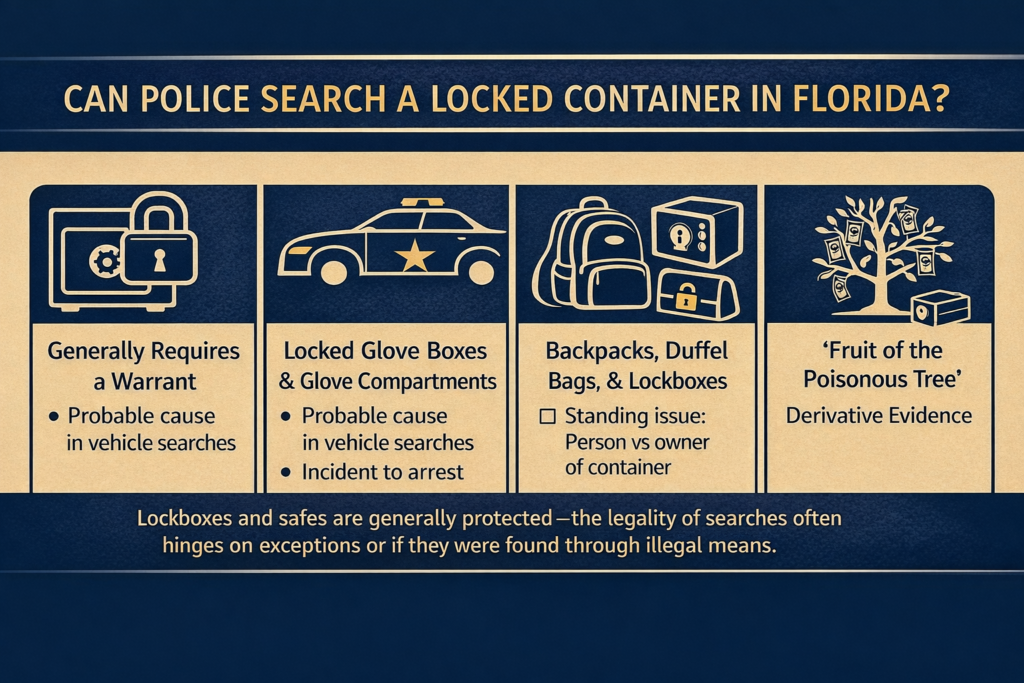
Locked containers — such as lockboxes, safes, suitcases, or locked backpacks — receive strong protection under both the U.S. Constitution and the Florida Constitution. Yet Florida police routinely search locked containers during traffic stops, arrests, and inventory searches, often claiming authority they do not have.
A locked container is not automatically searchable just because police are nearby, you are detained, or even because you were arrested.
For a broader look at these protections, see our guide to illegal searches and seizures.
A locked container is one of the clearest indicators of a person’s expectation of privacy under the Fourth Amendment. Whether a search is lawful depends on how, where, and why officers accessed the container — and many such searches are illegal.
⚖️ The General Rule: Locked Containers Are Highly Protected
Under the Fourth Amendment and Article I, Section 12 of the Florida Constitution, police generally need a warrant to search a locked container.
A lock signals a clear expectation of privacy. Courts treat locked containers differently from:
-
Loose items in plain view
-
Open bags
-
Areas immediately accessible during an arrest
Without a warrant or a valid exception, police cannot open a locked container simply because it exists.
🚗 Locked Containers Inside Vehicles
Locked-container issues most often arise during traffic stops and vehicle searches. This is where police most often overreach.
❌ What Police Cannot Do
Officers generally may not:
-
Open a locked glove box or console without justification
-
Break into a locked suitcase or lockbox
-
Open a locked backpack in the trunk
-
Force open a locked container belonging to a passenger
Even if police have probable cause to search a vehicle, that does not automatically authorize opening every locked container inside it.
Learn how courts evaluate vehicle-wide searches in vehicle searches in Florida.
✅ When Police May Search a Locked Container
There are only a few narrow exceptions where a locked container may be searched:
1️⃣ A Valid Search Warrant
A warrant that specifically authorizes searching the container — or searching for items that could reasonably be inside it — allows police to open it.
If the warrant is overbroad or vague, the search may still be challenged.
2️⃣ Voluntary Consent
If you clearly and voluntarily consent to the search of a locked container, police may open it.
However:
-
Consent must be explicit
-
Consent cannot be coerced
-
Consent to search a vehicle does not automatically include consent to open locked containers
Many “consent searches” fail under scrutiny.
3️⃣ Probable Cause + Exigent Circumstances (Rare)
Police may search a locked container without a warrant only if:
-
They have probable cause the container holds evidence of a crime and
-
There is an immediate emergency (e.g., imminent destruction of evidence)
This exception is narrow and frequently misused.
4️⃣ Inventory Searches (Strictly Limited)
Inventory searches are one of the most abused justifications for container searches.
Police may only open a locked container during an inventory search if:
-
The vehicle was lawfully impounded
-
The agency has a written policy
-
That policy explicitly authorizes opening locked containers
-
The search is administrative — not investigatory
If officers open a locked container without policy authorization, the search is unlawful.
Inventory searches are one of the most abused justifications for opening locked containers.
Learn how these rules apply in practice in inventory searches in Florida.
🚫 Common Illegal Locked-Container Searches
Florida courts frequently suppress evidence when police:
-
Force open a locked container during a traffic stop
-
Search a locked container after arrest without a warrant
-
Open containers belonging to passengers
-
Claim “officer safety” without specific facts
-
Use inventory searches as a pretext
-
Search before deciding to impound the vehicle
Similar constitutional limits apply to personal containers like backpack searches in Florida. These searches often collapse under a motion to suppress.
🧠 Where Locked-Container Cases Often Break Down
Common problems include:
- assuming vehicle probable cause applies to all containers
- opening containers without specific authorization
- relying on vague or overbroad warrants
- using inventory searches without policy support
Courts closely analyze these distinctions when determining whether evidence is admissible.
🛑 How Illegal Locked-Container Searches Are Challenged
When police unlawfully open a locked container, a defense attorney may file a motion to suppress in Florida to exclude:
-
Drugs or paraphernalia
-
Firearms or ammunition
-
Cash or alleged proceeds
-
Digital storage devices
-
Any statements tied to the search
If the suppressed evidence is central to the case, charges are often reduced or dismissed.
📍 Florida Defense Strategy Matters
At Michael White, P.A., we routinely challenge locked-container searches by:
-
Reviewing bodycam footage
-
Analyzing search timelines
-
Examining warrant language
-
Demanding written inventory policies
-
Identifying pretextual searches
-
Cross-examining officer credibility
Locked containers are one of the strongest suppression issues in Florida criminal defense.
🚨 Charged After a Locked-Container Search?
If police searched a locked container during a stop, arrest, or impound — you may have powerful constitutional defenses.
📞 Call (954) 270-0769 for a free consultation.
We’ll review the search and determine whether the evidence can be excluded.
❓ FAQs — Locked Container Searches in Florida
Can police open a locked container during a traffic stop?
Not without a warrant, valid consent, or a narrow legal exception.
Does probable cause to search a car allow police to open locked containers?
Not automatically. Courts closely scrutinize these searches.
Can police open a passenger’s locked container?
Usually no, unless they have independent probable cause or consent.
What if police claim it was an inventory search?
Inventory searches must follow written policy. Deviations often invalidate the search.
Can evidence from a locked-container search be suppressed?
Yes. Illegal container searches are frequently suppressed in Florida courts.