
Last updated March 2026
⚖️ When Both People Agree to Fight — Is It Still Battery?
Many battery cases don’t involve a one-sided incident. Instead, both individuals willingly engage in a physical confrontation — whether during an argument, a bar fight, or a heated dispute.
This situation is commonly referred to as mutual combat.
But under Florida law, the fact that both people participated does not automatically prevent criminal charges. In many cases, both individuals can still be arrested and prosecuted for battery.
To understand how Florida defines battery more broadly — including intent and unwanted contact — see our guide to Battery Charges in Florida.
🔍 What Is “Mutual Combat” in Florida?
“Mutual combat” is not a formal statutory term in Florida, but it is commonly used to describe situations where:
Both parties voluntarily engage in a physical altercation
There is no clear initial aggressor
Each person participates in the confrontation
These cases often arise from:
Bar or nightlife altercations
Domestic disputes that escalate
Road rage incidents
Arguments that turn physical
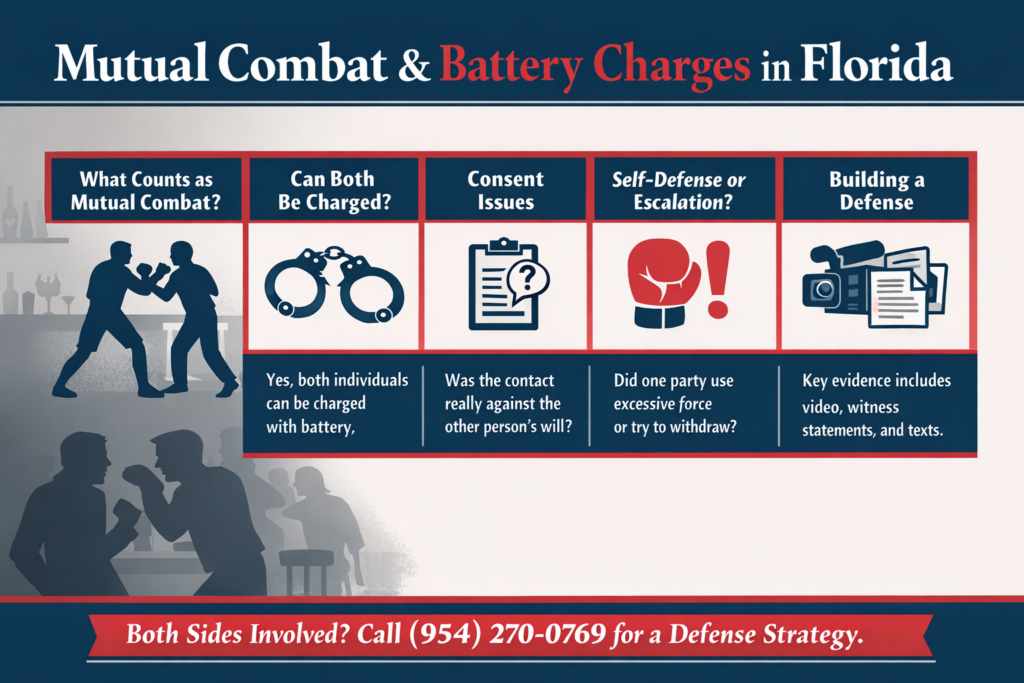
The key issue is whether the contact was truly against the other person’s will — an essential element of battery.
If you’re unsure what level of contact qualifies, even in a chaotic situation, see What Counts as Touching Someone for a Battery Charge in Florida.
⚖️ Can You Be Charged With Battery If Both People Were Fighting?
Yes. In Florida, mutual participation does not automatically equal consent under the law.
Even if both individuals were involved in the fight:
Each person can still be charged with battery
Police may arrest both parties at the scene
Prosecutors can pursue charges against one or both individuals
This is because Florida law focuses on whether each act of contact was:
intentional, and
against the other person’s will
In chaotic or escalating situations, those elements are often disputed — creating opportunities for defense.
🛑 Does Consent Defeat a Battery Charge?
Consent can be a powerful issue in mutual combat cases — but it is not always straightforward.
In some contexts, participation may suggest that the contact was not “against the other person’s will.” However, Florida courts do not treat all fights as legally consensual.
Important factors include:
Who initiated the confrontation
Whether one party attempted to withdraw
Whether the force used escalated beyond what was expected
Whether one party continued after the other stopped
Even if a fight begins as mutual, it can quickly become non-consensual if one party goes too far.
If the contact was accidental or misinterpreted, that can further weaken the State’s case. See Accidental Contact vs. Battery in Florida for how intent changes the analysis.
🛡️ Self-Defense vs. Mutual Combat
Mutual combat often overlaps with self-defense — but they are not the same.
Self-defense applies when a person uses reasonable force to prevent imminent harm. If one party becomes the aggressor, the other may still claim self-defense even if the encounter began mutually.
Key distinctions include:
A person who withdraws and is pursued may regain the right to self-defense
Disproportionate force can eliminate a self-defense claim
The timing and escalation of force matter
These issues are highly fact-specific and often determine whether a case proceeds or collapses.
⚠️ When Mutual Combat Becomes a Strong Defense
Mutual combat can weaken the State’s case in several ways:
Consent Issues
If both parties willingly engaged, the State may struggle to prove the contact was against the alleged victim’s will.
Credibility Problems
Conflicting accounts are common when both individuals participated.
Unclear Aggressor
If it’s unclear who initiated the confrontation, reasonable doubt increases.
Escalation Disputes
Cases often turn on whether one party used excessive or unjustified force.
These weaknesses can create leverage for dismissal, reduction, or diversion — especially when raised early in the case.
🔍 How Prosecutors Approach Mutual Combat Cases
Prosecutors do not simply dismiss cases because both parties were involved. Instead, they look for:
injuries suggesting one-sided force
witness statements identifying an aggressor
video or body-camera footage
prior history between the parties
In some cases, prosecutors may:
file charges against both individuals
pursue charges against only one party
reduce charges based on evidentiary weaknesses
Even when the alleged victim later changes their story, the case may still proceed. For more on that issue, see Can Battery Charges Be Dropped If the Victim Doesn’t Want to Prosecute?
🧩 Defense Strategy in Mutual Combat Cases
Successfully defending these cases requires a detailed analysis of:
how the confrontation started
whether consent existed at any point
whether one party withdrew
whether force escalated beyond lawful limits
Evidence is critical, including:
surveillance or cellphone video
text messages before or after the incident
witness statements
medical records
When properly developed, these factors can expose weaknesses in the State’s case early — often before trial.
🚨 What to Do If You’re Charged After a Fight
If you were arrested after a mutual altercation:
Do not assume the case is minor because “both people were fighting”
Do not contact the other party
Preserve any video, texts, or witness information
Write down your recollection immediately
Speak with a defense attorney before making statements
Early strategy often determines whether a case is dismissed or escalated.
📞 Charged With Battery After a Fight? Let’s Break It Down.
Mutual combat cases are rarely as simple as police reports suggest.
If you’ve been arrested after a physical confrontation, we analyze the full context — not just the allegation.
📲 Call (954) 270-0769 or schedule your consultation today.
❓ FAQs
What is mutual combat in Florida?
It refers to situations where both individuals voluntarily engage in a physical altercation, though it is not a formal legal term.
Can both people be charged with battery in a fight?
Yes. Florida law allows both participants to be charged if each engaged in intentional, unwanted contact.
Does consent prevent a battery charge?
Not always. Even if a fight begins mutually, it can become non-consensual if one party escalates or continues after the other stops.
Can mutual combat be used as a defense?
It can weaken the prosecution’s case by creating doubt about consent, intent, and who was the aggressor.