
Last updated March 2026
Not every unwanted physical contact in Florida is a crime.
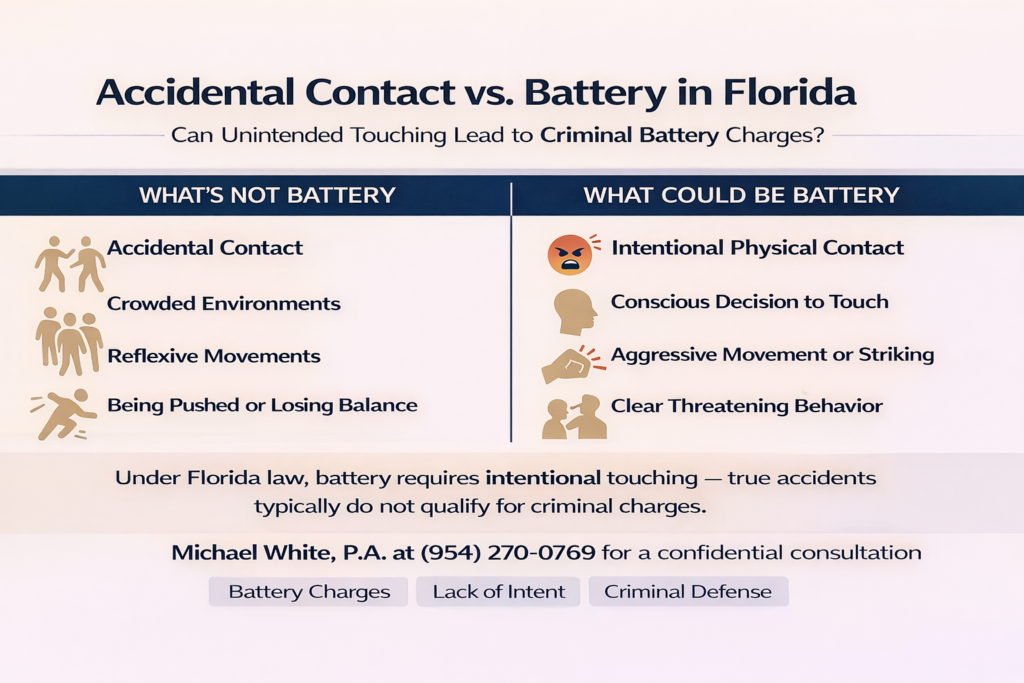
Under Florida law, battery requires intentional touching or striking. If the contact was accidental, reflexive, or unintended, the charge may not legally stand.
Understanding the difference between accidental contact and criminal battery is critical — especially in crowded spaces, heated arguments, or chaotic situations where physical contact can happen quickly.
For a full overview of how Florida defines battery and related offenses, see our guide to Battery Charges in Florida.
⚖️ The Legal Definition of Battery in Florida
Under Florida Statute § 784.03, a person commits battery if they:
1️⃣ Actually and intentionally touch or strike another person against their will, or
2️⃣ Intentionally cause bodily harm to another person
The key word is intentionally.
If the State cannot prove intent beyond a reasonable doubt, the charge cannot stand.
Even minimal contact can qualify if it is intentional. For a closer look at how Florida treats physical contact, see Can You Be Charged With Battery for Touching Someone in Florida?
🎯 What “Intentional” Really Means
Intent does not require planning.
But it does require:
A deliberate act
A conscious decision to make physical contact
Voluntary conduct
Battery is not based on:
Clumsiness
Reflex reactions
Losing balance
Being pushed into someone
Accidental bumping in a crowded space
The prosecution must prove the contact was not accidental.
Common real-world scenarios include:
🔹 Crowded Environments
Bars, sporting events, concerts, and public gatherings often involve incidental contact.
🔹 Mutual Physical Escalation
In heated arguments, people may step into each other’s space unintentionally. In situations where both individuals engage in a confrontation, the legal analysis becomes more complex. See Mutual Combat and Battery Charges in Florida for how consent and escalation affect these cases.
🔹 Reflexive Reactions
A sudden movement in response to being startled can lead to unintended contact.
🔹 Being Pushed or Losing Balance
If someone is shoved and collides with another person, that contact may not be intentional.
🔹 Defensive Movements
Raising an arm to shield yourself can sometimes result in unintended contact.
The difference between accident and battery often turns on seconds of movement.
🔍 How Prosecutors Try to Prove Intent
In battery cases, the State typically relies on:
• Witness statements
• Alleged victim testimony
• Body-worn camera footage
• Injury photographs
• Statements made at the scene
• Post-incident behavior
Because intent exists in the mind, prosecutors often argue that:
The movement was purposeful
The force was deliberate
The conduct shows anger or hostility
Defense strategy focuses on context.
🧠 Evidence That Distinguishes Accident From Intent
Small factual details often decide these cases:
• Distance between parties
• Body positioning
• Who initiated contact
• Whether the movement was defensive
• Whether alcohol or crowd conditions affected balance
• Whether video contradicts the allegation
Video evidence can be decisive.
What a report describes as “striking” may appear accidental on footage.
⚖️ Accidental Contact vs. Self-Defense
In some cases, the contact may not have been accidental — but it may have been justified.
Florida law allows reasonable force in self-defense.
If the contact occurred while defending yourself or another person from imminent harm, that may bar prosecution.
For more on justified force, see our overview of self-defense and Stand Your Ground in Florida.
🔁 Can Accidental Contact Lead to Charges Anyway?
Yes.
Police often arrest first and let prosecutors sort out intent later.
Battery charges sometimes arise when:
Emotions are high
Alcohol is involved
Witnesses disagree
The alleged victim exaggerates
Officers rely on one-sided statements
An arrest does not mean the State can prove intent.
Even when the alleged victim later changes their story, the case may still proceed. For more on how that works, see Can Battery Charges Be Dropped If the Victim Doesn’t Want to Prosecute?
📍 Broward County Reality
In Broward County, battery arrests frequently occur in:
Domestic disputes
Bar altercations
Sporting events
Roadside confrontations
Public disturbances
Many cases hinge entirely on credibility and context.
Early evidence preservation can significantly impact the outcome.
🛡️ Defense Strategy in Accidental Battery Cases
Effective defenses often include:
✔ Challenging intent
✔ Establishing accidental movement
✔ Using video to contradict witness claims
✔ Highlighting inconsistencies in statements
✔ Demonstrating mutual conduct
✔ Asserting lawful self-defense where appropriate
Because simple battery is a first-degree misdemeanor (and can escalate with priors), early legal analysis is critical.
⚖️ Can Battery Charges Be Reduced or Dismissed?
Yes.
If the defense demonstrates:
Lack of intent
Accidental contact
Insufficient evidence
Mutual confrontation
Credibility problems
Charges may be dismissed, reduced, or resolved through diversion.
Intent is the element that often determines the outcome.
If this is your first arrest, the outcome may depend heavily on how early the case is addressed. See First-Time Battery Charges in Florida: Will I Go to Jail? for what to expect.
📞 Charged With Battery in Florida?
If you’ve been accused of battery and believe the contact was accidental, the legal distinction matters.
Battery requires intentional touching — not every unwanted contact qualifies.
Call Michael White, P.A. at (954) 270-0769 for a confidential consultation.
FAQs
1) Does battery in Florida require intent?
Yes. Florida battery requires intentional touching or striking. Accidental or involuntary contact does not meet the legal definition.
2) Can I be charged with battery if the contact was accidental?
You can be charged, but the State must prove beyond a reasonable doubt that the contact was intentional — not accidental.
3) What if I didn’t mean to touch the person?
Lack of intent can be a complete defense. The prosecution must prove that the touching was deliberate.
4) Is bumping someone in a crowded place battery?
Usually not. Incidental contact in crowded environments often lacks the required intent.
5) How does the State prove intent in a battery case?
Prosecutors rely on witness testimony, video evidence, statements, and surrounding circumstances to argue that the contact was deliberate.