
Last updated March 2026
One of the most common — and most misunderstood — questions in Florida battery cases is:
“If the victim doesn’t want to press charges, will the case be dropped?”
The answer surprises many people.
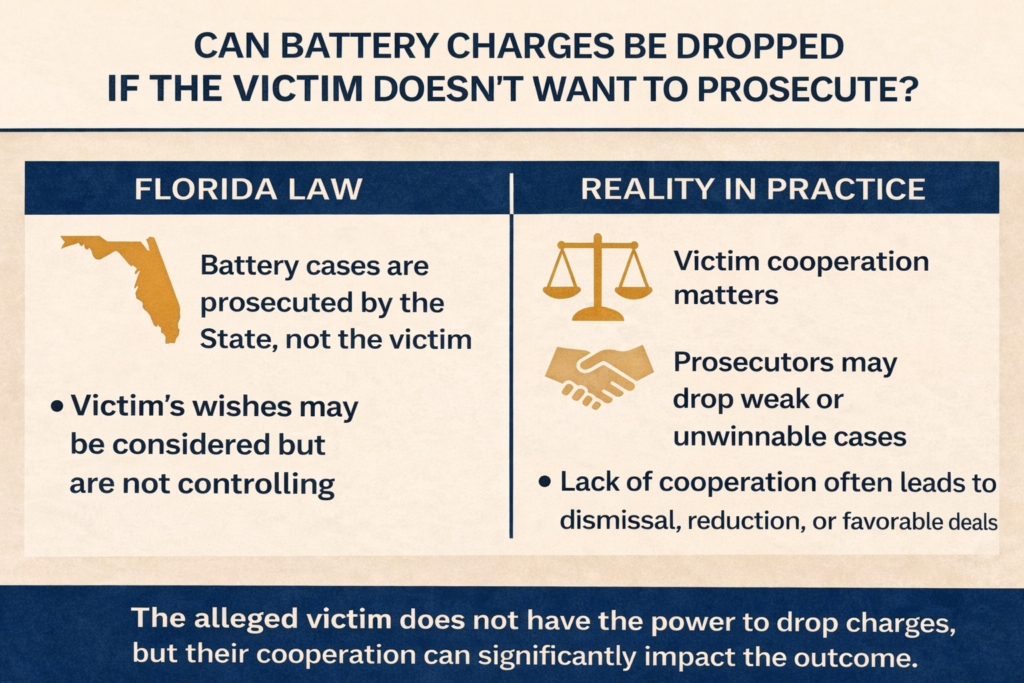
In Florida, battery charges are brought by the State, not the alleged victim. That means a case can move forward even when the victim asks for dismissal — but victim cooperation still matters a great deal.
For a full explanation of how battery charges work, including penalties, defenses, and when cases escalate, see our guide to Battery Charges in Florida.
Here’s how Florida law actually works, and when battery cases are most often dropped or reduced.
⚖️ The Short Answer
No — not automatically.
In Florida, only the prosecutor (State Attorney) has the authority to drop battery charges. An alleged victim cannot “press” or “drop” charges on their own.
That said, a victim’s refusal to cooperate can significantly weaken the case, especially when evidence is limited.
📜 Why the State Controls Battery Prosecutions
Battery is considered a crime against the State of Florida, not just a private dispute.
Once an arrest is made, prosecutors decide whether to:
file charges,
amend charges, or
dismiss the case.
This is especially true in:
domestic battery cases,
bar or nightclub incidents,
disputes involving alcohol or emotional arguments.
🔍 How Victim Cooperation Affects a Battery Case
While a victim cannot directly drop charges, their cooperation often affects:
whether charges are formally filed,
whether the case proceeds to trial,
whether plea offers are extended,
whether charges are reduced or dismissed.
When a victim:
refuses to testify,
recants their statement,
becomes unresponsive,
or contradicts earlier claims,
the prosecution’s case may become much weaker.
🚨 When Battery Charges Often Continue Anyway
Prosecutors may still proceed without a cooperative victim if they have:
body-camera footage,
photographs of injuries,
eyewitness testimony,
medical records,
recorded 911 calls,
text messages or admissions.
In domestic cases, “no-drop” policies are common — meaning prosecutors move forward even against the victim’s wishes.
✅ When Battery Charges Are More Likely to Be Dropped or Reduced
Battery cases are more likely to be dismissed or reduced when:
injuries are minor or nonexistent,
the alleged contact was brief or accidental — see Accidental Contact vs. Battery in Florida for how lack of intent can defeat the charge,
statements are inconsistent,
the alleged victim recants early,
there is no independent evidence,
self-defense or mutual confrontation applies — see See Mutual Combat and Battery Charges in Florida for how mutual altercations, consent and escalation issues can further weaken the State’s case,
video contradicts the police report.
Early legal intervention often determines whether prosecutors reassess the case.
If this is your first arrest, these factors can significantly impact whether the case is dismissed or resolved without a conviction. See First-Time Battery Charges in Florida: Will I Go to Jail?
⚠️ What You Should Not Do
If the alleged victim does not want to prosecute:
❌ Do not contact them directly
❌ Do not ask them to “drop” charges
❌ Do not send messages that could be misinterpreted
Contacting the alleged victim can lead to:
bond violations,
new charges,
witness tampering allegations.
All communication should go through an attorney.
🛡️ How Defense Attorneys Handle Non-Cooperative Victims
Effective defense strategies often include:
documenting recantations properly,
highlighting inconsistencies between statements,
challenging probable cause,
suppressing statements or evidence,
negotiating reductions based on evidentiary weakness,
pushing for diversion or dismissal.
Timing matters — prosecutors are more flexible before cases harden.
🔍 What the State Still Must Prove
Even without victim cooperation, the State must prove every element of battery beyond a reasonable doubt:
Intentional contact: even minimal contact can support a charge if proven intentional — see Can You Be Charged With Battery for Touching Someone in Florida?
Against the alleged victim’s will
No legal justification
If the evidence cannot meet that burden, the case cannot stand.
📍 Charged With Battery in Florida?
A victim’s wishes alone do not control the outcome — but they often shape it.
📞 Call (954) 270-0769 or request a confidential consultation today.
❓ Frequently Asked Questions
Can a victim drop battery charges in Florida?
No. Only the State Attorney can drop charges, though a victim’s cooperation can influence the decision.
Will the case be dismissed if the victim refuses to testify?
Not always. Prosecutors may still rely on video, photos, witnesses, or prior statements.
Does this apply to domestic battery cases?
Yes. In domestic cases, prosecutors often proceed even when the victim asks for dismissal.
Can battery charges still be reduced without the victim?
Yes. Weak evidence, lack of injuries, or inconsistent statements often lead to reductions or dismissal.
Should I talk to the victim if they don’t want to prosecute?
No. Direct contact can violate bond conditions or result in new charges.