
Last updated March 2026
Being arrested for battery for the first time is terrifying — especially if you’ve never been in trouble before. One of the first questions almost everyone asks is:
“Am I going to jail?”
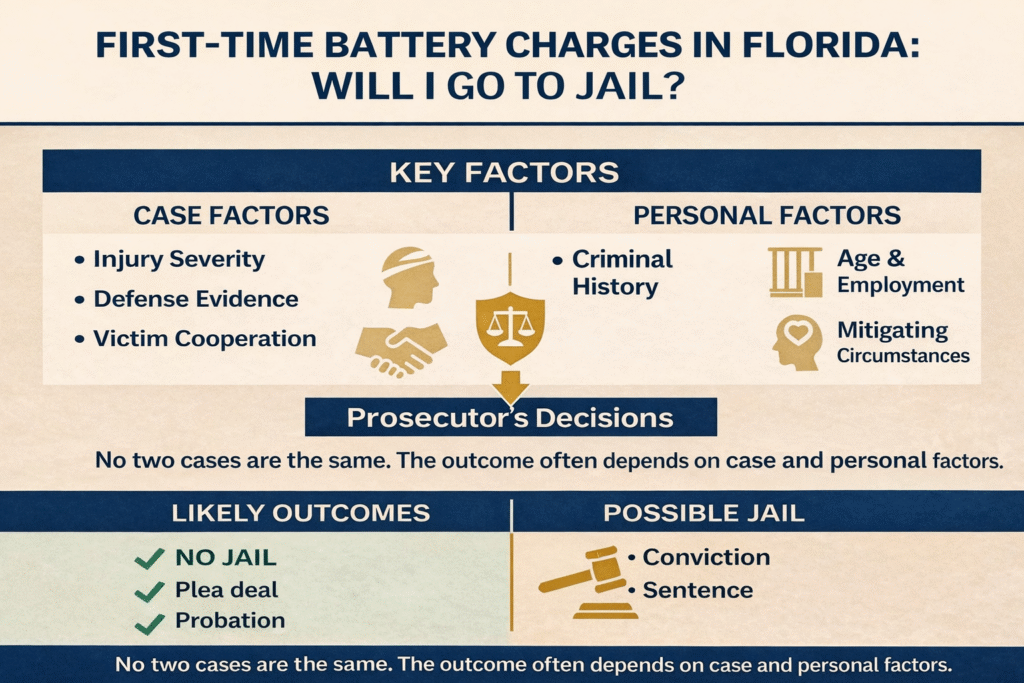
The answer in Florida is not always — and in many first-time battery cases, jail can often be avoided. But outcomes depend heavily on the facts, the evidence, and what happens early in the case.
For a full explanation of battery charges, penalties, defenses, and how cases escalate, see our guide to Battery Charges in Florida.
Here’s how Florida handles first-time battery charges, when jail is possible, and when it usually isn’t.
⚖️ The Short Answer
Not necessarily.
Many first-time battery defendants in Florida do not go to jail, particularly when:
injuries are minor or nonexistent
the alleged contact was accidental or brief — see Accidental Contact vs. Battery in Florida for how lack of intent can defeat the charge
the defendant has no prior criminal record
self-defense or mutual involvement is present
diversion or probation is available
However, jail is possible in certain situations — especially if the case escalates or is mishandled early.
📜 How Florida Law Treats Battery
Under Florida Statute § 784.03, battery is usually charged as a first-degree misdemeanor.
For a first offense, the maximum penalties are:
Up to 1 year in jail
Up to 1 year of probation
Up to a $1,000 fine
Importantly, maximum penalties are not the same as typical outcomes — especially for first-time offenders.
🚨 When Jail Is More Likely (Even for a First Offense)
A first-time battery charge is more likely to involve jail when:
The alleged victim suffered visible injuries
The case involves domestic violence
The defendant violated bond or no-contact conditions
The incident involved alcohol or drugs
The defendant made damaging statements to police
The case is upgraded to felony battery or aggravated battery
Early mistakes — especially talking to police — can dramatically increase jail exposure.
✅ When Jail Is Often Avoided
In many first-time battery cases, outcomes may include:
Pretrial diversion
Probation without jail
Charge reduction
Dismissal
These outcomes are more common when:
evidence is weak or contradictory
the alleged contact was brief or accidental
the alleged victim is uncooperative
self-defense applies
video or witnesses contradict police reports
🧭 Pretrial Diversion for First-Time Battery Charges
Some first-time battery defendants may qualify for pretrial diversion or deferred prosecution programs.
Successful completion can result in:
dismissal of the charge
avoidance of a conviction
eligibility for record sealing or expungement
Eligibility depends on the facts of the case, the alleged victim’s position, and prosecutorial discretion.
⚠️ What If the Alleged Victim Doesn’t Want to Prosecute?
This is one of the biggest misconceptions.
In Florida, the State — not the alleged victim — decides whether to proceed. Even if the alleged victim recants, prosecutors may still rely on:
body-camera footage
photographs
witness statements
prior statements
That said, lack of cooperation can significantly weaken the case and create leverage for reduction or dismissal.
For a full explanation of how prosecutors proceed in these situations, see Can Battery Charges Be Dropped If the Victim Doesn’t Want to Prosecute?
🛡️ How First-Time Battery Cases Are Defended
Effective defense strategies often focus on:
Lack of intent or accidental contact
Self-defense or defense of others
Mutual confrontation — including situations where both parties participated, as explained in Mutual Combat and Battery Charges in Florida
Credibility problems or inconsistent statements
Absence of injuries or medical proof
Video evidence contradicting allegations
Many first-time cases are resolved before trial when these issues are raised early.
🔍 What Prosecutors Must Prove
To convict someone of battery, the State must prove all three elements beyond a reasonable doubt:
Intentional contact
Against the alleged victim’s will
No legal justification
If any one element fails, the charge cannot stand.
📍 Facing a First-Time Battery Charge in Florida?
A first arrest does not define your future — but what you do next matters.
📞 Call (954) 270-0769 or request a confidential consultation today.
❓ Frequently Asked Questions
Will I go to jail for a first-time battery charge in Florida?
Not necessarily. Many first-time defendants avoid jail through diversion, probation, reduction, or dismissal depending on the facts.
Can a first-time battery charge be dismissed?
Yes. Weak evidence, lack of intent, self-defense, or credibility issues can lead to dismissal.
Does first-time battery qualify for diversion?
Sometimes. Eligibility depends on the facts, the alleged victim, and the prosecutor.
Is first-time battery a felony?
Usually no. Simple battery is a misdemeanor, but it can be upgraded in certain circumstances.
Will a conviction stay on my record?
A conviction cannot be sealed or expunged. Avoiding a conviction is critical for long-term consequences.