
Last updated March 2026
In many Florida criminal mischief cases, the biggest issue is not jail — it is money. Courts frequently focus on restitution, which is the requirement that a defendant pay for the damage allegedly caused.
For a general overview of the offense itself, see Criminal Mischief in Florida.
What Is Restitution?
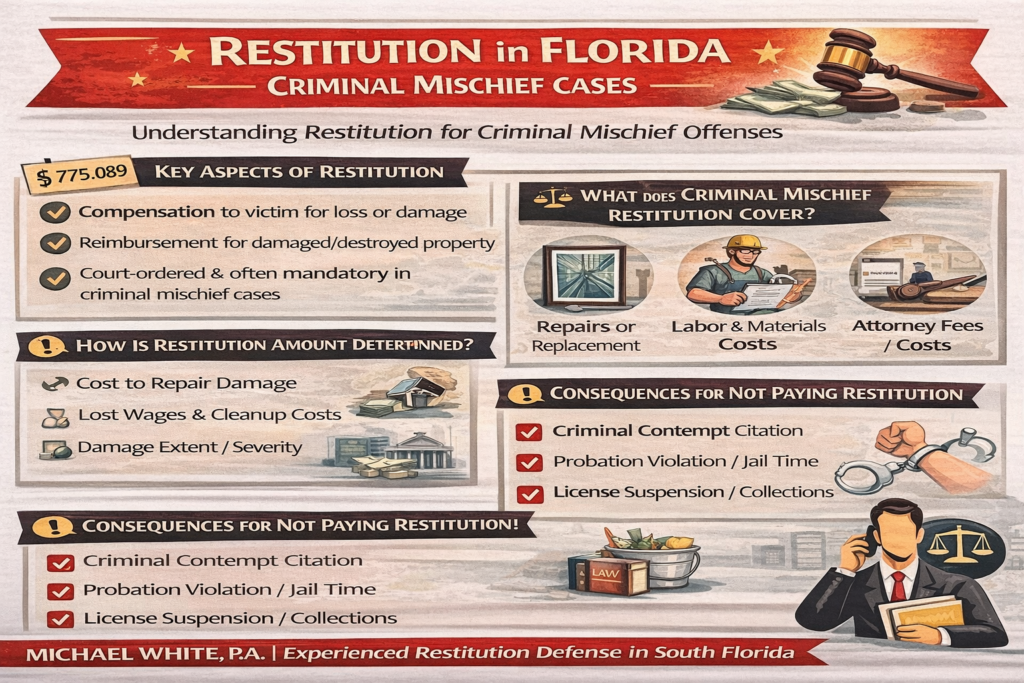
Restitution is a court-ordered payment intended to compensate a victim for property damage or loss.
In criminal mischief cases, restitution may include:
- repair costs
- replacement costs
- cleanup expenses
- related out-of-pocket losses
In many cases, restitution becomes a central issue — sometimes even more important than the underlying charge.
How Is Restitution Calculated?
Restitution is typically based on the value of the damage, but that value is not always straightforward.
Courts may consider:
- repair estimates
- invoices
- photographs of damage
- testimony from property owners
- expert opinions
The problem is that these numbers are often disputed or inflated.
For example:
- repairs may include full replacement instead of actual damage
- estimates may come from high-end vendors
- labor costs may be exaggerated
This is why damage valuation is often one of the most contested issues in criminal mischief cases.
Why Repair Cost Evidence Matters
The State must present evidence supporting the amount of restitution requested. That evidence may include written estimates, receipts, or testimony.
However, not all evidence is reliable.
Common issues include:
- unsupported or vague estimates
- lack of documentation
- inflated repair methods
- failure to consider cheaper alternatives
Challenging repair costs evidence can significantly reduce both restitution and the severity of the case.
Restitution vs. Criminal Charges
Restitution and criminal charges are closely connected.
The amount of damage can affect:
- whether the charge is a misdemeanor or felony
- how the case is negotiated
- what resolution options are available
For example, lower-value cases are often treated differently. See Criminal Mischief Under $200 in Florida.
What Happens If You Don’t Pay Restitution?
Failure to pay restitution can lead to serious consequences, especially if it is part of probation.
Possible outcomes include:
- violation of probation
- additional court hearings
- extended supervision
- potential jail exposure
Even after a case is resolved, restitution obligations may continue to affect a person financially and legally.
Restitution in Real-World Scenarios
Restitution issues frequently arise in cases involving:
- vehicle damage (including scratches or dents)
- graffiti or cleanup costs
- damage during domestic disputes
- broken windows or fixtures
For example:
- see Keying a Car in Florida for how vehicle damage is evaluated
- see Graffiti and Criminal Mischief in Florida for cleanup cost issues
Can Restitution Be Challenged?
Yes — and it often should be.
Defense strategies may include:
- disputing the amount of damage
- challenging repair methods
- presenting alternative estimates
- questioning documentation
- arguing that the damage is unrelated
Reducing restitution can have a major impact on both the financial outcome and the overall resolution of the case.
Can a Case Be Resolved Through Restitution?
In some cases, yes.
Depending on the facts, restitution may be part of:
- diversion programs
- negotiated resolutions
- pre-filing intervention
- reduced charges
However, paying restitution does not automatically mean the case will be dismissed. Strategy matters.
Fort Lauderdale Criminal Mischief Defense Attorney
Restitution is often one of the most important — and most overlooked — aspects of a criminal mischief case.
At Michael White, P.A., we focus on:
- challenging inflated damage claims
- analyzing repair cost evidence
- negotiating restitution strategically
- positioning cases for dismissal or reduction
In many cases, controlling the restitution issue is key to controlling the outcome.
FAQs
What is restitution in a criminal mischief case?
Restitution is a court-ordered payment to compensate for property damage or loss.
How do courts decide how much restitution to order?
Courts rely on repair estimates, invoices, and testimony, but those amounts can be challenged.
Can restitution be reduced?
Yes. Disputing damage valuation and repair costs can often lower the amount owed.
What happens if I can’t pay restitution?
Failure to pay can lead to probation violations and additional legal consequences.