
Last updated March 2026
Complete Guide for Fort Lauderdale & South Florida
If you’re looking to clear your criminal record in Fort Lauderdale or anywhere in South Florida, sealing or expungement may be an option. Even if your charges were dropped or you were never convicted, an arrest can remain visible on background checks for years.
Florida law allows eligible individuals to seal or expunge certain criminal records — but the process is strict, technical, and easy to get wrong. Understanding exactly who qualifies for record sealing or expungement in Florida is the first step before filing anything with FDLE or the court.
At Michael White, P.A., we help clients across Broward County and South Florida clear their records efficiently and correctly. As a former prosecutor, I understand how records are built — and how to legally remove them.
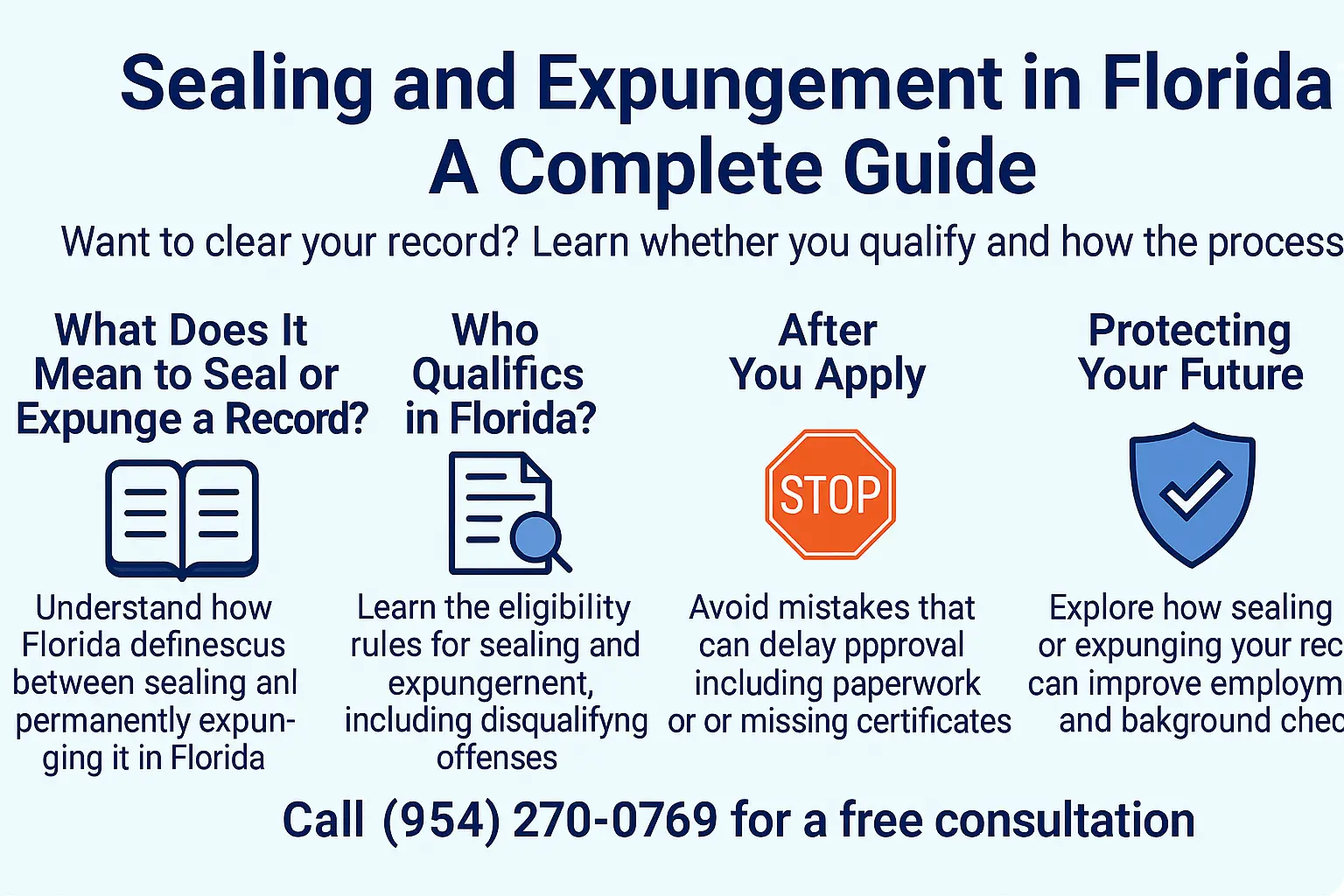
This guide explains:
The difference between sealing and expungement
Who qualifies
The full step-by-step process
What happens after approval
Common mistakes that cause delay or denial
🔒 Sealing vs. Expungement: What’s the Difference?
Many people use the terms “sealing” and “expungement” interchangeably — but under Florida law, they are very different remedies with different eligibility rules and long-term consequences.
In the short video below, I explain the key differences, who qualifies for each, and how to determine which option may apply to your case.
As discussed above, sealing and expungement differ in eligibility, long-term privacy protections, and strategic value. The chart below summarizes the key distinctions so you can quickly compare which option may apply to your case.
Under Florida Statutes §§ 943.0585 and 943.059, sealing and expungement are distinct legal remedies.
| Feature | Sealing | Expungement |
|---|---|---|
| Record Status | Made confidential | Destroyed (except confidential FDLE copy) |
| Public Access | Hidden from public view | Removed from public records |
| Agency Access | Certain agencies can still view | Limited access retained by FDLE |
| Eligibility | Usually requires a withhold of adjudication | Typically requires dismissal, no action, or acquittal |
| Future Relief | May expunge sealed record after 10 years (if eligible) | Final step |
In practice, expungement offers stronger privacy protections — but many people can only seal based on how their case was resolved.
If you’re unsure which applies to you, review:
👉 Sealing vs. Expunging in Florida
In the short video below, I explain the key differences, who qualifies for each, and how to determine which option may apply to your case.
✅ Who Qualifies for Sealing or Expungement in Florida?
Eligibility rules are strict. In general, you may qualify if:
Your case was dismissed, dropped, nolle prossed, or you were found not guilty (expungement)
You received a withhold of adjudication (usually sealable). If your case resulted in a withhold, eligibility depends on the exact disposition and your prior history. Learn more here:
You have no prior criminal convictions, including out-of-state convictions
You have never previously sealed or expunged another Florida record (with limited exceptions)
You have no pending charges anywhere
If your case ended without a conviction, you may still qualify for relief — even years later. 👉 Can You Seal or Expunge a Prior Arrest with No Conviction?
Certain offenses are permanently ineligible under Florida law, even if your case was dismissed.
Many people are surprised to learn that some felony charges may still be eligible for sealing if adjudication was withheld.
👉 Can You Seal a Felony Charge in Florida?
Misdemeanor charges follow similar but distinct eligibility rules depending on the final outcome.
👉 Can a Misdemeanor Be Expunged in Florida?
If you have more than one case in your history, eligibility becomes more complex.
👉 Can I Expunge Multiple Cases in Florida?
When multiple arrests arise from the same incident, special rules may allow relief that would otherwise be unavailable.
👉 Seal or Expunge Multiple Arrests from the Same Incident in Florida
If your case involved sensitive allegations — including certain domestic violence or sex-related offenses — eligibility requires careful review.
For instance, if your case involved domestic violence allegations, special statutory exclusions may apply — even if the charges were dropped.
👉 Can I Expunge a Domestic Violence Arrest in Florida?
Related resources:
Because sealing or expungement is often a one-time opportunity, confirming eligibility before filing is critical.
🧼 How Expungement Works in Florida
Under Fla. Stat. § 943.0585, expungement allows the legal destruction of a criminal record.
To qualify:
The case must have ended in dismissal, no action, nolle prosequi, or acquittal. If prosecutors never formally filed charges, your case may qualify for expungement even more quickly. 👉 Can You Seal or Expunge an Arrest That Was Never Filed in Florida?
You cannot have any prior convictions
You cannot have previously sealed or expunged a record
The offense must not fall within statutory exclusions
Expungement is not automatic. It requires a formal application, FDLE review, and court approval.
🛠️ The Step-by-Step Florida Sealing & Expungement Process
This is where most delays happen.
Step 1: Confirm Eligibility Before Spending Time or Money
Many denials occur because someone applies without realizing:
An old out-of-state conviction disqualifies them
A prior sealing prevents another
A case still shows as “pending” in the system
The statute number in court records is incorrect
Correcting those issues early prevents months of delay.
If your case involved DUI or a reduced charge such as wet reckless, eligibility depends heavily on how the case was resolved. See:
👉 Can I Expunge a DUI Arrest in Florida?
Step 2: Gather Required Documents
You typically need:
Certified copy of the final disposition
Charging document (information/citation)
Completed FDLE application packet
Fingerprint card from authorized agency
Required fees
The most common problem: mismatches between FDLE’s database and the clerk’s record.
Fixing those before submission avoids rejection.
Step 3: Apply to FDLE for a Certificate of Eligibility
For most adult cases, the process begins with FDLE.
You submit:
Application form
Fingerprints
Certified court documents
Payment
FDLE reviews eligibility and issues a Certificate of Eligibility if you qualify.
Processing time varies. Backlogs can cause several months of delay.
If you’re facing employment or licensing deadlines, timing strategy matters.
For a deeper look at typical timelines and delays, see:
👉 How Long Does It Take to Expunge a Record in Florida?
Step 4: File the Petition in Court
After receiving the Certificate of Eligibility, you file:
Petition to Seal or Expunge
Sworn affidavit
Proposed order
Supporting documentation
The State Attorney may:
Agree
Object
Take no position
Step 5: Hearing (Sometimes)
Many petitions are granted without a hearing.
A hearing may be set if:
The State objects
The disposition paperwork is unclear
The judge wants clarification on eligibility
If approved, the judge signs an order directing agencies to seal or expunge the record.
Step 6: After the Order — What Happens Next
The record does not disappear overnight.
Typically:
The clerk updates court files
Law enforcement updates internal systems
Background databases update over time
If a background check still shows the record:
It may be a delay
It may be a private database that needs correction
An attorney can follow up with agencies if necessary.
🌟 Benefits of Sealing or Expungement
Clearing your record can:
Improve employment opportunities
Expand housing access
Protect professional licensing
Remove mugshots and online arrest visibility
Allow you to lawfully deny the incident in most situations
Provide peace of mind
⚠️ Who Can Still See a Sealed or Expunged Record?
Even after approval, limited disclosure exceptions apply.
Certain entities may retain access, including:
Law enforcement
Florida Department of Children and Families
Department of Juvenile Justice (Juvenile cases follow different rules and timelines. See: 👉 Juvenile Record Expungement in Florida)
Certain professional licensing boards
Florida Bar admissions
When charged with a new offense
Understanding disclosure exceptions is essential — especially for professionals.
🚫 Common Mistakes That Cause Denials or Delays
Applying with a disqualifying conviction. Some offenses and prior histories permanently bar sealing or expungement under Florida law. 👉 Sealing & Expungement Disqualifiers in Florida
Filing with incorrect disposition paperwork
Fingerprints rejected or improperly completed
Attempting to seal/expunge wrong case number
Having pending charges anywhere
Rushing without confirming eligibility
Sealing and expungement are technical processes. Errors can cost months — or permanently disqualify relief.
💬 Frequently Asked Questions
Who qualifies for expungement in Florida?
Generally, individuals whose charges were dismissed or who were found not guilty and have no prior convictions may qualify. Eligibility is offense-specific and fact-dependent.
Can I seal a record with a withhold of adjudication?
Often yes, if you have no prior convictions and meet statutory requirements.
How long does sealing or expungement take?
Most cases take 6–12 months from FDLE submission to final court order, depending on backlog and whether a hearing is required.
Will it appear on background checks?
Sealed records are hidden from public view. Expunged records are destroyed except for confidential retention by FDLE. Most private employers cannot see them.
Do I need a lawyer?
While self-filing is possible, most delays and denials stem from eligibility errors or incomplete documentation. Legal guidance significantly reduces risk.
📞 Ready to Clear Your Record?
If your case ended in dismissal, no action, acquittal, or a withhold — you may be eligible to seal or expunge your Florida record.
If you’re searching specifically for a local attorney to handle the process from start to finish, learn more about our services here: 👉 Seal and Expunge Attorney in Fort Lauderdale. At Michael White, P.A., we have handled hundreds of record-clearing cases throughout Fort Lauderdale, Broward County, and South Florida.
📲 Call (954) 270-0769 or schedule your free consultation today.