
Last updated February 2026
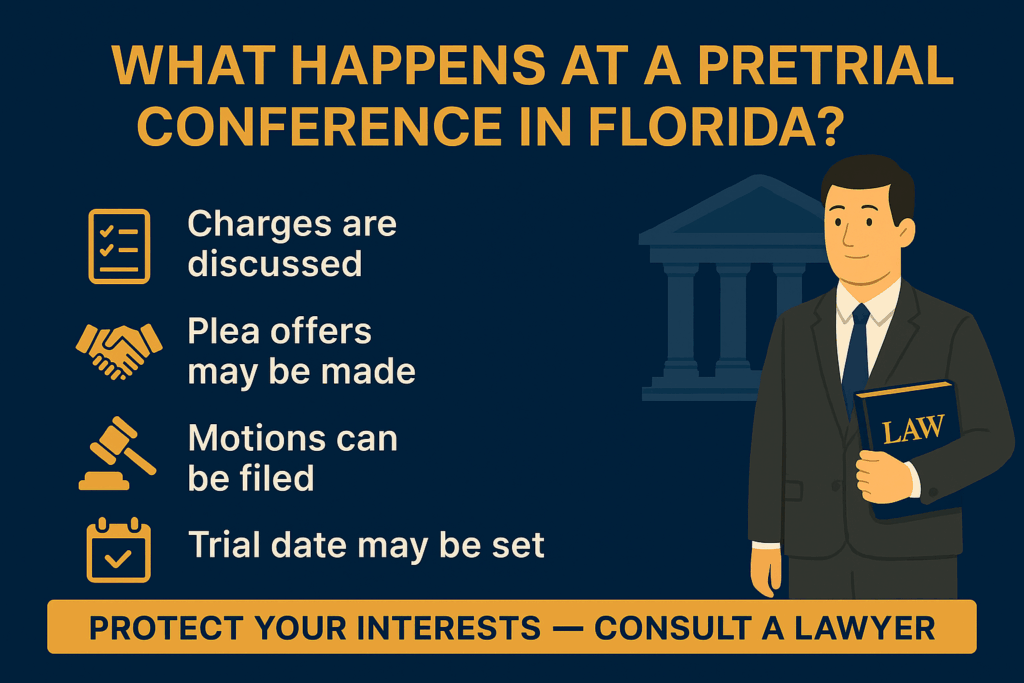
A pretrial conference is one of the most important — and most misunderstood — court dates in a Florida criminal case. It is not a trial, and it’s usually not a hearing where evidence is presented.
A pretrial conference is one of several formal court stages in a Florida criminal case. For a broader overview of how cases move from arraignment to trial, see our Court Stages in Florida Criminal Cases Guide.
Instead, the pretrial conference is where the judge checks the status of the case, ensures both sides are prepared, and pushes the case toward resolution or trial.
In Broward County, pretrial conferences are where many cases are quietly resolved — or strategically positioned for dismissal.
Here’s what actually happens.
🧭 What Is a Pretrial Conference?
Pretrial conferences occur after arraignment, once formal charges have been entered. Learn more about that stage in our guide to What Happens at a Criminal Arraignment in Florida.
At this stage, the court wants to know:
Has discovery been exchanged?
Are motions pending (or coming)?
Is the case being negotiated?
Is the defendant ready for trial?
Does the case need to be set for motion hearings or trial?
This phase closely overlaps with plea negotiations, motion practice, and trial preparation.
📝 What the Judge Typically Asks
At a pretrial conference, the judge may ask:
Is discovery complete?
Are there outstanding discovery violations?
Are any motions to suppress or motions to dismiss being filed?
Are the parties in plea negotiations?
Is the case trial-ready?
How much time is needed for trial?
The answers shape what happens next — including whether the case moves forward or resolves.
For a broader look at how these stages fit into the overall timeline of a case, see our Criminal Case Timeline in Fort Lauderdale Guide.
💬 What Happens Between the Lawyers
Most of the real work happens off the record, between defense counsel and the prosecutor.
This is where:
Plea offers are discussed or revised
Weaknesses in the State’s case are exposed
Suppression issues are previewed
Witness problems are raised
Victim availability (or non-cooperation) is addressed
Resolution strategies are finalized
⚠️ Can My Case Be Dismissed at Pretrial?
Sometimes — but not automatically.
A case may be dismissed at or shortly after pretrial when:
The State cannot proceed due to missing evidence
Discovery violations are fatal
A motion to dismiss is legally sufficient
The alleged victim does not appear or cooperate
Suppression issues gut the State’s case
More often, the pretrial conference is where the path to dismissal is set, not where dismissal happens on the spot.
🚫 What Pretrial Conference Is Not
A pretrial conference is not:
A trial
A witness hearing
A chance to argue facts
A place to testify
A sentencing hearing
Defendants typically do not speak. Your attorney handles everything.
🛡️ How We Use Pretrial Conferences Strategically
At Michael White, P.A., we use pretrial conferences to:
✔ Lock in Discovery Deadlines
Critical for later suppression or dismissal motions.
✔ Expose Weak Cases Early
Especially when evidence is thin or credibility is poor.
✔ Force the State’s Hand
Prosecutors must either move forward — or acknowledge problems.
✔ Preserve Trial Positioning
If the case must be tried, we ensure it’s set correctly and efficiently.
✔ Resolve Cases Quietly
Many cases resolve at or right after pretrial without drama.
🚨 Speak With a Fort Lauderdale Criminal Defense Lawyer Today
A pretrial conference can determine the future of your case — often without you realizing it.
If you have one coming up, make sure your case is positioned correctly before you walk into court.
Contact Michael White, P.A. today to protect your rights and your leverage.
❓ FAQs — Pretrial Conferences in Florida
1. Do I have to attend a pretrial conference?
Often no. Your attorney can usually appear on your behalf.
2. Can my case be resolved at pretrial?
Yes. Many cases are resolved through negotiations at or after pretrial.
3. Will the judge decide guilt at pretrial?
No. Pretrial conferences are procedural, not evidentiary.
4. What if discovery isn’t complete?
The judge may set deadlines or hearings to address violations.
5. Is this my last court date before trial?
Sometimes. If unresolved, the case may be set for trial next.