
Last updated April 2026
If you’ve been arrested for battery in Florida, one of the first questions is whether the charge is Felony Battery or Aggravated Battery.
Understanding the distinction can mean the difference between a five-year exposure and a fifteen-year exposure — or more if enhancements apply.
If you are facing either charge in Broward County or South Florida, early legal guidance is important.
While both are serious felony offenses, they are based on completely different legal theories — especially when the allegations involve serious injury or weapon use, which can trigger aggravated battery charges in Florida.
What Is Felony Battery in Florida?
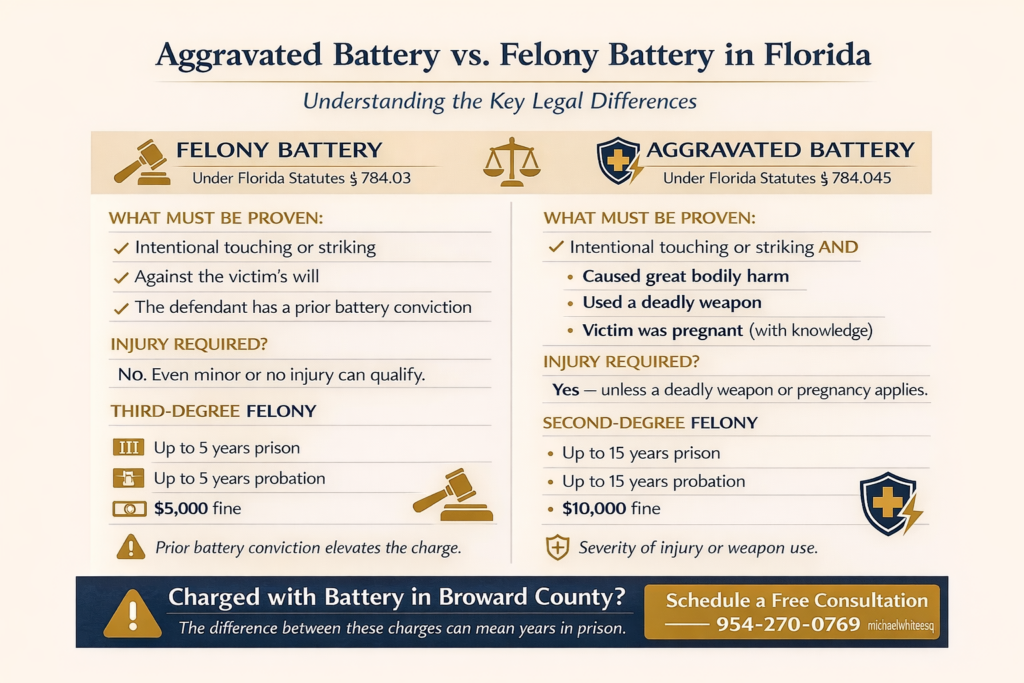
Felony Battery is defined under Florida Statute § 784.03(2).
To prove felony battery, the State must show:
The defendant intentionally touched or struck another person against their will; and
The defendant has a prior conviction for battery, aggravated battery, or felony battery.
Importantly, no serious injury is required.
Even minimal contact can qualify if there is a prior qualifying conviction.
Felony Level and Penalties
Felony Battery is a Third-Degree Felony, punishable by:
Up to 5 years in prison
Up to 5 years of probation
A $5,000 fine
The charge is elevated solely because of a prior conviction — not because of the level of harm in the current case.
The Core Legal Difference
The key distinction is this:
Felony Battery = Elevated because of a prior conviction.
Aggravated Battery = Elevated because of injury, weapon use, or pregnancy.
Felony battery is about criminal history.
Aggravated battery is about the seriousness of the current conduct.
In short, Aggravated Battery = Elevated because of injury, weapon use, or pregnancy — particularly when the State alleges great bodily harm.
Why Prosecutors Charge One Instead of the Other
In many cases, prosecutors file charges based on:
The level of injury documented in medical records
Whether a weapon was allegedly involved — and whether it legally qualifies as a deadly weapon
The defendant’s criminal history
Whether the victim falls into a protected category
Sometimes both charges are filed in the alternative.
Strategic defense analysis often focuses on:
Challenging whether the injury rises to “great bodily harm”
Contesting whether an object qualifies as a “deadly weapon”
Disputing intent
Examining self-defense or Stand Your Ground issues
These issues often turn on what the State can actually prove at trial. We break that down in our guide to What Prosecutors Must Prove to Convict Aggravated Battery in Florida.
Common Defense Strategies
Battery cases are highly fact-dependent. Potential defenses may include:
Self-defense
Stand Your Ground immunity
Lack of intent
Insufficient injury to qualify as aggravated battery
Misidentification
Mutual combat
Unlawful police conduct
Can Felony Battery Be Reduced?
Yes. In appropriate cases:
Felony Battery may be reduced to misdemeanor battery
Aggravated Battery may be reduced to simple battery
Charges may be amended based on medical evidence
Diversion programs may be available depending on history
Early intervention often makes a substantial difference.
We explain how these reductions occur in practice in our article on How Aggravated Battery Charges Can Be Reduced in Florida.
Which Charge Is Worse?
From a sentencing standpoint, Aggravated Battery is more serious because it is a second-degree felony.
However, felony battery can still have severe collateral consequences, including:
Loss of firearm rights
Immigration consequences
Professional licensing issues
Enhanced sentencing exposure in future cases
The long-term impact of either conviction is significant.
Charged with Battery in Broward County?
Battery cases often escalate quickly — especially when allegations of injury are involved.
As a former prosecutor, Attorney Michael White understands how these cases are evaluated internally and how injury classifications influence filing decisions.
If you are facing felony battery or aggravated battery charges in Fort Lauderdale or anywhere in South Florida, contact our office immediately.
The sooner a defense strategy is implemented, the better the outcome potential.
📞 954-270-0769
Schedule a Free Consultation
FAQs
What is the main difference between felony battery and aggravated battery in Florida?
Felony battery is elevated because of a prior battery conviction. Aggravated battery is elevated because of serious injury, weapon use, or pregnancy.
Is aggravated battery always a second-degree felony?
Yes. Under Florida law, aggravated battery is classified as a second-degree felony, punishable by up to 15 years in prison.
Does felony battery require serious injury?
No. Felony battery does not require serious injury. It becomes a felony based on the defendant’s prior battery conviction.