
Last updated March 2026
Understanding the Accuracy and Limitations of Vehicle “Black Box” Data in Fatal Crash Investigations
Modern vehicles often contain an Event Data Recorder (EDR) — commonly referred to as a vehicle “black box.” These systems capture technical information during the moments leading up to a crash and are frequently used by investigators in serious accident cases.
In Traffic Homicide Investigations, prosecutors often rely on black box data to reconstruct how a crash occurred. The data may include vehicle speed, braking activity, throttle input, and other mechanical information recorded in the seconds before impact.
Because this information appears highly technical and objective, it is sometimes treated as definitive proof of what happened.
But like any form of forensic evidence, black box data has limitations.
Understanding how Event Data Recorder Evidence works — and how it can be challenged — is critical in serious cases such as Vehicular Homicide in Florida, where crash reconstruction often becomes a central issue.
What Is an Event Data Recorder?
An Event Data Recorder (EDR) is a device installed in many modern vehicles that records certain vehicle data during specific triggering events, such as a collision or sudden deceleration.
These systems may capture:
• vehicle speed
• brake application
• throttle position
• steering input
• engine RPM
• seatbelt usage
• airbag deployment timing
Investigators typically retrieve this information using specialized Crash Data Retrieval tools.
In fatal crash cases, the information collected from the vehicle’s data recorder is often analyzed alongside physical crash evidence and reconstruction modeling.
These issues can become even more complex in high-speed scenarios, such as street racing fatalities, where multiple vehicles and driver decisions may influence how investigators interpret black box data.
How Black Box Data Is Used in Crash Investigations
Law enforcement agencies conducting Traffic Homicide Investigations frequently rely on EDR data to support accident reconstruction.
Investigators may use the data to estimate:
• the vehicle’s speed prior to impact
• whether braking occurred
• driver inputs before the crash
• the sequence of events during the collision
This information is often combined with Crash Reconstruction analysis that includes skid marks, debris patterns, vehicle damage, and scene measurements.
However, the conclusions investigators draw from EDR data depend heavily on interpretation.
Limitations of Event Data Recorder Evidence
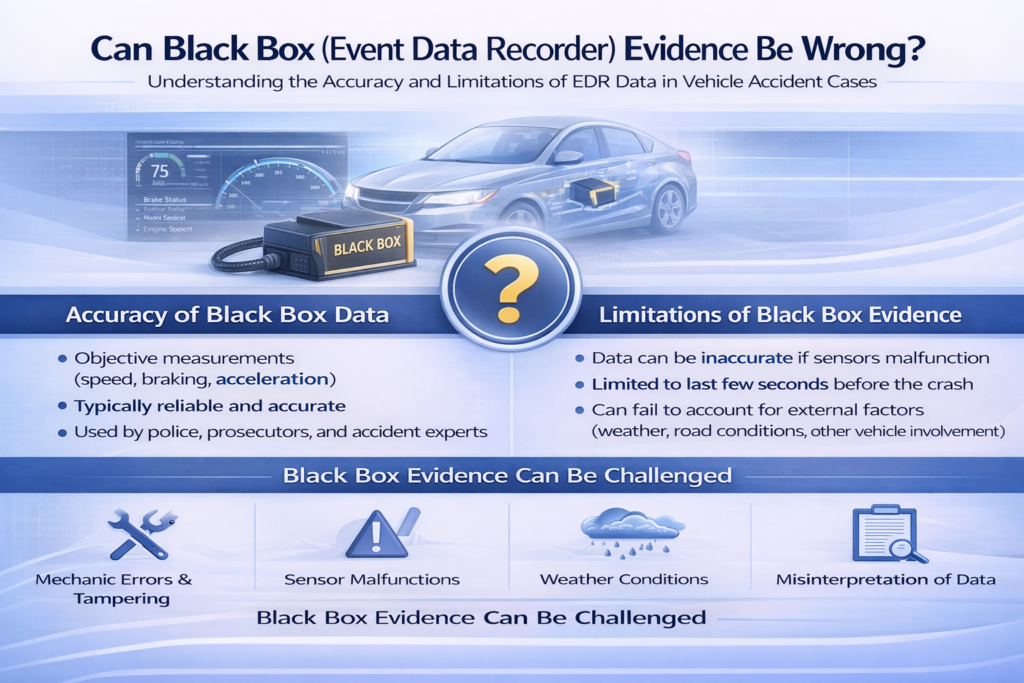
Despite its technical appearance, black box data is not a complete record of everything that occurred during a crash.
Several important limitations exist.
Limited Time Window
Most Event Data Recorders capture only the final few seconds before impact.
Events that occurred earlier — such as evasive maneuvers, other vehicles entering the roadway, or environmental hazards — may not appear in the data.
This limited time window can create an incomplete picture of the crash.
Sensor Accuracy and Calibration
EDR data relies on the vehicle’s internal sensors.
If sensors malfunction or produce inaccurate readings, the data recorded may also be inaccurate.
In some cases, sensor limitations can affect measurements related to:
• speed calculations
• braking detection
• steering inputs
Investigators must therefore verify that the vehicle’s systems were functioning properly before relying on the data.
These concerns are especially relevant in cases involving commercial vehicles, where different data systems and maintenance issues may affect the reliability of recorded information.
Interpretation Errors
Even when the data itself is accurate, misinterpretation can occur.
Crash investigators must analyze the data within the context of the entire crash scene.
Without proper interpretation, the data may be misunderstood or overstated.
For example:
• speed recorded may reflect wheel rotation rather than true vehicle speed
• braking data may not reflect road conditions
• driver inputs may be misinterpreted without context
These issues frequently arise in cases involving accident reconstruction errors in vehicular homicide cases.
Failure to Account for External Factors
Black box data records mechanical inputs within the vehicle, but it does not record external conditions.
Important factors that may not appear in EDR data include:
• road hazards
• weather conditions
• the actions of other drivers
• sudden pedestrian movement
• vehicle defects
When investigators rely too heavily on black box data without accounting for these variables, their conclusions about what caused the crash may be incomplete.
Black Box Evidence and Causation Disputes
In vehicular homicide cases, the key legal question is often causation.
Prosecutors must prove that a driver’s reckless operation of the vehicle caused the death.
However, EDR data alone rarely establishes causation.
A vehicle’s speed or braking activity does not automatically explain why the crash occurred.
Questions that often arise include:
• Did another driver initiate the crash?
• Were road conditions responsible?
• Did mechanical failure contribute?
• Would the collision have occurred regardless of the defendant’s actions?
These issues are explored further in our discussion of Challenging Causation in Vehicular Homicide cases.
When Black Box Data Becomes Critical Evidence
Although EDR evidence has limitations, it can still play an important role in serious crash cases.
Black box data may help investigators determine:
• the sequence of events leading to impact
• whether a driver attempted to brake
• whether evasive action occurred
• approximate vehicle dynamics during the crash
But this information must be evaluated carefully and alongside all other evidence.
A single data point from a vehicle recorder rarely provides a complete explanation of the crash.
Why Early Evidence Review Matters
In serious crash cases, investigators often retrieve black box data early in the investigation.
Once this information becomes part of the official crash reconstruction report, it may significantly influence how prosecutors evaluate the case.
For that reason, early independent analysis of:
• Event Data Recorder Evidence
• Crash Data Retrieval reports
• Crash Reconstruction conclusions
can be critical.
Errors or incomplete interpretations identified early may significantly affect how a case develops.
In many cases, the interpretation of this type of evidence plays a key role in determining when a fatal crash transitions into a criminal investigation.
Speak With a Florida Vehicular Homicide Defense Attorney
When a fatal crash leads to a criminal investigation, forensic evidence such as black box data can play a major role in determining how the case is charged.
However, that evidence must be carefully evaluated and interpreted within the broader context of the crash.
If you are under investigation or facing charges related to a fatal crash in Broward County courts or elsewhere in South Florida, early legal representation can help ensure that the evidence — including vehicle data — is properly examined.
Request a confidential consultation to discuss your situation.
FAQs
What is an event data recorder in a vehicle?
An event data recorder (EDR), often called a vehicle black box, is a device that records technical vehicle data during certain events such as a crash. The system may capture information about speed, braking activity, throttle position, and seatbelt use during the seconds leading up to impact.
Is black box crash data always accurate?
Black box data is often reliable but not perfect. The information recorded depends on the accuracy of the vehicle’s sensors and the correct interpretation of the data by investigators.
Can black box evidence be challenged in court?
Yes. Event data recorder evidence can be challenged if sensors malfunctioned, if the data was misinterpreted, or if investigators failed to consider other important factors such as road conditions or the actions of other drivers.
Does black box data prove who caused a crash?
Not necessarily. Black box data may show vehicle speed or braking activity, but it does not automatically establish causation. Investigators must still analyze all evidence to determine why the crash occurred.