
Last updated April 2026
Aggravated battery on a pregnant woman in Florida is a serious felony charge that can arise even when no weapon is alleged and injuries appear minor.
What makes these cases different is not just the alleged conduct—but the status of the alleged victim and what the State must prove about the defendant’s knowledge.
For a broader overview of how aggravated battery cases are charged and defended, see our guide to Aggravated Battery Charges in Florida.
⚖️ What Is Aggravated Battery on a Pregnant Woman?
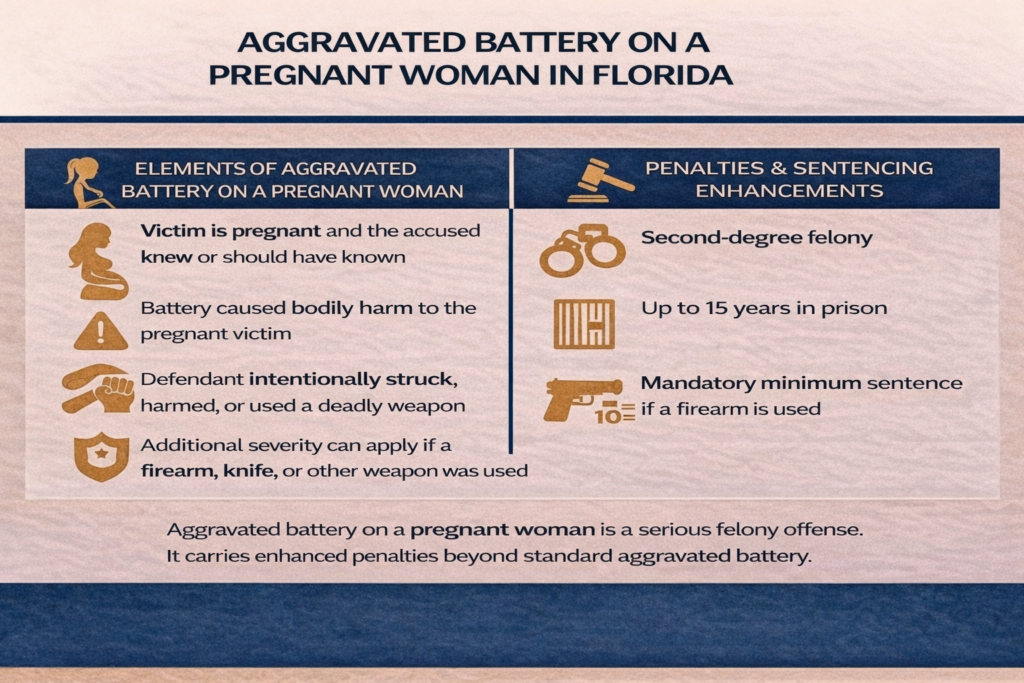
Under Florida law, battery becomes aggravated when:
• The alleged victim is pregnant
• The defendant knew or should have known of the pregnancy
• An intentional touching or striking occurred
Unlike other aggravated battery theories, this charge does not require great bodily harm or a deadly weapon.
That distinction is critical.
🔍 What Prosecutors Must Prove
To sustain this charge, the State must prove:
• Intentional contact or striking
• Against the alleged victim’s will
• The victim was pregnant
• The defendant knew or should have known of the pregnancy
We break this down in detail in our guide to What Prosecutors Must Prove to Convict Aggravated Battery in Florida.
The knowledge element often becomes the central issue in these cases.
🧠 The Knowledge Requirement (Key Issue)
The State must prove that the accused:
• Actually knew the alleged victim was pregnant, or
• Should have known based on the circumstances
This may involve:
• Statements made before the incident
• The visibility of the pregnancy
• Prior relationship between the parties
• Witness testimony
If knowledge cannot be proven, the aggravated charge may fail.
🔨 How This Differs From Other Aggravated Battery Cases
Most aggravated battery charges rely on:
• serious injury, or
• use of a deadly weapon
But pregnancy-based aggravated battery is different.
The State does not need to prove severe injury.
We explain how injury-based cases are evaluated in our guide to Great Bodily Harm in Florida Aggravated Battery Cases.
⚖️ Related Aggravated Battery Charges
Florida law includes several enhanced battery charges based on the status of the alleged victim.
These include:
• law enforcement officers
• firefighters and emergency personnel
• other protected individuals under Florida law
See Our Guide to Aggravated Battery on a Law Enforcement Officer in Florida for a breakdown of how those cases differ.
While these charges share similarities, each has distinct legal elements.
🛡️ Common Defense Strategies
These cases often turn on details the State cannot fully establish.
Common defenses include:
✔ Lack of Knowledge of Pregnancy
✔ No Intentional Contact
✔ Self-Defense or Defense of Others
✔ Credibility Issues or Conflicting Statements
✔ Exaggerated or Mischaracterized Events
These cases frequently arise in emotionally charged situations, where the evidence may be inconsistent or incomplete.
🔍 Credibility and Evidence Issues
In many cases, the outcome depends on:
• witness credibility
• inconsistent statements
• lack of corroborating evidence
• absence of physical injury
Even though injury is not required, the overall strength of the evidence still matters.
📉 Can These Charges Be Reduced?
Yes. Reductions are common when:
• knowledge of pregnancy is unclear
• evidence is inconsistent
• intent is disputed
• the alleged facts are overstated
See Our Guide to How Aggravated Battery Charges Can Be Reduced in Florida for a breakdown of how these cases are resolved.
📍 Facing Charges in Broward County or South Florida?
Aggravated battery on a pregnant woman is a serious allegation—but it is not automatic.
These cases often hinge on:
• what the defendant knew
• what actually occurred
• whether the State can prove each required element
Early defense analysis can make a significant difference.
📞 Call (954) 270-0769 or request a confidential consultation.
❓ FAQs
Does aggravated battery on a pregnant woman require injury?
No. The charge is based on pregnancy and knowledge—not the severity of injury.
What if I didn’t know the person was pregnant?
Lack of knowledge is a key defense and may defeat the aggravated charge.
Can this charge be reduced?
Yes. Many cases are reduced when knowledge, intent, or evidence is disputed.
Is this a felony in Florida?
Yes. It is typically charged as a second-degree felony.