
Last updated April 2026
Not every police encounter involves resisting or obstruction.
In many situations, people are arrested for public order offenses — charges based on behavior that police claim disrupts the peace, creates alarm, or raises suspicion.
These charges often arise quickly and are frequently misunderstood. What may seem like minor conduct — standing in the wrong place, being intoxicated in public, or arguing with someone — can lead to arrest.
But not every uncomfortable or unusual situation is a crime.
The key issue in most of these cases is whether the conduct actually meets Florida’s legal definition of a public order offense.
For a broader overview of how police interactions can lead to criminal charges, see our guide to Resisting & Obstruction Charges in Florida.
⚖️ What Are Public Order Offenses?
Public order offenses are charges based on behavior that allegedly disturbs the peace, creates public alarm, or raises concern for safety.
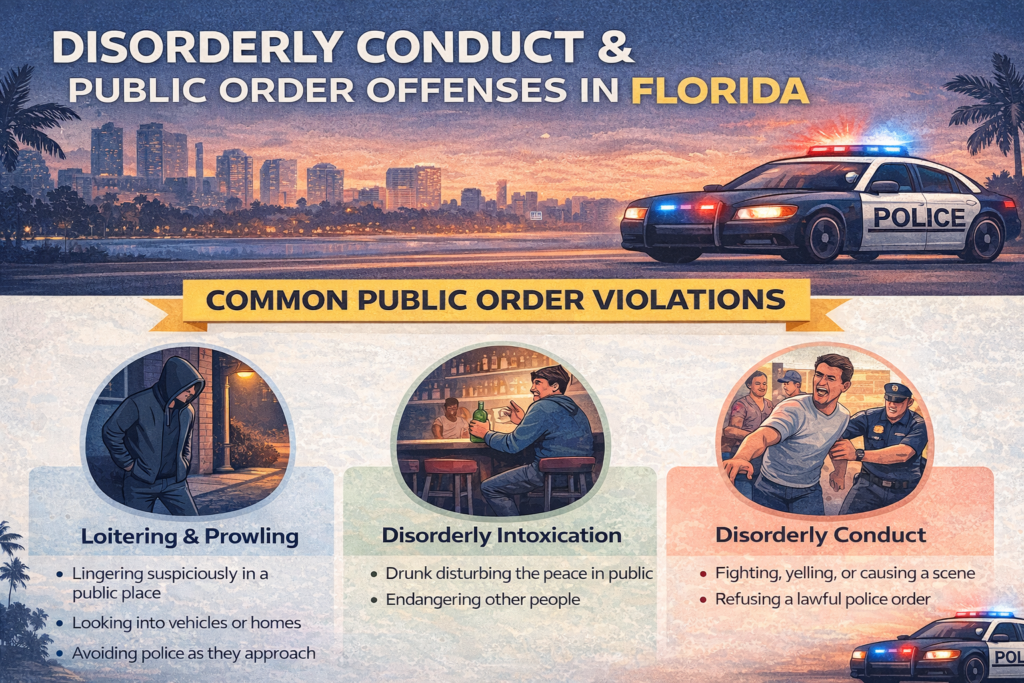
In Florida, the most common include:
- disorderly conduct
- disorderly intoxication
- loitering and prowling
These charges often depend heavily on police interpretation of behavior — not just clear criminal acts.
🔍 Common Public Order Charges in Florida
🔹 Disorderly Conduct
Involves behavior that disrupts public peace, such as fighting, excessive noise, or causing a disturbance.
👉 See Disorderly Conduct in Florida.
🔹 Disorderly Intoxication
Applies when someone is allegedly intoxicated in public in a way that endangers others or disrupts the peace.
👉 See Disorderly Intoxication in Florida.
🔹 Loitering and Prowling
Focuses on suspicious behavior that causes concern for safety — often before any actual crime occurs.
👉 See Loitering and Prowling in Florida.
⚠️ When Behavior Becomes a Crime
Not every unusual, loud, or uncomfortable situation is illegal.
In many cases, the key issue is whether the behavior actually created a legal basis for police action.
Situations that often fall into a gray area include:
- standing or lingering in a public place
- being intoxicated without causing harm
- arguing or raising your voice
- behavior that appears suspicious but is not illegal
In these scenarios, what police interpret as disorderly conduct or suspicious behavior may not meet the legal standard required for a conviction.
🧠 The Role of Police Discretion
Public order charges often depend on how an officer interprets a situation in real time.
Unlike many other offenses, these cases are frequently based on:
- subjective observations
- perceived threats or alarm
- rapidly evolving situations
- incomplete information
Because of this, similar behavior can lead to very different outcomes depending on how the situation is perceived.
🚨 How These Cases Escalate
Many public order arrests begin as routine encounters:
- a call for service
- a noise complaint
- a welfare check
- a street encounter
What starts as a simple interaction can escalate into an arrest if officers believe the situation is becoming disruptive or unsafe.
These cases sometimes overlap with resisting or obstruction charges when encounters escalate further.
🛡️ Defenses to Public Order Charges
These charges are often highly defensible.
Common defenses include:
- the conduct did not meet the legal definition of the offense
- no actual disturbance or threat occurred
- the officer misinterpreted the situation
- lack of evidence beyond subjective observations
- constitutional issues involving free speech or lawful presence
Because these cases rely heavily on interpretation, small details can significantly affect the outcome.
⚖️ Potential Penalties
Most public order offenses are charged as:
- Second-degree misdemeanors
- Up to 60 days in jail
- Up to 6 months probation
- Up to $500 fine
However, these charges can still carry long-term consequences.
⚖️ Related Public Order Offenses
📍 Why These Cases Are Often Challenged
Public order charges are rarely straightforward.
They often depend on:
- interpretation of behavior
- whether the conduct actually caused disruption
- whether police had legal grounds to act
- whether the situation escalated unnecessarily
Because of this, many cases are successfully challenged or reduced.
📞 Facing Disorderly Conduct or Related Charges?
If you were arrested for a public order offense in Florida, the facts — and how they are interpreted — matter.
Many of these cases are more defensible than they first appear.
❓ Frequently Asked Questions
Is disorderly conduct always a crime in Florida?
No. The behavior must meet specific legal standards — not just be annoying or unusual.
Can you be arrested just for being drunk in public?
Not necessarily. Disorderly intoxication requires more than just intoxication — there must be danger or disruption.
What is loitering and prowling?
It involves behavior that creates a reasonable concern for safety, not just being present in a location.
Are these charges serious?
They are misdemeanors, but can still have lasting consequences and should be taken seriously.