
Last updated April 2026
Not all evidence can be used in a criminal case — especially when it was obtained illegally.
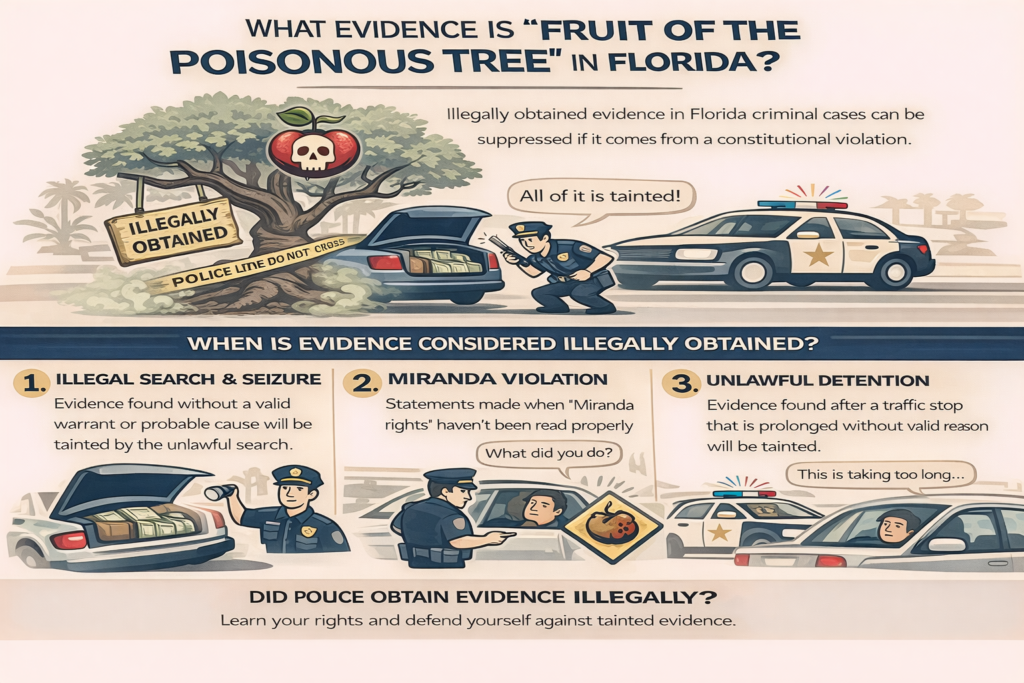
Under what’s known as the “fruit of the poisonous tree” doctrine, evidence that comes from a constitutional violation may be excluded from court entirely. In many cases, that means the strongest parts of the prosecution’s case can disappear.
This doctrine is a critical part of suppression strategy. For a broader look at how courts exclude unlawful evidence, see our guide to motion to suppress in Florida.
⚖️ What Does “Fruit of the Poisonous Tree” Mean?
The concept is simple:
- The “tree” = the original illegal police conduct
- The “fruit” = any evidence discovered because of that illegality
If the tree is poisoned, the fruit may be thrown out.
This rule is designed to prevent law enforcement from benefiting from unconstitutional actions — including illegal searches, unlawful detentions, and improper interrogations.
🚨 Common Examples of “Poisoned” Evidence
1. Illegal Search → Physical Evidence
If police conduct an unlawful search of your car, home, or belongings and find evidence:
- drugs
- weapons
- cash
- digital devices
That evidence may be suppressed.
For example, evidence found during an illegal search and seizure in Florida may not be admissible in court.
2. Unlawful Traffic Stop → Everything That Follows
If a traffic stop itself was illegal, anything discovered afterward may be tainted:
- field sobriety observations
- statements
- contraband
- arrests
Learn how these issues arise in our guide to illegal traffic stops in Florida.
3. Illegal Detention → Statements and Evidence
When police detain someone without reasonable suspicion or probable cause, any evidence obtained during that detention may be excluded.
This often comes up when a stop is prolonged without justification or escalates without legal grounds.
4. Miranda Violations → Statements (and More)
Miranda violations do not just affect whether a statement itself is admissible — they can also impact whether other evidence discovered as a result of that statement may be used.
For example:
- A suspect makes statements during custodial interrogation without proper warnings
- Those statements lead police to physical evidence or additional witnesses
- The defense may argue that both the statement and the derived evidence are “tainted”
Courts analyze whether the later evidence was obtained because of the constitutional violation or through an independent, lawful source.
In many cases, the key issue is whether the statement was:
- obtained during custodial interrogation
- preceded by a valid waiver of rights
- voluntary under the circumstances
If the waiver was invalid, the statement — and potentially the evidence derived from it — may be subject to suppression.
Whether a waiver is legally valid depends on whether it was knowing, voluntary, and intelligent, as explained in our guide to invalid Miranda waivers in Florida.
Similarly, statements made before Miranda warnings are given may still be admissible in some situations, depending on whether an exception applies. We break that down in statements made before Miranda in Florida.
For more, see Miranda rights in Florida.
🔗 How Far Does the “Poison” Spread?
This is where cases are won or lost.
Courts look at whether the evidence was:
- directly obtained from the illegal conduct
- discovered as a result of it
- closely connected to the violation
The stronger the connection, the more likely the evidence will be suppressed.
But the connection is not always obvious — and prosecutors often argue that the link is too weak.
⚠️ When “Poisoned” Evidence May Still Be Used
Not all illegally obtained evidence is automatically excluded.
There are important exceptions — including:
- independent source (evidence found through a separate legal path)
- inevitable discovery (evidence would have been found anyway)
- attenuation (the connection between the illegality and the evidence is too remote)
We break these down in detail in our guide to when illegal evidence can still be used in Florida.
🧠 Why This Doctrine Matters in Real Cases
In many Florida cases, the key issue isn’t whether something was found — it’s how it was found.
Even strong evidence can be excluded if:
- the stop was unlawful
- the search lacked probable cause
- the detention was extended improperly
- constitutional rights were violated
This is why suppression issues are often the turning point in a case.
🛑 How a Motion to Suppress Uses This Doctrine
The “fruit of the poisonous tree” doctrine is typically raised through a motion to suppress.
A defense attorney may argue that:
- the initial police conduct was illegal
- all resulting evidence is tainted
- the court should exclude that evidence
If successful, the prosecution may be left without enough evidence to proceed.
⚖️ Was Evidence in Your Case Obtained Illegally?
If your case involves:
- a questionable traffic stop
- a warrantless search
- prolonged detention
- police questioning issues
you may have grounds to challenge the evidence against you.
Understanding whether evidence is “poisoned” can be the difference between conviction and dismissal.
❓ Frequently Asked Questions
What is the “fruit of the poisonous tree” doctrine in Florida?
It is a legal rule that excludes evidence obtained as a result of unconstitutional police conduct, including illegal searches, detentions, or interrogations.
Does all illegally obtained evidence get thrown out?
Not always. Courts may allow evidence under exceptions like independent source, inevitable discovery, or attenuation.
Can statements be considered “fruit of the poisonous tree”?
Yes. If statements are obtained after an illegal stop or detention, they may be suppressed along with any evidence derived from them.
What happens if key evidence is suppressed?
In many cases, the prosecution may not have enough evidence to continue, which can lead to reduced charges or dismissal.