
Last updated March 2026
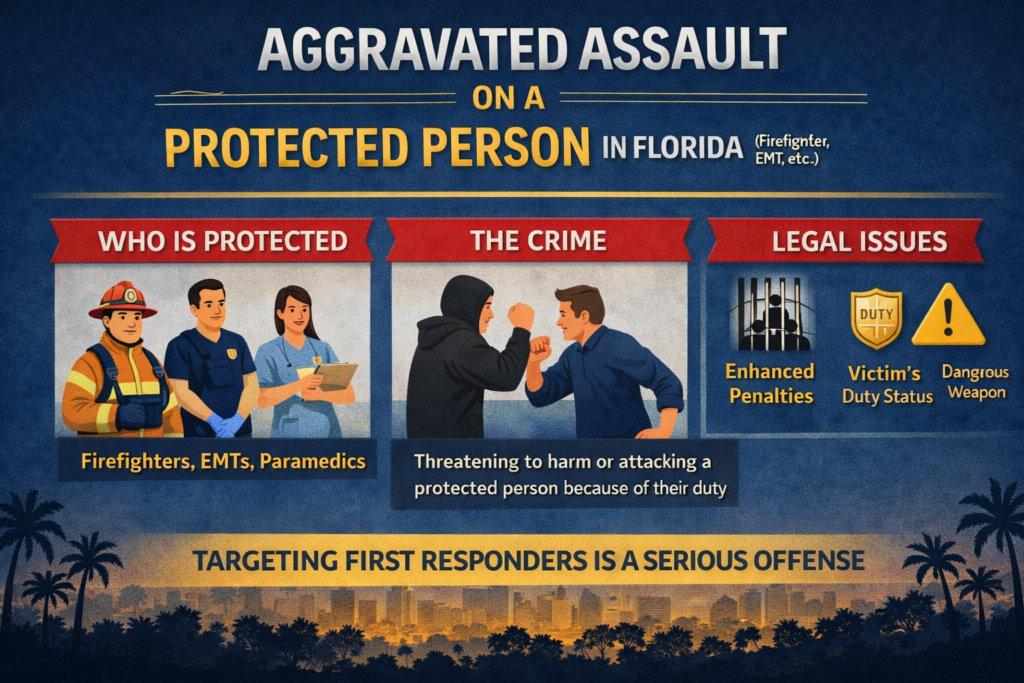
In Florida, aggravated assault charges can become more serious when the alleged victim is a protected person such as a firefighter, EMT, paramedic, or other specified public safety worker.
These cases are prosecuted aggressively because they involve people performing essential public duties. What might otherwise be charged as standard aggravated assault can be enhanced based on who the alleged victim was and what they were doing at the time.
For a full overview of how aggravated assault charges are defined and prosecuted, see Aggravated Assault Charges in Florida.
⚖️ Who Counts as a Protected Person?
Florida law provides enhanced treatment for aggravated assault cases involving certain categories of victims, including public safety and emergency personnel.
Depending on the statute and facts, protected persons may include:
Firefighters
Emergency medical technicians
Paramedics
Other specified first responders or public safety personnel
In general, the State must prove not only the aggravated assault itself, but also that the alleged victim falls within a protected category and was engaged in the lawful performance of their duties.
🚨 Why the Charge Is More Serious
When the alleged victim is a protected person, the case may be enhanced beyond standard aggravated assault exposure.
That means the defendant may face:
Higher felony exposure
More aggressive charging decisions
Reduced flexibility in negotiations
Greater prosecutorial emphasis on public safety
If a firearm is involved, the case may become even more serious. For a deeper discussion of firearm-specific exposure and sentencing risk, see Aggravated Assault with a Firearm in Florida: What You Need to Know.
🔍 What Prosecutors Must Prove
To convict on an aggravated assault charge involving a protected person, prosecutors generally must prove:
An intentional and unlawful threat
Apparent ability to carry out the threat
A well-founded fear of imminent violence
Use of a deadly weapon or intent to commit a felony
The alleged victim was a protected person
The protected person was engaged in lawful duties
The defendant knew or should have known the person’s status
These added elements make the case more complex — and often create more opportunities for defense.
The issue of whether the accused appeared able to carry out the threat is often central to the case and is explained further in What Is “Apparent Ability” in Florida Aggravated Assault Cases.
🚑 Common Situations That Lead to Charges
These allegations often arise during:
Emergency medical responses
Fire rescue calls
Hospital or ambulance-related encounters
Crowd-control or chaotic public situations
High-stress scenes where multiple responders are present
Because these events are often fast-moving and emotionally charged, police may rely heavily on the first version of events reported by responders or witnesses.
That does not always mean the case is legally strong.
🧠 Knowledge of Protected Status Matters
The State must usually prove that the accused knew or reasonably should have known the alleged victim was a protected person.
That can become a real issue when:
The encounter was chaotic
The scene was crowded
The responder was not clearly identified
The defendant was confused, injured, intoxicated, or overwhelmed
Multiple people were shouting commands at once
If the evidence is weak on this point, the enhancement may be vulnerable to challenge.
🛡️ Defenses to Aggravated Assault on a Protected Person
These cases are serious, but they are still defensible.
Common defense strategies include:
No True Threat
The conduct did not amount to an intentional and unlawful threat.
No Apparent Ability
The accused did not have the ability to carry out the alleged threat in an immediate way.
Protected Status Not Proven
The State cannot prove the alleged victim fell within the protected category or was clearly identifiable as such.
Not Engaged in Lawful Duties
The enhancement may not apply if the protected person was not acting within the lawful scope of their responsibilities.
Self-Defense
In limited circumstances, defensive conduct may still be legally relevant depending on the facts.
These principles are discussed more fully in How Self-Defense Defeats Aggravated Assault Charges in Florida.
⚖️ Can These Charges Be Reduced or Dropped?
Yes.
Even though these cases are prosecuted seriously, they can still be reduced or dismissed when the State cannot prove the added enhancement elements.
That may happen if:
The accused did not know the alleged victim’s status
The threat was legally insufficient
Apparent ability is weak
The evidence is inconsistent
Self-defense or justification issues exist
A closer look at early dismissal is covered in Can Aggravated Assault Be Dropped Before Trial in Florida.
🔄 How These Cases Sometimes Get Reduced
In some cases, the defense can negotiate a reduction from the enhanced form of aggravated assault to:
Standard aggravated assault
A lesser offense
A non-enhanced resolution
A broader discussion of how these outcomes occur appears in How Aggravated Assault Charges Get Reduced in Florida.
📍 Why These Cases Require Early Defense Work
Protected-person cases often start from a position of strong prosecutorial sympathy. That makes early defense intervention especially important.
Early legal work may include:
Securing bodycam or scene video
Identifying witnesses
Clarifying who said what and when
Challenging whether the defendant knew the person’s status
Attacking the enhancement before the case hardens
Because early narratives often shape the prosecution’s posture, timing matters.
📞 Charged With Aggravated Assault on a Firefighter, EMT, or Protected Person in Florida?
These are serious felony allegations, but the enhancement is not automatic.
At Michael White, P.A., we bring former prosecutor insight to every aggravated assault case. We understand how these charges are built, where the enhancement issues arise, and how to challenge them effectively.
If you are facing aggravated assault charges in Fort Lauderdale or anywhere in South Florida, call (954) 270-0769 for a confidential consultation.
❓ FAQs
Who counts as a protected person in a Florida aggravated assault case?
Protected persons may include firefighters, EMTs, paramedics, and other specified public safety workers depending on the statute and circumstances.
Is aggravated assault on a protected person more serious than regular aggravated assault?
Yes. These cases may carry enhanced penalties and are often prosecuted more aggressively.
Do prosecutors have to prove I knew the person was a firefighter or EMT?
Usually yes. Knowledge or reasonable awareness of the person’s protected status is often an important element.
Can these charges be reduced or dismissed?
Yes. If the State cannot prove the enhancement, intent, apparent ability, or other required elements, the charge may be reduced or dismissed.
Does self-defense ever matter in these cases?
Sometimes. Depending on the facts, self-defense or justification issues may still be relevant.