
Last updated February 2026
After an arrest in Florida, one of the most urgent questions is whether you can be released from jail — and under what conditions.
Florida law strongly favors pretrial release in most cases. But bond amounts, supervision requirements, and release restrictions vary depending on the charge, criminal history, and specific facts alleged.
Understanding how bond works — and how it can be modified — is critical to protecting your freedom while your case is pending.
For an overview of the arrest and first appearance stage, see our Florida Arrests & First Appearance Process Guide.
⚖️ What Is Bond in Florida?
Bond is a court-ordered condition that allows a person charged with a crime to be released from jail while their case is pending.
It serves one primary purpose:
to ensure the accused returns to court while protecting public safety.
Bond is not a punishment.
It is not a fine.
And it is not an admission of guilt.
Instead, bond functions as a legal guarantee — either financial or conditional — that the accused will comply with court requirements.
Many people use the terms bail and bond interchangeably, but they are not identical.
Learn the difference in our guide to Bail vs. Bond in Florida.
🔎 What Does Posting Bond Actually Mean?
Posting bond may involve:
• Paying a percentage to a licensed bondsman
• Depositing the full bond amount with the jail
• Signing a recognizance agreement promising to return
• Agreeing to supervision or monitoring
Failure to comply with bond conditions can result in arrest and bond revocation.
If you’re trying to secure someone’s release quickly, here’s a step-by-step guide on How to Get Bailed Out in Florida.
⚖️ When Is Bond Addressed?
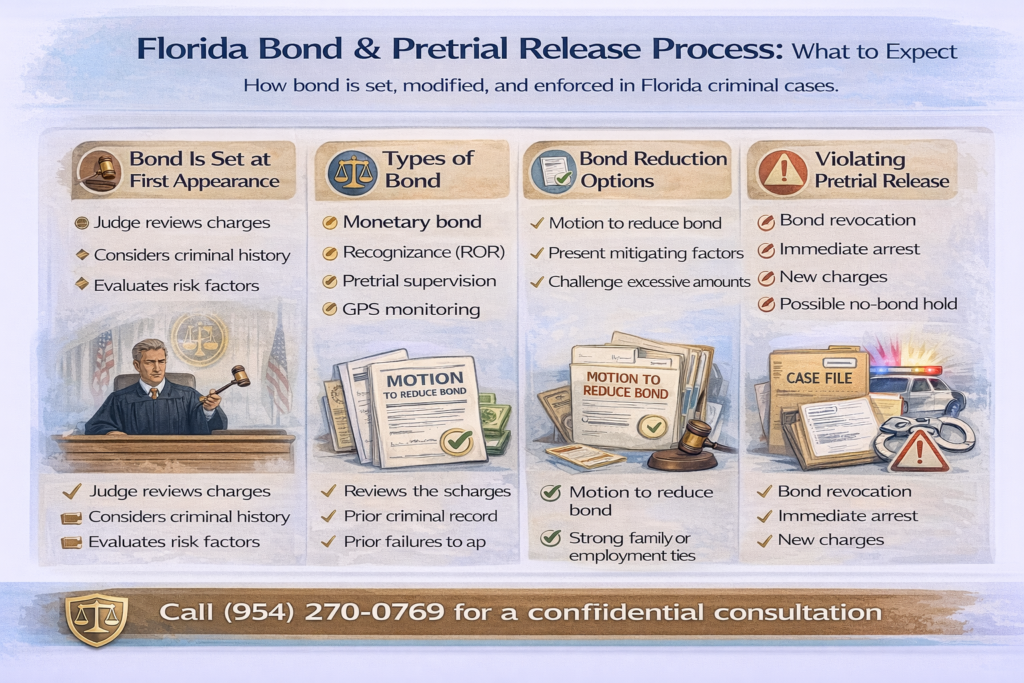
Bond is typically addressed at first appearance, which must occur within 24 hours of arrest.
At that hearing, the judge:
• Reviews the probable cause affidavit
• Confirms the charges
• Determines bond eligibility
• Sets monetary bond (if appropriate)
• Imposes release conditions
In some misdemeanor cases, bond is preset by a bond schedule. In more serious cases, the judge sets bond individually.
💰 Types of Pretrial Release in Florida
Florida courts may order several forms of release:
✔ Standard Monetary Bond
A set dollar amount posted through a bondsman or directly with the jail.
✔ Recognizance (ROR)
Release without paying money, based on your promise to return to court.
✔ Pretrial Supervision
Release monitored by a county pretrial services agency.
✔ Electronic Monitoring (GPS)
Often imposed in domestic violence, stalking, repeat DUI, or violent cases.
✔ Non-Monetary Conditions
May include:
• No-contact orders
• Travel restrictions
• Drug testing
• Firearm surrender
Bond is rarely “just paying money.” Conditions often matter more than the amount.
Bond procedures and supervision programs vary by county. For specifics on how bond and pretrial release work in Broward County, see our Broward Pretrial Release & Bond Guide.
🔎 What Happens at a Bond Hearing?
If bond is not preset or is contested, a bond hearing may occur.
At a bond hearing:
• The prosecution may argue for higher bond or conditions
• The defense may argue for reduced bond
• The judge considers flight risk and community safety
• The court may modify conditions
Bond hearings are strategic. Strong early advocacy can significantly affect the amount set and the conditions imposed.
For a detailed breakdown of what occurs during a Florida bond hearing — including how arguments are made and how judges evaluate risk — see our Florida Bond Hearing Process Guide.
🔁 Can Bond Be Reduced?
Yes.
If bond is set too high, your attorney may file a motion to reduce bond.
Courts may reconsider bond based on:
• Weaknesses in the State’s evidence
• Strong family or employment ties
• Medical conditions
• Excessive bond compared to similar cases
Bond decisions are not permanent.
🚫 When Bond Can Be Denied
Bond may be denied in limited cases involving capital or life-punishable offenses.
For a full explanation of detention without bond, see our guide to Jail Before Trial in Florida.
⚠️ What Happens If You Violate Pretrial Release?
Violating bond conditions can lead to:
• Bond revocation
• Immediate arrest
• Additional charges
• Being held without bond
Common violations include:
• Contacting a protected person
• Missing court
• Failing drug tests
• Leaving the jurisdiction
Strict compliance is essential.
Violating bond conditions can lead to bond revocation, new charges, or being held without bond. For a full explanation of common violations and their consequences, see our guide to Violating Pretrial Release in Florida.
🧭 Why Bond Strategy Matters
Bond impacts more than temporary freedom.
It affects:
• Employment
• Ability to support family
• Case preparation
• Negotiation leverage
• Overall case trajectory
Early bond advocacy can shape how the entire case unfolds.
📞 Speak With a Florida Criminal Defense Attorney
If you or a loved one is in jail or facing restrictive release conditions, immediate legal intervention can make a measurable difference.
Call (954) 270-0769 for a confidential consultation.