
Last updated March 2026
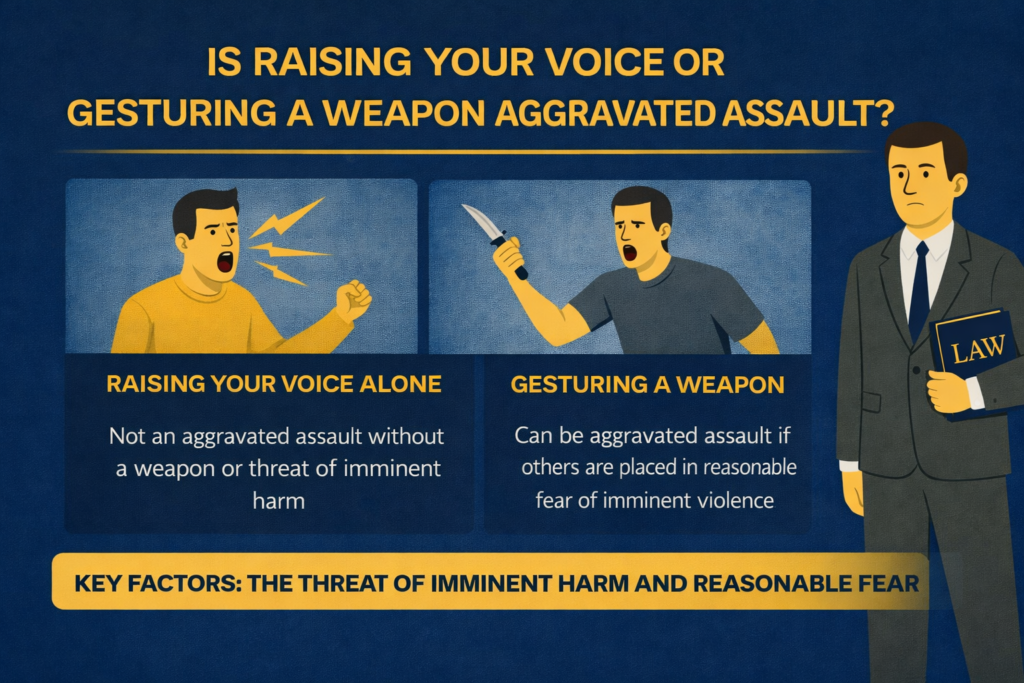
Arguments can escalate quickly. A raised voice, an aggressive gesture, or even picking up an object in the heat of the moment can lead to an arrest in Florida.
That often leads to a critical question:
Can yelling or gesturing alone turn into a felony aggravated assault charge?
In many cases, no — but it depends on the context.
Under Florida law, aggravated assault is based on threats, perception, and surrounding circumstances — not just physical contact. For a full overview of how these charges are defined and prosecuted, see Aggravated Assault Charges in Florida.
⚖️ When Behavior Crosses the Line Into Aggravated Assault
To prove aggravated assault, prosecutors must establish:
An intentional threat by word or act
Apparent ability to carry out the threat
A well-founded fear of imminent harm
Use of a deadly weapon or intent to commit a felony
This means the focus is not just on what you did — but how it was perceived.
A raised voice or gesture, by itself, is usually not enough. But when combined with other factors, it may be interpreted as a real and immediate threat.
🗣️ Is Raising Your Voice Enough?
Generally, no.
Yelling, arguing, or using harsh language does not automatically meet the legal standard for aggravated assault.
The law requires more than anger — it requires a credible threat of imminent violence.
Situations involving speech alone are often weak cases, especially where there is no movement, weapon, or immediate ability to act. These distinctions are explained further in Can Words Alone Be Aggravated Assault in Florida.
✋ What About Gesturing With an Object?
This is where cases become more complicated.
Gesturing with an object may lead to charges if:
The object appears capable of causing harm
It is used in a threatening manner
The alleged victim reasonably fears imminent violence
For example:
Raising a bottle, tool, or heavy object
Making a striking motion toward someone
Holding an object in a way that suggests it will be used
In these situations, the issue becomes whether the object was used — or appeared to be used — as a deadly weapon.
🔍 The Role of “Apparent Ability”
Even if a gesture looks aggressive, the State must still prove that the accused had the ability to carry out the threat.
If the conduct did not create a real and immediate danger, it may not qualify as assault at all.
This concept — known as “apparent ability” — is central to many cases and is explained in What Is “Apparent Ability” in Florida Aggravated Assault Cases.
🔫 When Gestures Involve a Firearm
Cases become more serious when a firearm is involved.
Even brief or unclear movements may be interpreted as threatening if a weapon is visible. However, context still matters — including whether the conduct was intentional and whether it created a reasonable fear of imminent harm.
These issues are analyzed more fully in Is Pointing a Gun Aggravated Assault in Florida.
🧠 Context and Perception Matter Most
Two identical actions can lead to completely different outcomes depending on the circumstances.
Courts consider:
Distance between the parties
Tone and escalation of the interaction
Whether the accused moved toward the other person
Whether the alleged victim had a reasonable basis for fear
Whether the conduct was defensive rather than aggressive
Because aggravated assault is a perception-driven offense, these details often determine whether a charge is legally supported.
🛡️ Defenses to Gesture-Based Allegations
Many of these cases are defensible.
Common defenses include:
No True Threat
The conduct was misinterpreted or exaggerated.
No Imminent Harm
There was no immediate danger.
No Deadly Weapon
The object did not legally qualify as a weapon.
Self-Defense
The conduct was a response to another person’s behavior.
Florida law allows the threatened use of force in certain situations. These principles are explained in How Self-Defense Defeats Aggravated Assault Charges in Florida.
⚖️ Can These Charges Be Dropped?
Yes.
Cases based on yelling or gestures are often reduced or dismissed because:
The threat is not legally sufficient
The evidence is inconsistent
The alleged fear was not reasonable
A closer look at how these cases are resolved early is explained in Can Aggravated Assault Be Dropped Before Trial in Florida.
📍 Why These Cases Are Often Defensible
Aggravated assault requires more than aggressive behavior.
Many cases involve:
Emotional reactions
Misinterpretation of gestures
Lack of clear evidence
Conflicting accounts
That makes early legal intervention critical.
📞 Accused of Threatening Behavior in Florida?
Not every argument or gesture is a crime.
If you are facing aggravated assault allegations based on yelling, gestures, or a brief confrontation, the full context matters.
At Michael White, P.A., we bring former prosecutor insight to every case. We understand how these cases are evaluated — and how to challenge them effectively.
Call (954) 270-0769 for a confidential consultation.
❓ FAQs
Can yelling alone be aggravated assault in Florida?
No. Yelling or arguing alone is usually not enough without a credible threat of imminent harm.
Can gesturing with an object lead to charges?
Yes. If the object is used in a threatening way and creates reasonable fear, it may support an aggravated assault charge.
Does the object have to be a weapon?
Not necessarily. It may qualify if it appears capable of causing serious harm.
What if the gesture was misunderstood?
Misinterpretation is a common issue and may support dismissal or reduction.
Can these cases be dropped?
Yes. Many are reduced or dismissed before trial depending on the evidence.