
Last updated March 2026
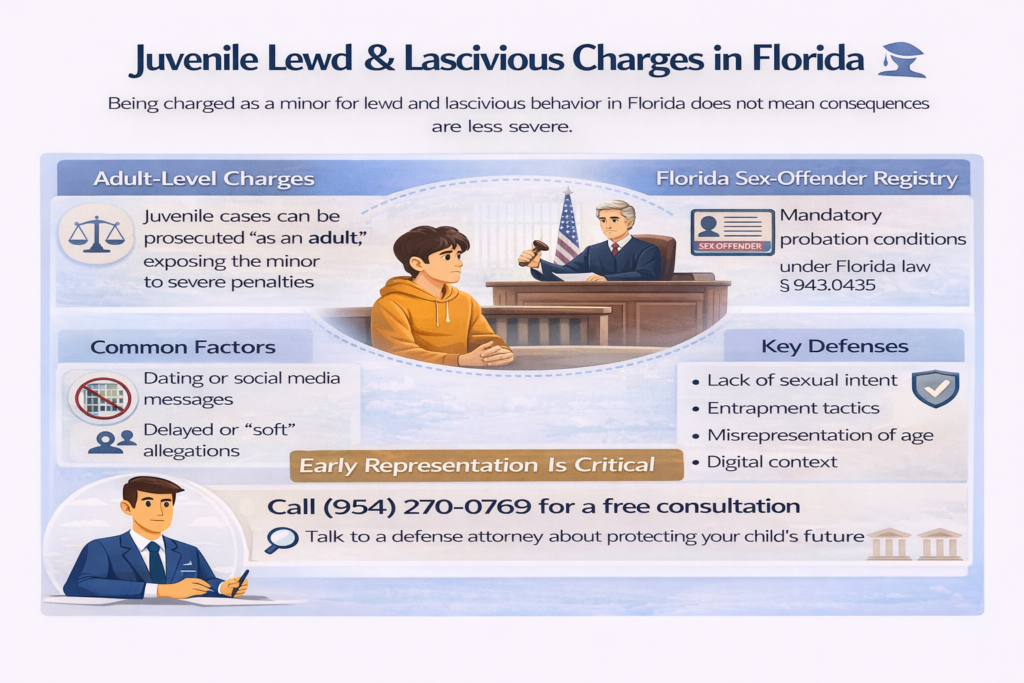
Juvenile lewd and lascivious allegations in Florida are handled differently than adult sex crime cases — but the consequences can still be life-changing.
These cases often involve:
School-based accusations
Teen relationships and “age gap” issues, which in some situations may fall under Florida’s Romeo and Juliet law
Digital evidence (texts, Snapchat, images)
Peer pressure and rumors
Misunderstood conduct that escalates into a felony allegation
Even when the accused is a minor, prosecutors can pursue serious felony charges under Florida law, and the case can affect school, family life, mental health, and future opportunities.
For a broader overview of Florida’s lewd and lascivious offenses and how they’re charged, see our guide to Lewd & Lascivious Offenses in Florida.
⚖️ What “Lewd & Lascivious” Means Under Florida Law
Florida’s “lewd and lascivious” offenses are generally charged under Fla. Stat. § 800.04. The statute includes several separate offenses, and the specific charge depends on:
The ages of the people involved
The alleged conduct
Whether the allegation involves contact, exposure, or sexual activity
Whether the State claims coercion or exploitation
Many juvenile cases are charged under broader statutes like lewd conduct, which can apply to messages, solicitation, or behavior without physical contact. See how those cases are handled in Lewd and Lascivious Conduct on a Minor in Florida.
🧠 Why Juvenile Cases Are Often More Complicated Than People Expect
Juvenile sex offense cases frequently have messy facts and high emotion.
Common drivers include:
Misinterpretation and escalation
A single message thread, joking conversation, or partial screenshot can be framed as criminal intent.
Peer influence and school involvement
Many cases start with a school report, a counselor referral, or a parent discovering messages.
Memory and interview issues
In juvenile and child-involved cases, the outcome can turn on how statements were taken, interpreted, and repeated.
Digital context problems
Selective screenshots rarely tell the full story. Timing, context, and missing threads matter.
🏫 Immediate Consequences: School and Family Impact
Even before court outcomes, juvenile lewd allegations can trigger:
School suspension or expulsion proceedings
“No contact” directives between students
DCF involvement in some circumstances
Restrictions on devices or social media
Family court or parenting disputes
The practical damage often begins before the first hearing.
🚨 Can a Juvenile Be Tried as an Adult?
In some cases, yes.
Whether a juvenile case stays in delinquency court or is transferred depends on factors like:
Age of the child accused
Alleged offense severity
Prior history
Prosecutorial discretion
Statutory eligibility for adult prosecution
This is a major strategic issue early — because adult prosecution can create far more severe long-term consequences.
📱 Digital Evidence Is Often the Center of the Case
Juvenile lewd allegations often involve:
Text messages
Social media DMs
Photos/videos
Group chats
Location data
Device searches
A major defense issue is whether the State has the complete record, or only fragments presented by a complainant, parent, or school.
In many cases, the defense strategy includes reconstructing:
Full conversation chains
Timelines
Metadata
Who initiated contact
Whether messages were altered or forwarded
🔍 Common Defense Themes in Juvenile Lewd Cases
Defense strategy depends on the charge, but often centers on:
Credibility and inconsistency
Conflicting statements, peer pressure, retaliation, or rumor dynamics.
Identity and account access
Was the account actually used by the accused? Shared devices? Friends sending messages?
Context and intent
A juvenile case may be prosecuted as criminal behavior when it’s better understood as immature conduct or miscommunication.
Interview and statement issues
Juveniles are vulnerable in interrogations. The way statements are obtained can become a major defense issue.
🧾 Long-Term Consequences: Record and Registry Issues
Parents often assume juvenile cases “disappear at 18.”
That is not always true.
Depending on the allegation and outcome, consequences may include:
A delinquency record that affects college, military, and employment opportunities
Court-ordered counseling or treatment programs
Probation with strict conditions
Restrictions on internet/device access
In some cases, sex offender-related consequences in Florida depending on the disposition and classification
The most important point: how the case is resolved can determine whether consequences are temporary or permanent.
🧭 Why Early Strategy Matters in Juvenile Sex Allegations
In juvenile lewd cases, the first decisions often drive the final outcome:
Whether the child gives a statement
Whether devices are searched
Whether evidence is preserved
How quickly defense counsel gets involved
Whether the case is diverted, reduced, or litigated
The best opportunities to protect a juvenile’s future often arise early — before the State’s narrative hardens.
📞 If Your Child Is Being Investigated
Juvenile lewd and lascivious allegations are serious. But they are also frequently defensible, especially when the facts are incomplete, the digital evidence is out of context, or the accusation dynamics are unstable.
If your child is under investigation or has been charged in Broward County or South Florida, early legal counsel can help protect their rights, their education, and their future.
✅ FAQs
1) Can a school start a juvenile lewd case even without police involvement?
Schools can initiate reporting that leads to law enforcement involvement. Many juvenile cases begin through school administrators, counselors, or mandatory reporting pathways.
2) Should a juvenile talk to police “just to clear it up”?
Usually no. Juveniles are vulnerable in questioning, and statements can be misunderstood or used out of context. It’s safer to involve counsel before any interview.
3) Do juvenile lewd cases always involve digital evidence?
Not always, but digital evidence is common. Even when the allegation is in-person, messages and social media often become central to the State’s theory.
4) Can a juvenile record affect college or future opportunities?
Yes. Even juvenile outcomes can affect admissions, scholarships, military eligibility, and certain career pathways depending on the charge and resolution.
5) Are juvenile lewd cases eligible for diversion or alternative resolutions?
Sometimes. Eligibility depends on the facts, prior history, and the specific charge. Early advocacy can be critical in positioning the case for a non-permanent outcome.