
Last updated March 2026
Lewd and lascivious conduct is one of the most frequently charged offenses under Florida Statute § 800.04.
It does not require penetration.
It does not require force.
It does not require violence.
But it is still a felony sex offense — and it can permanently change your life.
Many cases are built almost entirely on statements, interpretation of behavior, or digital communications. That makes early legal intervention critical.
If you are under investigation or have been arrested for lewd and lascivious conduct in Fort Lauderdale or anywhere in South Florida, understanding the exact legal elements matters.
For a broader breakdown of how these offenses are structured under Florida law, see our Lewd and Lascivious Offenses in Florida guide.
📜 What Is Lewd & Lascivious Conduct Under Florida Law?
Lewd and lascivious conduct is defined under § 800.04(6), Florida Statutes.
The offense generally involves one of two categories:
1️⃣ Intentionally touching a person under 16 years of age in a lewd or lascivious manner
OR
2️⃣ Soliciting a person under 16 years of age to commit a lewd or lascivious act
The alleged victim must be under 16.
The accused must be 18 or older.
Consent is not a defense.
🔎 What Makes “Conduct” Different From Other § 800.04 Offenses?
Florida law separates lewd and lascivious offenses into distinct categories:
Battery focuses on “sexual activity” (which can include penetration or union).
Molestation focuses on intentional touching of specific body parts (breasts, genitals, buttocks).
Exhibition focuses on exposure or performance in front of a minor.
Conduct is broader and often turns on behavior, intent, or solicitation.
Lewd conduct does not require:
Penetration
Touching of specific enumerated body parts
Physical injury
This broad language gives prosecutors significant discretion in charging.
🧠 The Two Ways Conduct Is Charged
1️⃣ Touching in a Lewd or Lascivious Manner
The State must prove:
The alleged victim was under 16
The accused intentionally touched the minor
The touching was “lewd or lascivious”
What does “lewd or lascivious” mean?
Florida courts interpret it as conduct that is indecent, sexual, or done with sexual intent — evaluated under the surrounding circumstances.
That means context matters:
Where did it occur?
What was said before or after?
Was the contact accidental or intentional?
Were there witnesses?
Is there digital evidence?
2️⃣ Solicitation to Commit a Lewd Act
Lewd conduct can also be charged when a person allegedly solicits a minor to engage in sexual behavior.
This often arises in:
Text messages
Social media conversations
Online gaming chats
Private messaging platforms
Importantly:
No physical contact is required.
A case can be filed entirely on alleged statements.
🚨 Why Lewd Conduct Is Frequently Overcharged
Because the statute is broad, lewd conduct is sometimes filed in cases involving:
Misinterpreted interactions
Exaggerated allegations
Custody disputes
Teen relationship conflicts
Poorly documented interviews
Many cases rely heavily on:
Child forensic interviews
Delayed reporting
Inconsistent statements
Digital message interpretation
There is often no physical evidence.
That makes credibility analysis central.
⚖️ Penalties for Lewd & Lascivious Conduct
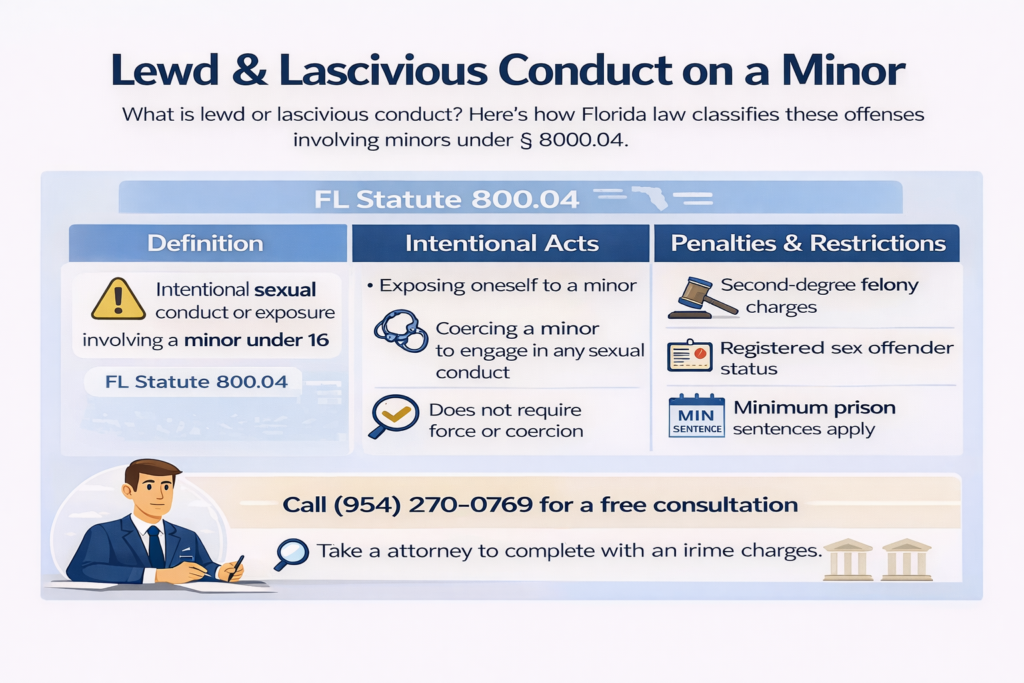
Lewd and lascivious conduct is typically a second-degree felony.
Penalties may include:
Up to 15 years in prison
Sex-offender registration in Florida, which can impose long-term restrictions on housing, employment, and reporting requirements
Mandatory counseling or treatment
Electronic monitoring
Permanent felony record
Sex-offender registration
Even if prison is avoided, the long-term collateral consequences can be severe.
🔍 How These Cases Are Investigated
In Broward County and throughout South Florida, investigations often involve:
School reporting procedures
Department of Children and Families (DCF) involvement
Child advocacy center interviews
Seizure of phones and devices
Forensic digital analysis
One statement — even before arrest — can determine whether charges are filed.
If law enforcement asks you to “come in and explain,” you are already in the charging evaluation stage.
🛡️ Common Defense Themes in Lewd Conduct Cases
Every case is unique, but recurring defense strategies include:
🔹 Lack of Sexual Intent
The State must prove the touching or communication was done with sexual intent — not accidental contact, innocent behavior, or misunderstood interaction.
Intent is often inferred — not proven directly.
🔹 Inconsistent Statements
Child interviews may evolve over time.
Defense review often focuses on:
Timeline inconsistencies
Coaching indicators
Leading questions
Memory contamination
🔹 Digital Context
Screenshots rarely tell the whole story.
Defense investigation may examine:
Full message threads
Deleted communications
Tone and context
Device ownership issues
🔹 Age Verification Issues
Age matters under § 800.04.
Mistakes, misrepresentations, or confusion about age can affect charging decisions and negotiation posture.
🚸 Is There a “Romeo & Juliet” Defense?
Florida provides limited relief in certain close-in-age situations under the Romeo and Juliet law in Florida, which may allow certain individuals to seek removal from sex offender registration requirements.
However:
It does not eliminate criminal liability
It does not automatically prevent sex-offender registration
It applies only under specific statutory criteria
This issue arises frequently in lewd conduct cases involving teenage relationships.
🚨 What To Do If You’re Under Investigation
If you are being investigated for lewd and lascivious conduct:
Do not give a statement.
Do not attempt to “clear things up.”
Do not contact the alleged minor.
Preserve any digital evidence.
Early intervention can influence:
Whether charges are filed
What statute is charged
Whether the case proceeds at all
📞 Fort Lauderdale Lewd Conduct Defense Attorney
At Michael White, P.A., we defend clients accused of lewd and lascivious conduct throughout Fort Lauderdale and South Florida.
These cases often hinge on credibility, context, and early strategy.
If you are facing investigation or charges, call (954) 270-0769 for a confidential consultation.
❓ Frequently Asked Questions
What is lewd and lascivious conduct in Florida?
Lewd and lascivious conduct under § 800.04(6) generally involves intentionally touching a minor under 16 in a lewd manner or soliciting a minor to commit a lewd act. It does not require penetration.
Does lewd conduct require touching private parts?
Not necessarily. Unlike molestation charges, lewd conduct does not require touching specific enumerated body parts. The focus is on whether the conduct was lewd or sexually motivated.
Can you be charged with lewd conduct for text messages alone?
Yes. Solicitation through text messages, social media, or online platforms can result in charges even if no physical contact occurred.
Is lewd and lascivious conduct a felony?
Yes. It is typically charged as a second-degree felony and can carry up to 15 years in prison.
Does lewd conduct require sex-offender registration?
Many convictions require sex-offender registration, depending on the specific charge and statutory classification.
What is the difference between lewd conduct and molestation?
Molestation involves intentional touching of specific body parts (such as breasts, genitals, or buttocks). Lewd conduct is broader and may involve touching or solicitation without the specific body-part requirement.
Can lewd conduct charges be dropped?
Yes. Outcomes depend on the evidence, credibility, and legal strategy. Early representation can influence filing decisions and negotiation posture.