
Last updated March 2026
🚨 What Prosecutors Must Prove, Penalties, and Defenses
Leaving the scene of an accident involving death is one of the most serious felony charges a driver can face in Florida. Unlike vehicular homicide or DUI manslaughter, this offense does not focus on how the crash happened — it focuses on what the driver did afterward.
Even when a crash was accidental or caused by someone else, a failure to stop, remain at the scene, and render aid can expose a driver to decades in prison.
Understanding how these cases are charged — and where prosecutors often overreach — is critical.
Leaving the scene of an accident involving death is often charged alongside Vehicular Homicide in Florida when prosecutors believe the driver’s conduct caused the fatal crash.
⚖️ What Is Leaving the Scene of an Accident Involving Death?
Under Florida law, a driver commits leaving the scene of an accident involving death when:
A crash occurs
A person is killed
The driver knew or should have known they were involved in the crash
The driver failed to stop, remain at the scene, and render aid or report the accident
Importantly, the State does not need to prove that the driver caused the crash.
This charge is often filed even when:
Fault is disputed
Another driver caused the collision
The death occurred after the driver left
🧩 What Prosecutors Must Prove Beyond a Reasonable Doubt
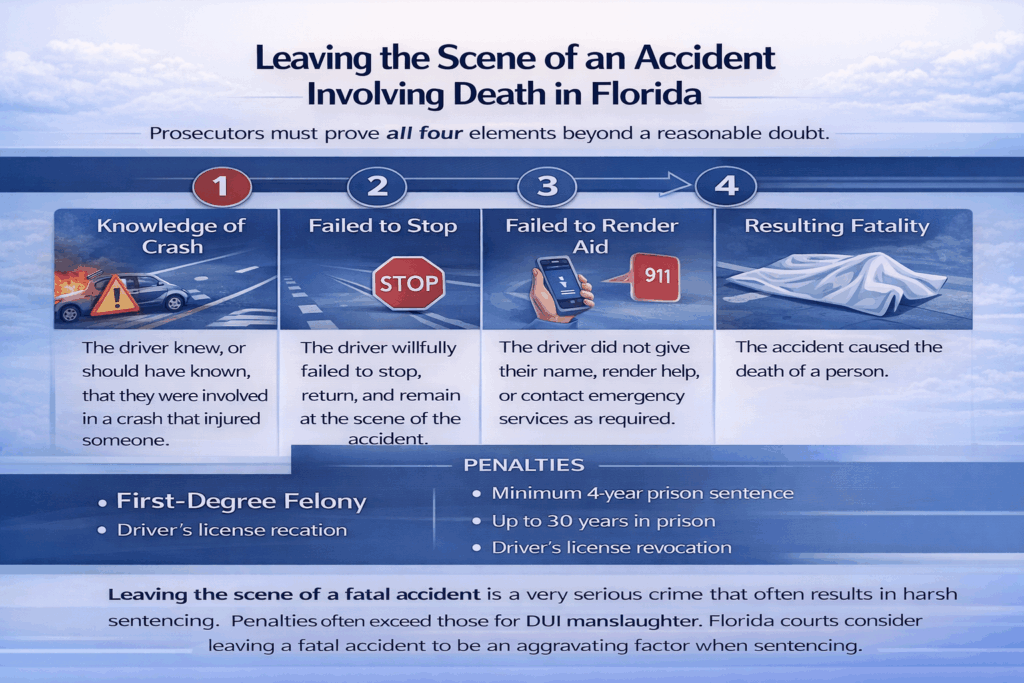
To obtain a conviction, prosecutors must prove each of the following elements beyond a reasonable doubt. If any element is not proven, the charge fails.
1️⃣ Knowledge of the Crash
The State must prove the driver knew or should have known they were involved in a crash. Actual knowledge is not required; knowledge can be inferred from the circumstances.
Prosecutors often rely on:
Severity of impact
Vehicle damage
Airbag deployment
Witness testimony
Driver statements or behavior
This is frequently the most contested element.
2️⃣ Failure to Stop and Remain at the Scene
Florida law requires drivers involved in fatal crashes to immediately stop and remain at or near the scene until legal duties are fulfilled.
Leaving the scene — even briefly — can be alleged as a violation depending on the facts.
3️⃣ Failure to Render Aid or Report the Accident
Drivers involved in fatal crashes have an affirmative legal duty to render reasonable assistance and ensure emergency services are contacted.
This typically means:
Calling 911
Requesting medical help
Cooperating with emergency responders
Failure to take these steps is often used by prosecutors to support the charge.
4️⃣ Resulting Death
Finally, the State must prove that a person died as a result of the crash. The death does not have to be immediate; later death from crash-related injuries may satisfy this element.
🔍 Common Defenses in Leaving the Scene Cases
Leaving the scene cases are highly fact-specific. Common defense issues include:
Lack of knowledge of the crash
Medical emergencies or disorientation
Fear or confusion immediately after impact
Identity disputes
Evidence that the driver attempted to report or return
Early evidence preservation is often critical.
📊 Penalties for Leaving the Scene Involving Death
Leaving the scene of an accident involving death is typically charged as a first-degree felony under Florida law.
A conviction exposes a defendant to:
Up to 30 years in prison
Up to 30 years of probation
A mandatory minimum prison sentence of four years
A minimum three-year driver’s license revocation
A permanent felony record
Unlike many other offenses, the four-year mandatory minimum applies by statute upon conviction for leaving the scene involving death.
Alcohol or Drugs as a Contributing Factor
While alcohol or drug impairment does not change the mandatory minimum for the leaving-the-scene charge itself, it can dramatically increase overall sentencing exposure.
If investigators believe alcohol or drugs contributed to the crash, prosecutors often pursue additional charges, such as:
DUI manslaughter
Vehicular homicide with impairment allegations
In cases where impairment is not alleged, prosecutors may instead attempt to characterize the driver’s conduct as reckless. We discuss how courts evaluate that issue in What Does “Reckless Driving” Mean in Vehicular Homicide Cases?
Those offenses carry their own mandatory minimum prison sentences and sentencing enhancements under Florida law, separate from the leaving-the-scene penalty.
As a result, cases involving alleged impairment frequently involve stacked exposure, where the defendant faces mandatory prison time for the leaving-the-scene charge plus additional mandatory penalties tied to impairment-based offenses.
🔗 Relationship to Vehicular Homicide and DUI Manslaughter
Leaving the scene involving death is a separate offense from vehicular homicide and DUI manslaughter. It focuses on post-crash conduct rather than how the collision occurred.
Prosecutors often charge these offenses together when they believe the driver both caused the fatality and failed to remain at the scene.
When vehicular homicide is alleged, prosecutors must still prove each statutory element beyond a reasonable doubt. We examine those elements in What Prosecutors Must Prove in a Florida Vehicular Homicide Case.
🚨 Why Early Legal Intervention Matters
Investigations often rely on surveillance footage, license-plate readers, cell-phone data, and vehicle damage analysis. Statements made early can become central to the prosecution’s case.
These investigations frequently rely on crash reconstruction analysis, which can sometimes be based on incomplete assumptions or flawed methodology. We discuss those issues in Accident Reconstruction Errors in Vehicular Homicide Cases.
Even when prosecutors allege that a driver caused the fatal crash, causation itself can be heavily contested. We examine those disputes in Challenging Causation in Vehicular Homicide Cases.
Early legal involvement can help shape how knowledge, intent, and conduct are interpreted.
✅ Final Takeaway
To convict someone of leaving the scene of an accident involving death, prosecutors must prove:
Knowledge of the crash
Failure to stop and remain
Failure to render aid or report
A resulting death
These cases are serious, technical, and highly dependent on early factual assumptions.
📞 Under Investigation for Leaving the Scene of a Fatal Accident?
These cases move quickly and carry severe consequences. Early legal involvement can affect how evidence is interpreted and whether charges escalate.
❓ Frequently Asked Questions: Leaving the Scene of an Accident Involving Death in Florida
What is leaving the scene of an accident involving death in Florida?
Leaving the scene of an accident involving death is a felony charge that applies when a driver is involved in a crash that results in a death and fails to immediately stop, remain at the scene, provide required information, and render reasonable assistance as required by Florida law.
Does the State have to prove the driver caused the accident?
No. Prosecutors do not need to prove that the driver caused the crash. The charge focuses on the driver’s conduct after the collision, not on fault for the accident itself.
Does the driver have to know that someone died?
No. The State generally must prove that the driver knew or should have known they were involved in a crash likely to have caused injury. Knowledge can be inferred from the severity of the impact, vehicle damage, airbag deployment, or surrounding circumstances.
What counts as “leaving the scene” under Florida law?
Leaving the scene typically means failing to immediately stop and remain at or near the crash site long enough to provide identifying information, render reasonable assistance, and ensure law enforcement or emergency services are contacted.
What does “rendering aid” mean in a fatal accident case?
Rendering aid usually means calling 911, requesting medical assistance, and providing reasonable help that can be given safely. The law does not require a driver to perform medical treatment, but it does require taking steps to ensure help is summoned.
What if the driver panicked and left but later contacted police?
Returning later or contacting law enforcement may be considered, but it does not automatically prevent charges. Prosecutors often evaluate the timing, circumstances, and intent behind the departure when deciding how to proceed.
What are the penalties for leaving the scene of an accident involving death?
Leaving the scene involving death is typically charged as a first-degree felony, punishable by up to 30 years in prison, potential mandatory minimum sentences, driver’s license consequences, and a permanent felony record.
Can leaving the scene involving death be charged along with vehicular homicide or DUI manslaughter?
Yes. Prosecutors may charge leaving the scene alongside vehicular homicide or DUI manslaughter when they believe the driver both caused the fatality and failed to remain at the scene and render aid.