
Last updated March 2026
Road rage happens fast.
A sudden lane change, a horn, or a gesture can escalate into a confrontation within seconds. But not every moment of aggressive driving is a crime—and not every road rage incident qualifies as assault.
In Florida, the key issue is whether the conduct creates a well-founded fear of imminent violence.
So when does road rage cross the line into criminal assault?
For a broader explanation of how assault charges work, see our guide to Assault Charges in Florida.
⚖️ The Legal Standard Still Applies
Under Florida Statute § 784.011, assault occurs when a person:
• intentionally threatens violence by word or act
• has the apparent ability to carry out the threat
• creates a well-founded fear that violence is imminent
Road rage cases are evaluated under the same standard.
The fact that the incident occurs in a vehicle does not change the legal elements—cases involving assault without physical contact are still evaluated under the same standard—but it can affect how those elements are applied.
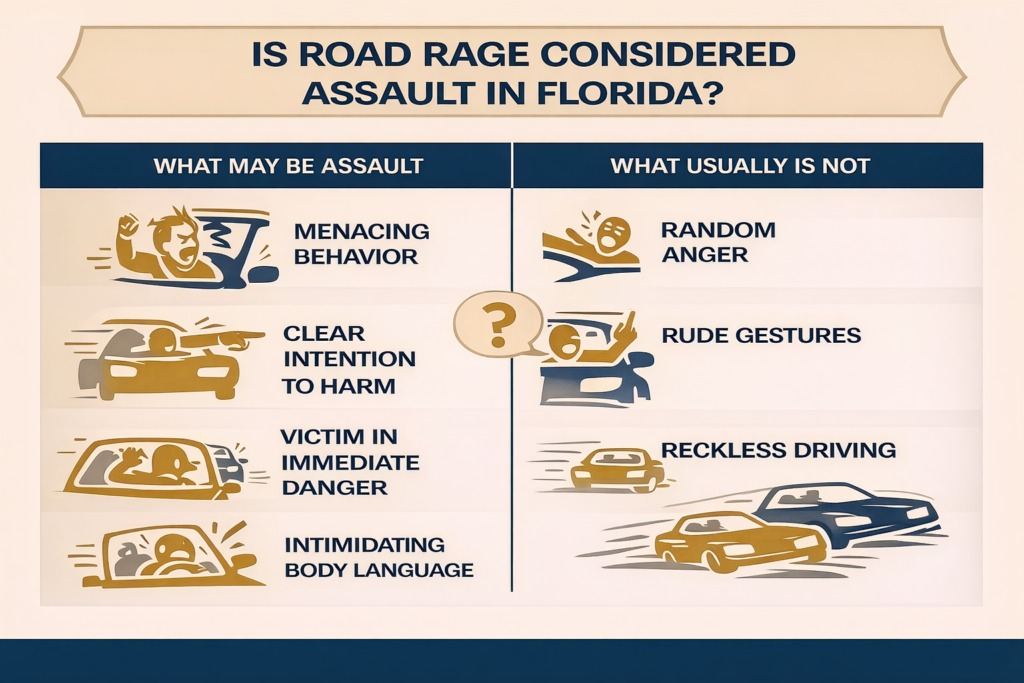
🚨 When Road Rage May Be Considered Assault
Road rage may qualify as assault when a driver’s actions communicate an immediate threat of harm.
Examples include:
• aggressively swerving toward another vehicle
• using a car to block or trap another driver
• chasing another vehicle in a threatening manner
• stopping abruptly and approaching another driver
• making threatening gestures while advancing
In these situations, the combination of movement and context may create a well-founded fear of imminent violence.
🚫 When Road Rage Is Not Assault
Many road rage incidents do not meet the legal definition of assault.
Common examples include:
🔹 Rude or Offensive Behavior
Honking, yelling, or making gestures without a clear threat of harm.
🔹 Reckless Driving Alone
Speeding or weaving through traffic without targeting a specific person.
🔹 Lack of Immediacy
Angry behavior that does not suggest immediate violence.
🔹 No Apparent Ability
Situations where distance or traffic conditions make harm unlikely.
Even aggressive driving does not automatically equal assault.
🧠 The Role of Gestures and Words
Many road rage cases involve a mix of conduct:
• yelling or verbal threats
• pointing or raising hands
• aggressive movement with a vehicle
These behaviors may strengthen an allegation—but they must still create an immediate and reasonable fear of harm.
Cases involving verbal threats alone or gestures without real ability often fall short of the legal standard.
⏱️ Immediacy and Control of the Vehicle
In road rage cases, courts look closely at:
• how close the vehicles were
• whether the driver could immediately act
• whether the conduct was directed at a specific person
• how quickly the situation was unfolding
A driver’s control of a vehicle can increase perceived danger—but only if the threat is immediate.
⚠️ When Road Rage Becomes Aggravated Assault
Road rage incidents may escalate to aggravated assault if:
• a weapon is displayed or used
• the vehicle itself is used as a deadly weapon
• the conduct involves intent to commit another crime
These cases carry significantly more serious penalties.
🔍 Evidence That Decides These Cases
Road rage cases often depend on objective evidence.
Key sources include:
• dashcam footage
• traffic cameras
• body-worn camera video
• witness statements
• vehicle positioning and movement
Video evidence frequently determines whether conduct was threatening—or just aggressive.
🛡️ Common Defense Strategies
Defenses often focus on:
✔ no intentional threat
✔ no imminent danger
✔ no targeting of a specific person
✔ exaggerated or inconsistent statements
✔ lack of apparent ability
✔ misinterpretation of driving behavior
Many cases weaken when the State cannot prove a clear, immediate threat.
📍 Broward County Reality
In Broward County, road rage arrests often arise from:
• highway confrontations
• intersection disputes
• parking lot incidents
• escalating driver interactions
Officers may rely on one driver’s version of events, especially when no video is available.
But the legal standard requires more than anger—it requires a provable threat.
⚖️ Where the Line Is Drawn
The difference between:
aggressive driving, and
criminal assault
comes down to whether the conduct created a real, immediate, and reasonable fear of harm.
Without that, there is no assault under Florida law.
📞 Facing a Road Rage–Related Charge in Florida?
If you were accused after a driving incident, the legal question is not whether you were angry—it is whether your actions legally constituted a threat.
Call Michael White, P.A. at (954) 270-0769 for a confidential consultation.
❓ FREQUENTLY ASKED QUESTIONS
Is road rage illegal in Florida?
Not by itself. Road rage becomes criminal only if it meets the elements of an offense such as assault, reckless driving, or aggravated assault.
Can aggressive driving be considered assault?
Sometimes. It depends on whether the conduct created a well-founded fear of imminent harm.
Is using a car considered a weapon in Florida?
It can be. A vehicle may be considered a deadly weapon if used in a way capable of causing serious harm.
Do gestures during road rage count as assault?
Not by themselves. Gestures must be combined with intent, immediacy, and apparent ability to create a valid assault charge.
Can road rage charges be dismissed?
Yes. Many cases are dismissed or reduced when the State cannot prove a clear and immediate threat.