
Last updated March 2026
🚧 How Flawed Analysis Can Turn an Accident into a Homicide Charge
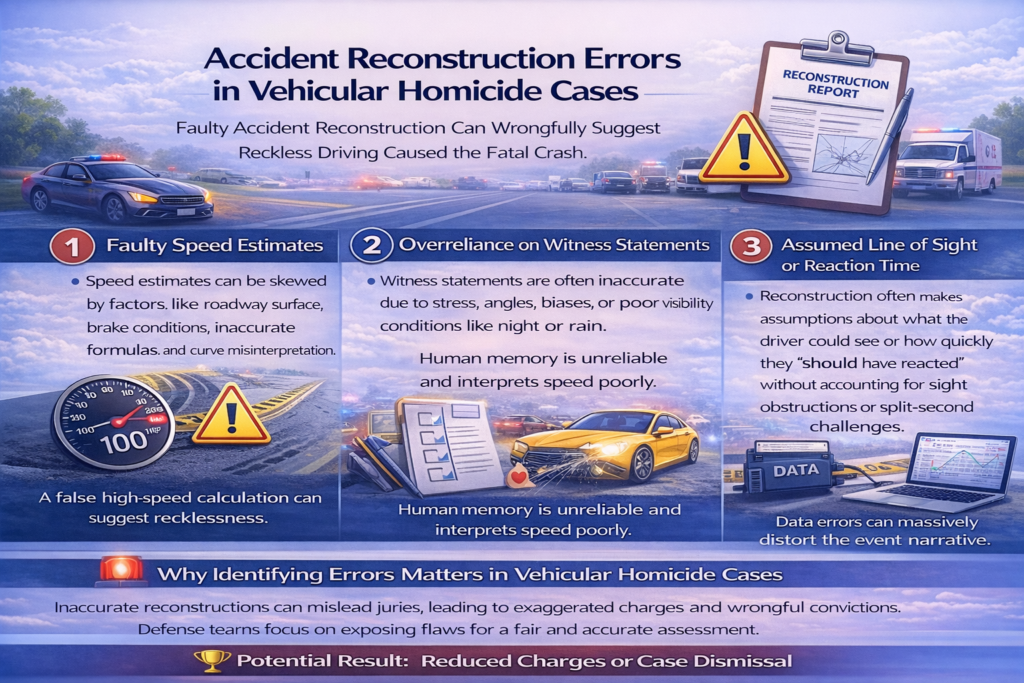
In Florida vehicular homicide cases, accident reconstruction evidence often drives the entire prosecution. Speed estimates, reaction times, points of impact, and vehicle data are frequently used to argue that a driver acted recklessly and caused a death.
But accident reconstruction is not infallible. Small errors, assumptions, or incomplete data can dramatically distort what actually happened — sometimes turning an accident into an alleged homicide.
Understanding where reconstruction goes wrong is critical, because many vehicular homicide cases rise or fall on these details.
To understand how reconstruction evidence fits into the broader legal framework of these cases, see our overview of Vehicular Homicide in Florida.
⚖️ Why Accident Reconstruction Carries So Much Weight
In vehicular homicide cases, prosecutors often rely on reconstruction because:
There are no surviving eyewitnesses
Events happened in seconds
Physical evidence appears “objective” to juries
Reconstruction testimony is frequently used to support:
Claims of excessive speed
Allegations of reckless driving
Arguments about what a driver “should have done”
Jurors tend to give this evidence significant weight — even when it is built on assumptions rather than certainties.
🚫 Common Accident Reconstruction Errors
Accident reconstruction errors usually fall into a few recurring categories. Each can materially affect charging decisions and trial outcomes.
🧮 Faulty Speed Estimates
Speed calculations are one of the most common — and most misunderstood — reconstruction tools.
Speed estimates can be skewed by:
Road surface conditions
Brake efficiency assumptions
Tire condition or ABS activation
Inaccurate drag factor values
Misinterpretation of yaw or skid marks
A falsely inflated speed estimate can be used to suggest recklessness when the actual speed may have been far lower.
Courts have repeatedly recognized that speed alone does not automatically establish criminal recklessness. We examine that issue in Can Speed Alone Support a Vehicular Homicide Charge in Florida?
🧠 Overreliance on Witness Statements
Witness statements are often used to “confirm” reconstruction conclusions — but human perception is unreliable, especially in traumatic events.
Common problems include:
Poor lighting or visibility
Stress-induced memory distortion
Limited viewing angles
Assumptions based on sound rather than sight
Witnesses frequently overestimate speed and misjudge distance, yet their statements are often treated as corroboration.
👁️ Assumed Line of Sight or Reaction Time
Reconstruction reports often include conclusions about:
What the driver “should have seen”
How quickly the driver “should have reacted”
These conclusions are frequently based on idealized assumptions, not real-world conditions.
Errors arise when reconstructions fail to account for:
Visual obstructions
Nighttime or weather conditions
Glare, shadows, or roadway curvature
Split-second decision-making under stress
These assumptions can unfairly portray normal human reaction limits as criminal conduct.
💻 Misinterpretation of Vehicle Data
Modern vehicles often contain event data recorders (“black boxes”), but that data has limitations.
Common issues include:
Partial or incomplete data capture
Incorrect interpretation of throttle or braking inputs
Failure to account for pre-crash steering or evasive actions
Overstating the precision of recorded data
Black-box data does not tell the full story — and treating it as definitive can be misleading.
⚠️ Why These Errors Matter in Vehicular Homicide Cases
In many vehicular homicide prosecutions:
Death is not disputed
Identity is not disputed
That leaves recklessness and causation as the key issues.
Understanding how courts evaluate reckless driving in fatal crash cases is central to this analysis. We discuss that issue in What Does “Reckless Driving” Mean in Vehicular Homicide Cases?
Accident reconstruction errors can:
Inflate perceived speed
Manufacture recklessness
Oversimplify causation
Shift blame away from other drivers or roadway conditions
Determining whether the alleged conduct actually caused the fatal crash is often heavily contested.
We examine those disputes in Challenging Causation in Vehicular Homicide Cases.
Once these conclusions are adopted early, they often become embedded in police reports, charging documents, and expert opinions.
🔗 How Reconstruction Errors Tie into Vehicular Homicide Charges
Vehicular homicide requires proof that a driver acted with willful or wanton disregard for safety and that this conduct caused the death.
Prosecutors must establish each element of the offense beyond a reasonable doubt, including reckless operation and causation. We explain those elements in What Prosecutors Must Prove in a Florida Vehicular Homicide Case.
If reconstruction evidence is flawed, prosecutors may be building a homicide case on unstable ground.
This is why accident reconstruction analysis is a central focus in many vehicular homicide defenses.
In vehicular homicide cases, accident reconstruction evidence is often used to establish recklessness and causation, making any analytical errors especially consequential.
🚨 Why Early Review by the Defense Is Critical
Accident scenes change quickly. Vehicles are repaired or destroyed. Data can be overwritten. Skid marks fade.
Early legal involvement allows:
Independent reconstruction analysis
Preservation of vehicle and roadway evidence
Identification of faulty assumptions before they harden
Challenge to exaggerated or speculative conclusions
Once a reconstruction narrative becomes “official,” it can be difficult to undo.
✅ Final Takeaway
Accident reconstruction is a powerful tool — but it is not immune from error. In vehicular homicide cases, small mistakes in speed estimates, visibility assumptions, or data interpretation can lead to exaggerated charges and wrongful conclusions.
Careful scrutiny of reconstruction evidence is often the key to a fair outcome.
Under Investigation After a Fatal Crash?
Vehicular homicide cases often hinge on accident reconstruction conclusions. Early legal involvement can affect how evidence is preserved, analyzed, and ultimately presented.
Request a confidential consultation to discuss your situation.
❓ Frequently Asked Questions: Accident Reconstruction Errors in Vehicular Homicide Cases
Can accident reconstruction evidence be wrong in vehicular homicide cases?
Yes. Accident reconstruction relies on assumptions, formulas, and available data. Errors in speed calculations, visibility analysis, or data interpretation can materially affect conclusions about recklessness and causation.
Are speed estimates in fatal crash cases always accurate?
No. Speed estimates can be affected by road surface conditions, braking assumptions, tire performance, drag factors, and how skid or yaw marks are interpreted. Small errors can significantly inflate perceived speed.
How reliable are witness statements in accident reconstruction?
Witness statements are often unreliable for estimating speed or distance, especially in stressful or low-visibility conditions. Human perception frequently overestimates speed and misjudges timing.
Can black box or event data recorder (EDR) data be misinterpreted?
Yes. Vehicle data may be incomplete, misread, or taken out of context. EDR data does not always capture steering inputs, evasive actions, or conditions leading up to the crash.
Why do reaction-time and visibility assumptions matter?
Reconstruction reports often assume ideal reaction times and clear lines of sight. These assumptions may not reflect real-world conditions such as darkness, glare, obstructions, or split-second decision-making.
How do reconstruction errors affect vehicular homicide charges?
Because vehicular homicide requires proof of recklessness and causation, flawed reconstruction evidence can exaggerate driving behavior and improperly support homicide-level charges.