
Last updated March 2026
When Illegal Racing Turns Fatal
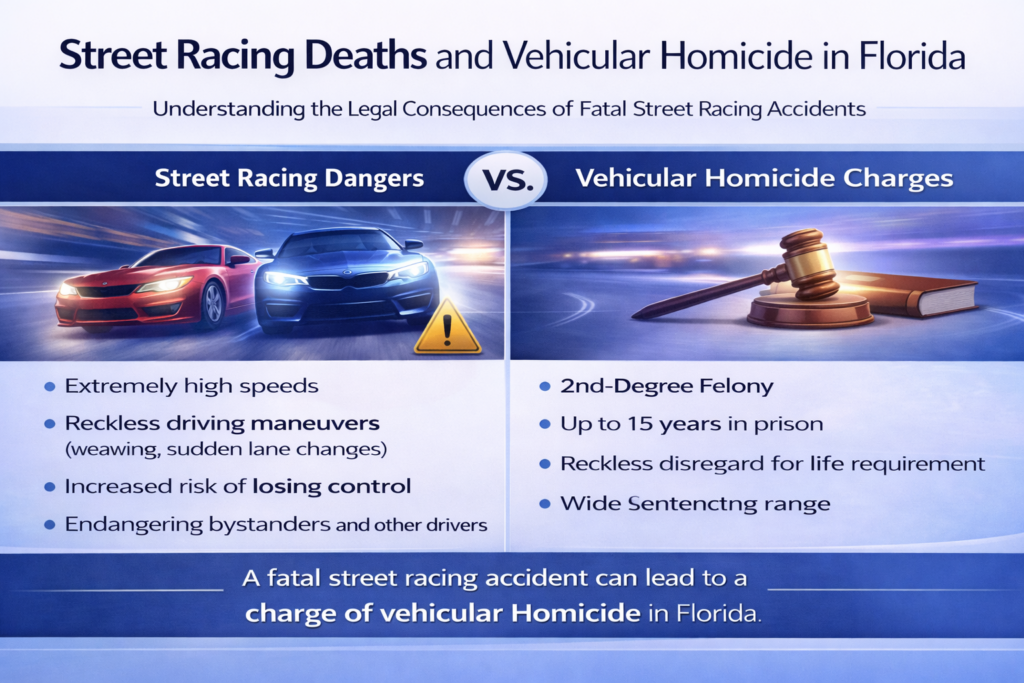
Street racing is one of the driving behaviors most likely to trigger vehicular homicide charges in Florida. When a fatal crash occurs during an illegal race, investigators often assume that the racing itself demonstrates the reckless conduct required for a felony prosecution.
Under Florida law, racing on public roads can dramatically increase criminal exposure. If someone dies during or as a result of a race, prosecutors may pursue charges ranging from vehicular homicide to manslaughter or even murder charges depending on the circumstances.
However, proving criminal liability in these cases still requires prosecutors to establish recklessness and causation, not simply that racing occurred.
Understanding how these cases are investigated and prosecuted is critical for anyone facing allegations related to a fatal street racing incident.
For a broader explanation of how these cases are structured under Florida law, see our overview of Vehicular Homicide in Florida.
Florida’s Street Racing Laws
Florida aggressively prosecutes illegal racing on highways and public roads.
Street racing typically involves:
• two or more vehicles competing in speed
• attempts to out-distance another vehicle
• timed acceleration contests
• coordinated high-speed driving
In many situations where no injury occurs, street racing may be prosecuted as a misdemeanor traffic offense. We explain the penalties and defenses in our guide to Street Racing Charges in Florida.
Even without a crash, street racing can result in criminal charges. But when a race leads to a fatal collision, investigators often consider the behavior strong evidence of Reckless Driving.
Because racing involves deliberate high-speed competition, prosecutors frequently argue that it demonstrates a willful disregard for human life, which is a key element in vehicular homicide cases.
How Street Racing Can Lead to Vehicular Homicide Charges
Vehicular homicide occurs when a person causes the death of another human being through the reckless operation of a motor vehicle likely to cause death or great bodily harm.
Street racing may satisfy the recklessness element because it often involves:
• extremely high speeds
• dangerous lane changes
• disregard for traffic signals
• driving through populated areas
However, racing alone does not automatically establish criminal liability.
Prosecutors must still prove that the defendant’s actions caused the fatal crash.
For a deeper explanation of the elements prosecutors must establish, see our analysis of What Prosecutors Must Prove in a Florida Vehicular Homicide Case.
Investigating Fatal Street Racing Crashes
Fatal racing incidents typically trigger a Traffic Homicide Investigation.
These investigations are often conducted by specialized crash investigators who analyze the circumstances surrounding the collision.
Investigators may examine:
• crash scene measurements
• vehicle damage patterns
• witness statements
• surveillance or traffic camera footage
• Event Data Recorder Evidence
• Crash Data Retrieval reports
These findings are frequently used to build a Crash Reconstruction model that attempts to explain how the collision occurred.
The Role of Speed in Street Racing Cases
Speed is almost always a central issue in racing-related fatalities.
Investigators may attempt to estimate vehicle speed using:
• skid marks
• vehicle damage
• debris fields
• black box data
However, courts recognize that speed alone does not automatically establish vehicular homicide.
Even when excessive speed is involved, prosecutors must still prove that the driver’s conduct caused the fatal crash.
We examine this issue further in our analysis of Whether Speed Alone Can Support a Vehicular Homicide Charge.
When Multiple Drivers May Be Responsible
Street racing incidents often involve more than one vehicle, which can complicate the question of responsibility.
Investigators must determine:
• which driver initiated the crash sequence
• whether both drivers contributed to the collision
• whether a non-racing driver caused the fatal impact
In some cases, a driver who was racing may not have been the vehicle that directly caused the fatal crash.
Determining responsibility in these situations often requires detailed reconstruction analysis and examination of all available evidence.
Causation in Fatal Racing Cases
Even when illegal racing occurred, prosecutors must still prove causation in criminal law.
The key legal question becomes:
Did the defendant’s racing conduct actually cause the death?
Factors that may complicate causation include:
• another driver entering the roadway
• sudden pedestrian movement
• road hazards or construction zones
• mechanical failures
When another factor becomes the primary cause of the crash, prosecutors may have difficulty establishing criminal liability.
These issues are discussed in greater detail in our article on Challenging Causation in Vehicular Homicide cases.
Accident Reconstruction and Racing Investigations
Fatal racing incidents frequently involve extensive Crash Reconstruction analysis.
Experts may examine:
• vehicle trajectories
• braking distances
• debris distribution
• driver reaction times
• black box data
However, accident reconstruction conclusions depend on assumptions and interpretation of evidence.
Errors in those assumptions can lead to incorrect conclusions about how the crash occurred.
We explore these issues in our discussion of Accident Reconstruction Errors in Vehicular Homicide cases.
Why These Cases Are Aggressively Prosecuted
Street racing fatalities often attract significant public attention, and prosecutors may pursue these cases aggressively.
Authorities often view racing as an inherently dangerous activity that places the public at serious risk.
For that reason, fatal racing incidents may lead to severe criminal charges and substantial penalties under Florida Statutes.
But even in these cases, prosecutors must still prove every element of the offense beyond a reasonable doubt.
Speak With a Florida Vehicular Homicide Defense Attorney
Fatal crash investigations move quickly, and early conclusions by investigators can strongly influence how prosecutors evaluate a case.
When street racing is alleged, investigators may assume that racing alone establishes criminal liability.
However, careful analysis of the evidence — including reconstruction reports and vehicle data — may reveal important questions about what actually caused the crash.
If you are under investigation or facing charges related to a fatal crash in Broward County courts or elsewhere in South Florida, early legal representation can help ensure that the evidence is carefully reviewed.
Request a confidential consultation to discuss your situation.
FAQs
Can street racing lead to vehicular homicide charges in Florida?
Yes. If a fatal crash occurs during an illegal race, prosecutors may charge drivers with vehicular homicide if they believe reckless racing behavior caused the death.
Is street racing automatically considered reckless driving?
Street racing often qualifies as reckless driving because it involves high speeds and dangerous competition on public roads. However, prosecutors must still prove the driver’s conduct caused the fatal crash.
Can both drivers in a race be charged if someone dies?
In some cases, multiple drivers involved in a race may face criminal charges if investigators believe both contributed to the fatal collision.
Does speed alone prove vehicular homicide in a racing case?
No. Even when excessive speed is involved, prosecutors must still prove that the defendant’s conduct caused the death.