
Last updated April 2026
If you’ve been accused of resisting arrest or obstructing a police officer in Florida, you may be facing charges even if no force was used and no arrest actually occurred.
These cases often arise from everyday interactions — traffic stops, street encounters, or situations where someone questions police authority or refuses to comply immediately. But not every lack of cooperation is a crime, and many of these charges depend on whether the officer was acting lawfully in the first place.
For a broader overview of how obstruction-related offenses are charged and defended, see our guide to Resisting & Obstruction Charges in Florida.
⚖️ What Counts as Resisting or Obstruction in Florida?
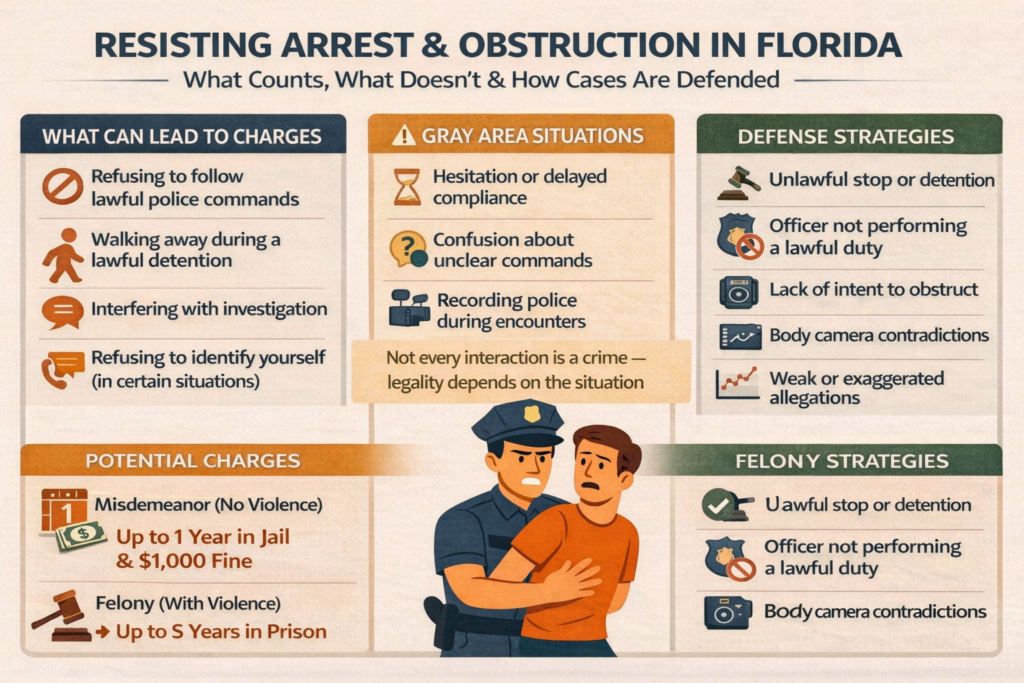
Under Florida law, resisting or obstruction generally means interfering with a law enforcement officer who is performing a lawful duty.
This can include:
- refusing to comply with lawful commands
- providing false identifying information
- physically pulling away or tensing during a detention
- interfering with an investigation or traffic stop
Importantly, these charges do not always require violence. Many cases are charged as resisting without violence — a misdemeanor that still carries serious consequences.
For a breakdown of how these cases are charged, see Resisting Arrest Without Violence in Florida.
⚠️ When Does Noncompliance Become a Crime?
Not every hesitation, question, or failure to immediately comply with police instructions is a crime.
In many cases, the line between lawful behavior and obstruction depends on how clearly the officer’s command was given and whether the officer had legal authority to issue it in the first place.
Situations that often fall into a gray area include:
- hesitation or delayed compliance
- confusion about what is being ordered
- conflicting or unclear commands
- encounters that escalate quickly without clear direction
- recording police or questioning authority during an encounter
Issues involving recording law enforcement are especially fact-specific. Learn more in Recording Police and Obstruction in Florida.
In these scenarios, what one officer interprets as obstruction may actually be a misunderstanding or a reaction to an unclear or unlawful situation. These distinctions are often critical — and they frequently become the focus of the defense.
🚨 Lawfulness of the Officer Matters
One of the most important issues in any resisting or obstruction case is whether the officer was acting lawfully.
If the underlying stop, detention, or command was illegal, the charge may not stand.
Common legal issues include:
- lack of probable cause
- unlawful detention
- improper expansion of a traffic stop
- commands that exceed legal authority
For example, whether you must identify yourself depends heavily on the circumstances. Learn more in Refusing to Show ID in Florida and Can Police Demand Your ID If You’re Not Driving?.
🧠 Common Situations That Lead to Charges
Many resisting and obstruction charges arise from situations where people do not realize their conduct could be interpreted as interference.
🔹 Traffic Stops
Disputes over documents, exiting the vehicle, or questioning the stop can escalate into obstruction allegations.
See how these cases develop in Obstruction During Traffic Stops in Florida.
⚖️ Related Resisting & Obstruction Topics
- Resisting Arrest Without Violence in Florida
- Refusing to Show ID in Florida
- Providing a False Name to Police in Florida
- Walking Away from Police in Florida
- Refusing a Lawful Order in Florida
🔹 Providing Information to Police
Giving a false name or misleading information can result in separate criminal charges.
Learn more in Providing a False Name to Police in Florida.
🔹 Walking Away or Refusing Commands
In some situations, walking away from police or refusing to comply may be lawful — but in others, it can lead to arrest.
For a deeper look, see Walking Away from Police in Florida and Refusing a Lawful Order in Florida.
🔹 Passenger Encounters
Passengers often believe they have no obligations during a stop, but police authority can vary depending on the situation.
See Can Police Run Your Name If You’re a Passenger?.
⚖️ Resisting Without Violence vs. With Violence
Florida law distinguishes between nonviolent resistance and cases involving force.
- Resisting without violence is typically a misdemeanor
- Resisting with violence is a felony and carries significantly higher penalties
Understanding how these charges differ is critical to evaluating your case. For a full comparison, see Resisting Without Violence vs. Resisting With Violence.
⚖️ What Happens After a Resisting Arrest Charge?
The process following a resisting or obstruction charge depends on how the case is filed and whether additional charges are involved.
In many cases, individuals are either arrested at the scene or issued a notice to appear in court. From there, the case typically proceeds through:
- first appearance or bond determination
- formal charging by the State Attorney’s Office
- pretrial hearings and possible motion practice
Resisting without violence is generally charged as a misdemeanor, while resisting with violence is a felony and carries significantly greater penalties.
However, the outcome of these cases often depends on early legal analysis — particularly whether the officer was acting lawfully and whether the alleged conduct actually meets the legal definition of obstruction.
🛡️ Defenses to Resisting & Obstruction Charges
In many resisting and obstruction cases, the defense focuses on whether the officer’s actions were lawful in the first place.
If the stop, detention, or command was not legally justified, the entire charge may be subject to challenge.
Common defense strategies include:
- the officer was not engaged in a lawful duty
- the detention or stop was unsupported by probable cause or reasonable suspicion
- the conduct did not rise to the level of obstruction under Florida law
- the situation involved confusion, unclear commands, or rapid escalation
These cases are often built on an officer’s interpretation of events, but they are frequently challenged through body camera footage, timing analysis, and close examination of the legal basis for the encounter.
In some situations, individuals are accused of resisting even when the underlying arrest or detention may not have been lawful. For a deeper analysis, see Resisting an Unlawful Arrest in Florida.
These cases often turn on body camera footage, timing, and whether commands were clearly lawful.
📍 Why These Cases Are Often Challenged
Resisting and obstruction charges are rarely as straightforward as they may appear in an arrest report.
Unlike other offenses, these cases often depend on how an interaction is interpreted — not just what occurred, but how quickly someone responded, whether commands were clearly lawful, and whether the officer’s actions were justified under the circumstances.
Because of this, small details can have a significant impact on the outcome of the case, particularly when video evidence is available.
📞 Charged With Resisting Arrest in Fort Lauderdale?
If you’ve been accused of resisting arrest or obstructing an officer in South Florida, it’s important to understand your rights and your options.
These cases are often more complex than they appear — and many can be challenged based on the legality of the police encounter itself.
Frequently Asked Questions
Can you be charged with resisting arrest without being arrested?
Yes. In Florida, you can be charged with resisting or obstructing an officer even if no formal arrest occurs, as long as the officer was performing a lawful duty.
Is refusing to show ID considered resisting?
It depends on the situation. In some cases, refusal is lawful. In others, it may lead to obstruction charges if the officer had legal grounds to require identification.
What is the difference between resisting with and without violence?
Resisting without violence involves non-forceful interference, while resisting with violence involves physical force and is charged as a felony.
Can you walk away from police in Florida?
Sometimes. If you are not being lawfully detained, you may have the right to leave — but this depends on the specific circumstances.