
Last updated March 2026
Keyed a car. Smashed a window. Spray-painted a wall.
In Florida, these acts fall under criminal mischief — often called vandalism — and they can lead to serious criminal charges, even when the damage seems minor.
Depending on the amount of damage, the type of property involved, and your prior record, criminal mischief may be charged as a misdemeanor or a felony. In some cases, felony charges apply regardless of the dollar amount.
If you’re facing a vandalism or property damage charge in Fort Lauderdale or Broward County, understanding how Florida law treats criminal mischief is critical.
For an overview of how burglary, trespassing, and property damage charges are handled together, see our Property Crimes Defense guide.
Many criminal mischief cases involve specific fact patterns — from minor damage to disputes over evidence — which we break down in more detail below.
⚖️ What Is Criminal Mischief Under Florida Law?
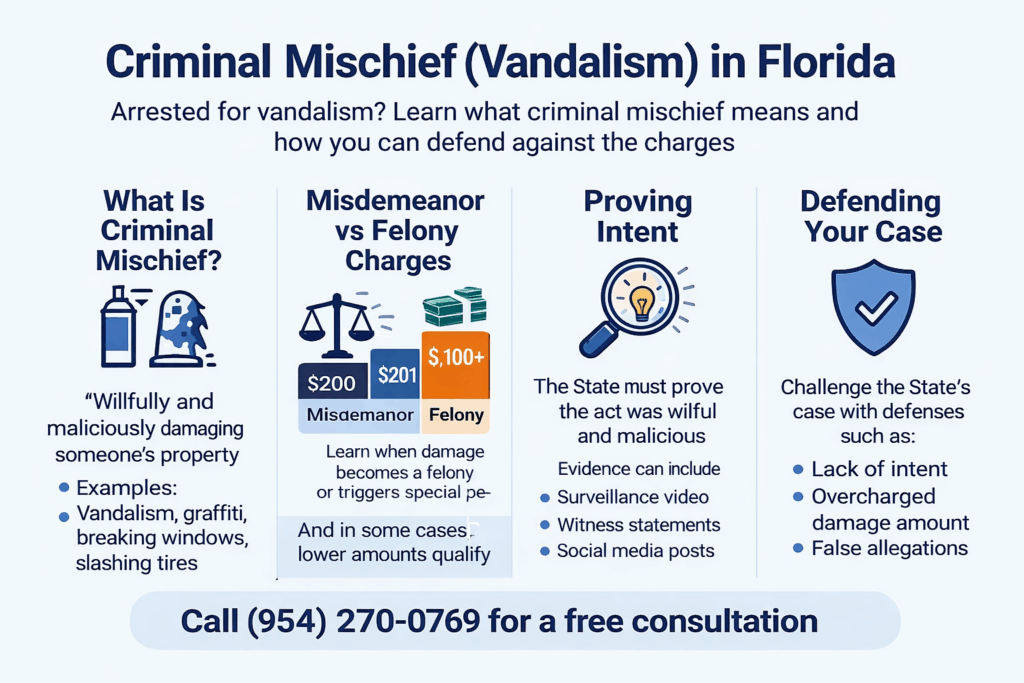
Criminal mischief is prosecuted under Florida Statute § 806.13, which covers both misdemeanor and felony property damages. It defines criminal mischief as:
Willfully and maliciously injuring or damaging, by any means, any real or personal property belonging to another.
Criminal mischief can include conduct such as:
-
Vandalism or graffiti
-
Breaking windows or doors
-
Slashing tires
-
Damaging vehicles
-
Defacing buildings or public property
-
Destroying fences, locks, or fixtures
The key elements prosecutors must prove are willful conduct and malicious intent. Accidental damage does not qualify.
Learn more: Is breaking a window a crime in Florida?
📊 Misdemeanor vs. Felony Criminal Mischief in Florida
The value of the damage is the primary factor that determines whether criminal mischief is charged as a misdemeanor or a felony.
Criminal Mischief Penalty Thresholds
| Amount of Damage | Charge Level | Maximum Penalty |
|---|---|---|
| $200 or less | Second-degree misdemeanor | Up to 60 days jail + $500 fine |
| $201 – $999 | First-degree misdemeanor | Up to 1 year jail + $1,000 fine |
| $1,000 or more | Third-degree felony | Up to 5 years prison + $5,000 fine |
Even misdemeanor vandalism charges can result in jail, probation, restitution, and a permanent criminal record. For a closer look at lower-level cases, see when criminal mischief is treated as a misdemeanor in Florida.
Criminal mischief is one of several non-violent property offenses prosecuted in Florida.
If you’ve been accused of property damage in Florida, early action can make a difference.
🚨 When Criminal Mischief Is a Felony Regardless of Damage Amount
Florida law allows felony criminal mischief charges even when the dollar amount is low if certain aggravating factors apply.
Criminal mischief may be charged as a felony if:
-
The property damaged was a place of worship
-
The damage interrupted public services, such as utilities or emergency response
-
The vandalism targeted public communication systems (telephone, cable, or similar infrastructure)
-
The accused has prior criminal mischief convictions
Example:
Graffiti on a church wall — even causing minimal damage — can still result in a felony charge.
Graffiti cases are a common example of how small damage can still lead to serious charges — see how graffiti is prosecuted under Florida law.
Vehicle-related damage is especially common — see how car keying cases are charged in Florida.
💰 Restitution in Criminal Mischief Cases
In addition to jail or probation, courts often order restitution for the alleged damage. Restitution may include:
-
Repair costs
-
Replacement value
-
Labor expenses
-
Administrative fees
Disputes over valuation often determine whether a case remains a misdemeanor or becomes a felony.
For a deeper breakdown, see how restitution works in Florida criminal mischief cases.
🧠 Do Prosecutors Have to Prove Intent?
Yes. Criminal mischief is not a strict-liability offense.
The State must prove the damage was done willfully and maliciously, not by accident or negligence.
Prosecutors often try to establish intent using:
-
Surveillance or body-camera footage
-
Witness statements
-
Social media posts or messages
-
Prior disputes with the property owner
If intent cannot be proven beyond a reasonable doubt, the charge may fail.
In many cases, this comes down to how evidence is interpreted — especially video — see how video evidence is used and challenged in these cases.
🛡️ Common Defenses to Criminal Mischief Charges
Every case is different, but effective defenses to vandalism and property damage charges often include:
-
Lack of intent (accidental or reckless conduct, not willful damage)
-
Disputed ownership or consent (shared property, landlord-tenant disputes, domestic conflicts)
-
False or exaggerated allegations during neighbor or family disputes
-
Valuation challenges to reduce a felony to a misdemeanor
-
Identification issues, including weak eyewitness testimony
In many cases, early legal intervention can prevent overcharging or lead to dismissal.
In some situations, whether property damage charges be dropped depends on the strength of the evidence and proof of intent.
These issues frequently arise in relationship-based cases — see criminal mischief during domestic disputes.
🚨 What To Do If You’re Accused of Property Damage
An accusation of property damage can escalate quickly — especially when the alleged victim provides photos, repair estimates, or text messages to law enforcement. Many criminal mischief cases are built on informal evidence gathered in the heat of a dispute.
What you do in the first hours or days after an accusation can significantly affect whether the case is filed as a misdemeanor, elevated to a felony, or resolved early.
1️⃣ Do Not Admit Fault in Writing
Text messages, direct messages, emails, and social media posts are frequently used to prove both identity and intent. Even statements like:
-
“I didn’t mean to.”
-
“I’ll pay for it.”
-
“It wasn’t that bad.”
can be used to argue that the act was willful and malicious.
Avoid discussing the incident electronically or with the alleged victim once you know accusations are being made.
2️⃣ Preserve Your Own Evidence
Property damage cases often become one-sided investigations. Protect yourself by preserving:
-
Your full text and call history
-
Photos or videos from your phone
-
Location data or timestamps
-
Names of witnesses present
-
Any evidence showing pre-existing damage
Early documentation can weaken inflated repair claims or exaggerated narratives.
3️⃣ Do Not Accept an Inflated Damage Estimate
The value of the alleged damage determines whether criminal mischief is charged as a misdemeanor or felony. Repair estimates may:
-
Bundle unrelated damage
-
Include cosmetic upgrades
-
Overstate labor costs
-
Fail to distinguish between old and new damage
Do not agree to a dollar amount without independent verification. Valuation disputes are often the difference between a misdemeanor and a third-degree felony.
4️⃣ Avoid Escalating Contact
Many criminal mischief allegations arise from:
-
Domestic disputes
-
Breakups
-
Neighbor conflicts
-
Landlord-tenant disagreements
Continued communication can lead to additional allegations, including harassment or witness tampering claims. Once an accusation surfaces, keep communication minimal and legally appropriate.
5️⃣ Speak With a Defense Lawyer Before Speaking to Police
You are not required to provide a statement to law enforcement. Statements given “to clear things up” often provide prosecutors with the intent evidence they need to file charges.
Because criminal mischief requires proof that the damage was done willfully and maliciously, your words can become the State’s strongest evidence.
Early legal guidance can:
-
Prevent overcharging
-
Challenge inflated valuations
-
Preserve diversion eligibility
-
Position the case for dismissal
If you have been accused of property damage in Fort Lauderdale or anywhere in Broward County, taking action early can significantly improve the outcome.
✅ Can Criminal Mischief Be Resolved Through Diversion?
In first-time or low-damage cases, prosecutors may offer:
-
Pretrial diversion
-
Deferred prosecution
-
Restitution-based resolution
Successful completion may result in dismissal.
🧱 Criminal Mischief vs. Burglary or Trespass
Not all property crimes are treated the same under Florida law.
-
Criminal mischief involves damage to property
-
Trespass involves unlawful entry without intent to commit another crime
-
Burglary involves entry with intent to commit an offense inside
Misclassification happens often. Conduct that supports criminal mischief does not automatically justify burglary charges.
👨⚖️ Criminal Mischief Defense Lawyer in Fort Lauderdale
At Michael White, P.A., we defend clients accused of vandalism, property damage, and criminal mischief throughout Fort Lauderdale and Broward County.
As a former prosecutor, Michael White understands how these cases are charged — and how prosecutors attempt to inflate misdemeanor conduct into felony exposure. We fight for:
-
Charge reductions
-
Dismissals
-
Diversion programs
-
Civil resolutions when appropriate
📞 Call (954) 270-0769 or request a free consultation before speaking with law enforcement.
🔎 Common Criminal Mischief Scenarios in Florida
Criminal mischief charges can arise in a wide range of situations. For more detailed breakdowns of how these cases are charged and defended, see:
- Misdemeanor Criminal Mischief (Under $200)
- Graffiti and Vandalism Charges
- Keying a Car and Vehicle Damage Cases
- Property Damage in Domestic Disputes
- Restitution and Damage Valuation
- Video Evidence in Criminal Mischief Cases
🔍 Frequently Asked Questions About Criminal Mischief in Florida
Is criminal mischief the same as vandalism?
Yes. “Criminal mischief” is the legal term Florida uses for vandalism and property damage offenses.
Can you go to jail for misdemeanor criminal mischief?
Yes. Even misdemeanor vandalism can result in jail, probation, fines, and restitution.
Can a felony criminal mischief charge be reduced?
Often, yes. Challenging the valuation of damage or the alleged intent may reduce a felony to a misdemeanor or result in dismissal.
Is criminal mischief eligible for record sealing or expungement?
Convictions are not eligible. However, dismissed cases or those resolved with a withhold of adjudication may qualify.