
Last updated March 2026
What Prosecutors Must Prove, Penalties, and Defenses
Vehicular homicide is one of the most serious charges a driver can face in Florida.
Unlike DUI manslaughter, vehicular homicide does not require proof of intoxication. Instead, prosecutors focus on whether a driver’s reckless or negligent operation of a vehicle caused the death of another person.
These cases often begin as “accidents” — but quickly escalate into homicide investigations involving crash reconstruction, data downloads, surveillance footage, and expert testimony.
Understanding how vehicular homicide works, what the State must prove, and how these cases are defended is critical if you or someone you love is under investigation.
Vehicular homicide is prosecuted as a violent felony and is classified under Florida’s homicide laws. For an overview of how Florida distinguishes between homicide offenses, see Florida Homicide charges.
For a broader overview of violent crimes in Florida, see our guide on Violent Crimes in Florida.
What Is Vehicular Homicide in Florida?
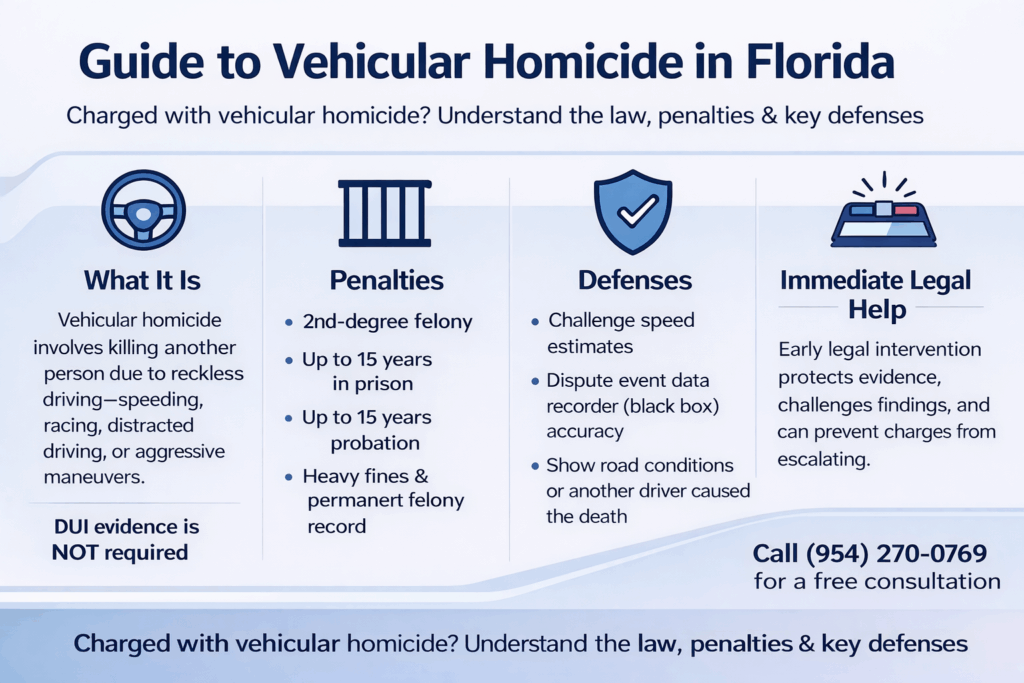
Vehicular homicide occurs when a person causes the death of another human being through the operation of a motor vehicle in a reckless manner likely to cause death or great bodily harm.
Key characteristics:
No requirement of alcohol or drug impairment
Focus on driving behavior, not intoxication
Charged as a serious felony, not a traffic offense
Vehicular homicide charges are frequently filed after:
High-speed crashes
Street racing allegations
Distracted driving incidents
Aggressive or reckless maneuvers
Commercial vehicle accidents
Street racing allegations — which can quickly escalate into homicide prosecutions when a fatal crash occurs. We explain how those cases are investigated and charged in Street Racing Deaths and Vehicular Homicide in Florida.
Commercial vehicle accidents, which often involve complex regulatory and forensic investigations. Learn more in Commercial Vehicle Accidents and Vehicular Homicide Investigations.
Vehicular Homicide vs. DUI Manslaughter
This distinction matters — legally and strategically.
Vehicular Homicide
Based on reckless or negligent driving
No intoxication required
Focuses on speed, behavior, and decision-making
DUI Manslaughter
Requires proof of impairment
Built on toxicology and DUI investigation
Often charged when alcohol or drugs are alleged
👉 If impairment is alleged, cases are typically charged as DUI manslaughter and handled under felony DUI law.
This distinction matters — legally and strategically.
For a deeper breakdown of how these two charges differ in investigation, sentencing exposure, and defense strategy, see our detailed comparison of Vehicular Homicide vs. DUI Manslaughter in Florida.
What Prosecutors Must Prove
To secure a conviction, the State must establish every element beyond a reasonable doubt.
1. A Death Occurred
The prosecution must prove that a human being died as a result of the incident. This often involves:
Medical examiner testimony
Cause-of-death reports
Timeline reconstruction
2. The Defendant Was Operating a Motor Vehicle
Identity and operation must be proven — not assumed.
Common disputes include:
Who was actually driving
Whether the defendant had control of the vehicle
Shared or transferred control moments before impact
3. Reckless Operation of the Vehicle
This is the core battleground in most cases.
Recklessness is more than ordinary negligence. Prosecutors often point to:
Excessive speed
Racing or aggressive driving
Disregard of traffic signals
Dangerous maneuvers
Distracted driving evidence
Although prosecutors often highlight excessive speed, speed alone does not automatically constitute criminal recklessness. Florida courts require proof of willful or wanton disregard — not merely high speed. We analyze this distinction in detail in our breakdown of Whether Speed Alone Can Support a Vehicular Homicide Charge in Florida.
Similarly, not every distracted driving incident supports a homicide charge. The legal distinction between a tragic accident and criminal recklessness is analyzed in our guide on Distracted Driving Causing Death in Florida.
Defense cases often focus on:
Road conditions
Mechanical failure
Conduct of other drivers
Sudden emergencies
Florida courts draw an important distinction between ordinary negligence and criminal recklessness. Learn how reckless driving allegations escalate into felony homicide charges in our analysis of Reckless Driving and Vehicular Homicide in Florida.
4. Causation
The State must prove the alleged reckless driving actually caused the death.
If the death would have occurred regardless of the defendant’s actions, causation becomes a major defense issue.
Determining whether a driver’s conduct actually caused the fatal crash is often one of the most contested issues in these prosecutions. We examine that issue in Challenging Causation in Vehicular Homicide Cases.
We break down each statutory element in greater detail in our guide on What Prosecutors Must Prove in a Florida Vehicular Homicide Case, including how recklessness and causation are challenged at trial.
Penalties for Vehicular Homicide in Florida
Vehicular homicide is typically charged as a second-degree felony, punishable by:
Up to 15 years in prison
Up to 15 years of probation
Substantial fines
Permanent felony record
In certain circumstances — such as leaving the scene — penalties can escalate significantly.
Leaving the Scene of an Accident Involving Death
In many vehicular fatality cases, prosecutors also investigate whether the driver failed to stop, render aid, or report the crash.
Leaving the scene of an accident involving death is:
A separate felony offense
Often charged alongside vehicular homicide
Frequently treated as evidence of “consciousness of guilt”
Importantly: a driver can be charged with leaving the scene even if the crash itself was accidental.
Leaving the scene of an accident involving death is a separate first-degree felony in Florida and is frequently charged alongside vehicular homicide. For a full explanation of the elements and penalties, see our guide on Leaving the Scene of an Accident Involving Death in Florida.
Common Defenses to Vehicular Homicide
Vehicular homicide cases are highly technical and evidence-driven. Common defense strategies include:
Challenging Recklessness
Speed estimates based on flawed assumptions
Unreliable event data recorder (black box) interpretations
Mischaracterization of normal driving as reckless
Vehicle data recorders can be powerful evidence, but the data is not always interpreted correctly. We discuss the limitations of this technology in Can Black Box (Event Data Recorder) Evidence Be Wrong?
Disputing Causation
Independent actions of other drivers
Roadway defects or poor signage
Mechanical or tire failures
Accident Reconstruction Errors
Incomplete scene analysis
Faulty measurements
Selective use of data
We examine common reconstruction flaws — including flawed drag factor assumptions, black box misinterpretation, and selective scene measurements — in our detailed guide on Accident Reconstruction Errors in Vehicular Homicide Cases.
Identity & Operation Issues
Uncertainty about who was driving
Passenger involvement
Post-crash confusion
How Vehicular Homicide Investigations Begin
Many cases start as:
Traffic homicide investigations
Fatal crash reports
“Accident” scenes that escalate
In many situations, a crash that initially appears to be a tragic accident can quickly escalate into a criminal investigation. We explain how these cases evolve in When a Fatal Crash Becomes a Homicide Investigation.
Law enforcement often deploys:
Crash reconstruction teams
Vehicle data downloads
Surveillance and traffic cameras
Cell phone data analysis
Early intervention by defense counsel can significantly affect:
Charging decisions
Evidence preservation
Whether the case escalates to homicide at all
Why These Cases Require Immediate Legal Representation
Vehicular homicide cases move fast — and once charged, the damage is difficult to undo.
An experienced defense attorney can:
Intervene before charges are filed
Preserve favorable evidence
Challenge flawed reconstructions
Control the narrative before arrest
Key Issues Investigated in Florida Vehicular Homicide Cases
Vehicular homicide investigations often focus on several critical issues that determine whether criminal charges are filed and whether a conviction is possible under Florida law.
These investigations typically examine:
• Reckless driving conduct, including excessive speed, racing behavior, or aggressive maneuvers
• Distracted driving evidence, such as cellphone use or infotainment system activity
• Accident reconstruction analysis, including speed estimates, reaction times, and points of impact
• Vehicle data evidence, including Event Data Recorder (“black box”) downloads
• Causation, meaning whether the driver’s conduct actually caused the fatal crash
Each of these issues can become a central battleground in a vehicular homicide case. We examine them in greater detail in our related guides, including:
• What Prosecutors Must Prove in a Florida Vehicular Homicide Case
• What Does “Reckless Driving” Mean in Vehicular Homicide Cases?
• Can Speed Alone Support a Vehicular Homicide Charge in Florida?
• Distracted Driving Causing Death: Vehicular Homicide or Accident?
• Accident Reconstruction Errors in Vehicular Homicide Cases
• Challenging Causation in Vehicular Homicide Cases
• Can Black Box (Event Data Recorder) Evidence Be Wrong?
Where Vehicular Homicide Fits in Florida Criminal Law
Vehicular homicide occupies a distinct position within Florida’s homicide statutes.
It is:
• More serious than traffic offenses
• Different from DUI manslaughter
• Based on reckless operation — not impairment
• Closely related to manslaughter and other homicide crimes
Understanding how vehicular homicide fits within Florida’s broader homicide framework is critical when evaluating charging decisions, plea negotiations, and trial strategy.
Talk to a Florida Vehicular Homicide Defense Attorney
Vehicular homicide investigations often begin before formal charges are filed. Early legal involvement can affect how evidence is preserved, how the incident is characterized, and whether a case escalates to homicide charges at all.
If you are being investigated or have been charged in Broward County or South Florida, speaking with an experienced defense attorney early matters.
Request a confidential consultation.