
Last updated April 2026
Constitutional violations don’t just “matter” in criminal cases — they often decide them.
When law enforcement crosses constitutional boundaries, the remedy is not a complaint. It is suppression of evidence. And in many cases, once key evidence is excluded, the prosecution’s case weakens — or collapses entirely.
In courts throughout Fort Lauderdale and South Florida, constitutional litigation frequently determines whether a case proceeds to trial or ends before it begins.
Your rights arise under:
- the Fourth Amendment (search and seizure)
- the Fifth Amendment (self-incrimination and Miranda)
- the Sixth Amendment (right to counsel)
- the Fourteenth Amendment (due process)
- Article I of the Florida Constitution
At Michael White, P.A., every case is evaluated for constitutional vulnerabilities — because when evidence is obtained unlawfully, it may not be used at all.
🗂 Types of Constitutional Violations in Florida Criminal Cases
Most constitutional issues fall into a few key categories:
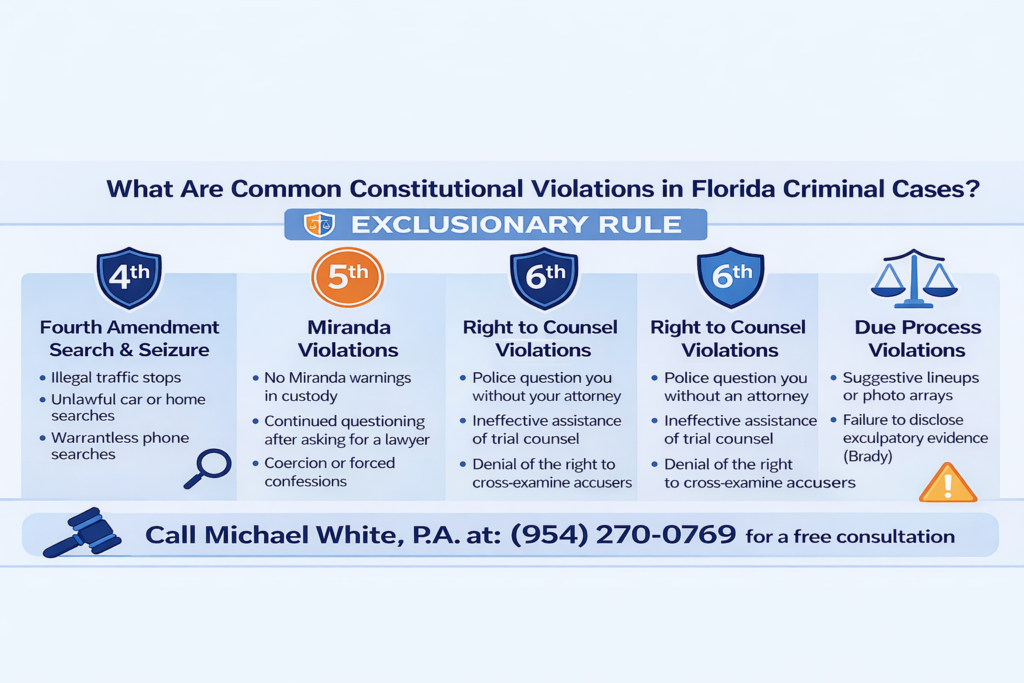
- Fourth Amendment – illegal searches, seizures, and detentions
- Fifth Amendment – Miranda violations and compelled statements
- Sixth Amendment – right to counsel violations
- Due Process – identification procedures and prosecutorial misconduct
- Double Jeopardy – multiple prosecutions or punishments
- Speedy Trial – unreasonable delay
Each category has different legal standards — but the goal is the same: exclude unlawful evidence.
🧠 Where Constitutional Cases Are Won or Lost
In many cases, the issue is not whether a right exists — it’s whether the rules were followed at the right moment.
Common turning points include:
- traffic stops that begin lawfully but become prolonged
- questioning that shifts from voluntary to custodial
- statements obtained after rights have attached
- searches that exceed their legal scope
These details often determine whether evidence is admitted — or excluded entirely.
⚖️ The Exclusionary Rule: How Courts Enforce Your Rights
Constitutional protections are enforced through the exclusionary rule, which prevents the government from using evidence obtained in violation of your rights.
This may include:
- physical evidence (drugs, firearms, cash)
- digital data (phones, GPS, accounts)
- statements or confessions
- identification evidence
- evidence derived from earlier illegal conduct
The primary tool used to enforce these protections is a motion to suppress in Florida.
🌳 The “Fruit of the Poisonous Tree” Doctrine
When police violate the Constitution, the damage may extend beyond the initial act.
Evidence discovered because of that violation may also be excluded.
For example:
- an illegal stop leads to discovery of drugs
- an unlawful interrogation leads to physical evidence
- an improper search leads to additional warrants
👉 Learn how this works in fruit of the poisonous tree in Florida
Even when evidence appears strong, it may still be excluded if it stems from unconstitutional conduct.
👉 Learn when evidence may still be used in when illegal evidence can still be used in Florida
🔍 Fourth Amendment Violations: Illegal Searches & Seizures
The Fourth Amendment protects against unreasonable searches and seizures.
Common violations include:
- traffic stops without reasonable suspicion
- vehicle searches without probable cause
- warrantless entry into homes
- improper inventory searches
- prolonged detentions
- cell phone searches without a warrant
👉 Learn more about Fourth Amendment issues:
- Illegal search and seizure
- Illegal traffic stops
- Vehicle searches
- Backpack searches
- Passenger searches
- Locked container searches
🎙 Fifth Amendment Violations: Miranda & Self-Incrimination
Under Miranda, police must advise you of your rights before custodial interrogation.
Violations occur when:
- questioning occurs without warnings
- police ignore a request for a lawyer
- a waiver is not knowing or voluntary
- coercion or pressure is used
👉 Learn more about Miranda issues:
- Miranda rights in Florida
- Miranda custody
- Invalid Miranda waivers
- Statements before Miranda
- Talking to police without a lawyer
- Miranda suppression strategies
Statements obtained in violation of Miranda may be excluded — and in many cases, they are the most important evidence in the case.
🧑⚖️ Sixth Amendment Violations: Right to Counsel
Once formal charges are filed, the Sixth Amendment guarantees the right to counsel.
Violations may occur when:
- police question a defendant after charges without counsel
- officers use informants to obtain statements
- the State interferes with attorney access
👉 Learn more about right-to-counsel issues:
- Right to counsel in Florida
- When the right to counsel attaches
- Police questioning after you have a lawyer
- Massiah violations
Statements obtained in violation of the Sixth Amendment may be suppressed.
👁 Due Process Violations: Identification & Fairness
Due process protects against unreliable or unfair procedures.
Common issues include:
- suggestive lineups
- biased photo arrays
- improper show-ups
- officer influence over witnesses
Unreliable identification evidence may be excluded.
🔁 Double Jeopardy & Speedy Trial Violations
Other constitutional protections include:
- Double jeopardy – being prosecuted twice for the same offense
- Speedy trial – protection against unreasonable delay
Violations can result in dismissal of charges.
⚠️ Prosecutorial Misconduct & Due Process
Due process violations also arise when prosecutors:
- fail to disclose exculpatory evidence
- present false testimony
- interfere with witnesses
Serious misconduct can lead to mistrial or reversal.
🔄 When Constitutional Violations Are Raised
These issues can be raised:
- pretrial – through motions to suppress
- during trial – through objections
- on appeal – if preserved
- post-conviction – through constitutional claims
Timing is critical — failing to raise an issue properly can result in waiver.
🔗 Related Constitutional Issues (Cross-Silo)
Some constitutional issues overlap with related criminal charges and defenses, including situations involving refusal to comply with police orders or provide identification.
These issues often depend on whether the encounter was lawful in the first place — particularly whether a person was detained or free to leave.
💥 Why Constitutional Violations Change Cases
When evidence is excluded:
- drug cases collapse
- DUI prosecutions weaken
- firearm charges unravel
- fraud cases lose digital proof
- violent cases lose statements or identifications
Without admissible evidence, the State may have no case.
📍 Fort Lauderdale Constitutional Defense Attorney
At Michael White, P.A., we examine every case for constitutional violations by:
- reviewing bodycam and dashcam footage
- analyzing warrants and affidavits
- evaluating interrogation recordings
- investigating identification procedures
- filing targeted suppression motions
As a former prosecutor, Michael White understands how cases are built — and how constitutional errors can dismantle them.
📞 Call (954) 270-0769 for a confidential consultation.
🔗 Key Constitutional Issues in Florida Criminal Cases
- Illegal searches and seizures
- Miranda rights
- Right to counsel
- Fruit of the poisonous tree
- Motion to suppress
💬 FAQs: Constitutional Violations in Florida Criminal Cases
What happens if my constitutional rights were violated?
If a violation led to evidence being obtained, your attorney may file a motion to suppress. If granted, the evidence cannot be used in court.
Does a constitutional violation automatically mean my case is dismissed?
Not always. The impact depends on how central the excluded evidence is to the prosecution’s case.
When are Miranda warnings required?
Miranda warnings are required before custodial interrogation — when a person is in custody and being questioned.
Can constitutional violations be raised on appeal?
Yes, but only if properly preserved in the trial court.
What is the exclusionary rule?
The exclusionary rule prevents the government from using evidence obtained through unconstitutional conduct.